



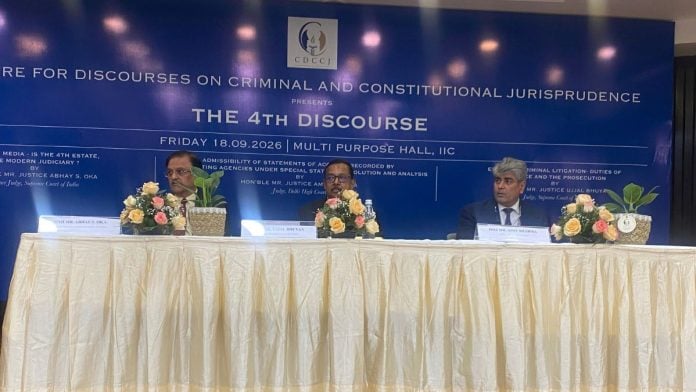
New Delhi: It was 6.30 pm on a Friday, an hour usually reserved for anything but work, and the seating at Delhi’s India International Centre had run out. Many in the 200-strong audience stood through the evening, listening to three judges speak on how criminal cases are built, tried and, increasingly, publicised.
“We don’t often see events related to criminal or constitutional law,” said Dhruv Chaudhry, a 37-year-old advocate.
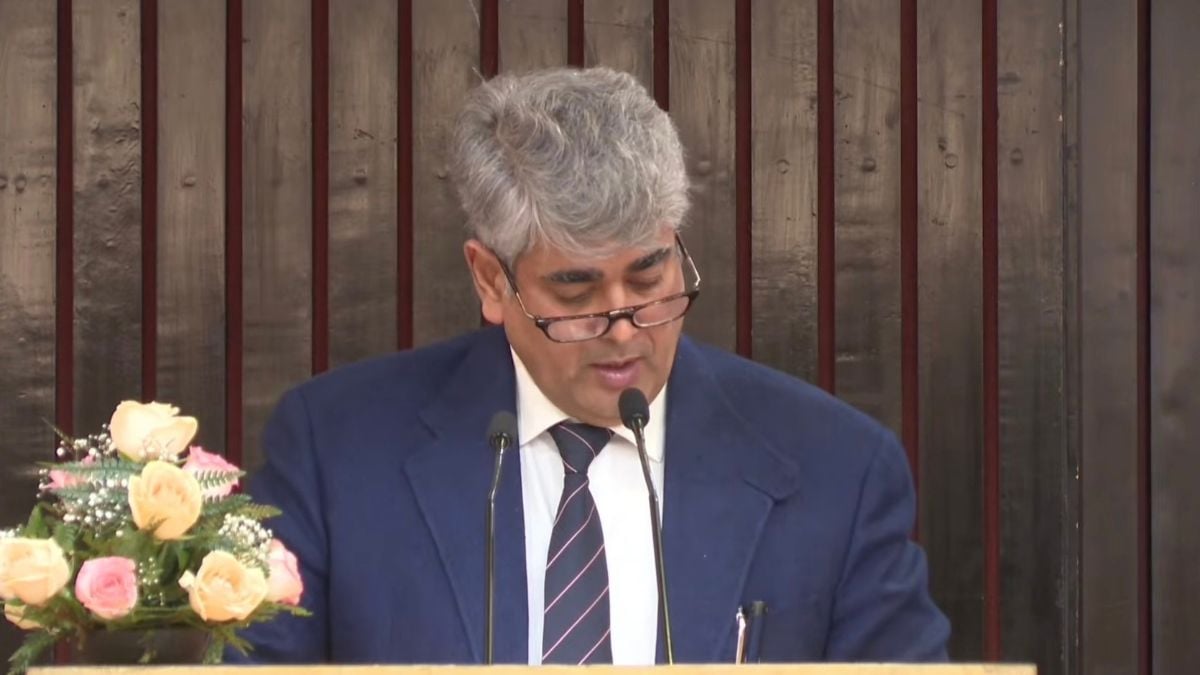
The panel, organised by the Centre for Discourses on Criminal and Constitutional Jurisprudence, brought together Justice Amit Sharma of the Delhi High Court, Supreme Court judge Justice Ujjal Bhuyan, and Justice Abhay S Oka, a former Supreme Court judge. Over the evening, they followed a case from the police station to the courtroom to the television studio, taking in coerced confessions, prosecutors under political pressure and trials conducted in the media.
The confession problem
Justice Sharma took up confessions. In a country where coerced police confessions have led to unjust imprisonments, he questioned the extent to which such statements should be admissible in court, and stressed the role of judicial wisdom in protecting the fundamental right to a free and fair trial.
“The essential requirement of voluntariness” in a confession “is all pervasive,” he said. To compromise on it would “whittle down the fundamental rights of the accused.”
He was speaking in the context of Indian law, where a confession made by an accused to a police officer is inadmissible in court. The rule, Sharma pointed out, was a British creation. Colonial administrators had observed the excesses of the police as early as the 1860s, and the safeguard, written into Section 25 of the Indian Evidence Act, 1872, departed from English Common Law.
He cited Justice Syed Mahmood’s observation in the landmark Queen-Empress v. Babu Lal (1884) that the departure owed itself to “the malpractices of police officers in extorting confessions from accused persons in order to gain credit by securing convictions.” “Those malpractices,” Sharma added, “went to the length of positive torture.”
A loophole for other agencies
The safeguard does not always hold for other investigating agencies, Sharma said. The Enforcement Directorate (ED), the Narcotics Control Bureau (NCB) and the Directorate of Revenue Intelligence (DRI) sidestep the provision by relying on a strict technical definition of “police officer.”
Sharma argued against this workaround. The term, he said, “should be read not in a strict technical sense, but according to its more comprehensive and popular meaning.” It should cover any officer “invested with powers of investigation which culminates in filing of a police report.” Expanding the definition was integral to granting “wholesome protection to the accused,” he argued, and would protect those who may be unjustly incarcerated because of such ambiguities.
‘Cannot afford to antagonise the boss’
Justice Bhuyan moved the conversation into the courtroom, where he examined the duties of the prosecution and the defence.
Public prosecutors, he said, were often asked to withdraw the cases filed against a politician once he or she came to office. He described how it unfolded: “You are a politician, you win elections, you become a powerful public figure.” He continued, “Then you misuse your office, and an application is filed for withdrawal of all the cases against you, and after sometime all the cases are withdrawn.” The politician, in the end, walks away with a clean chit.
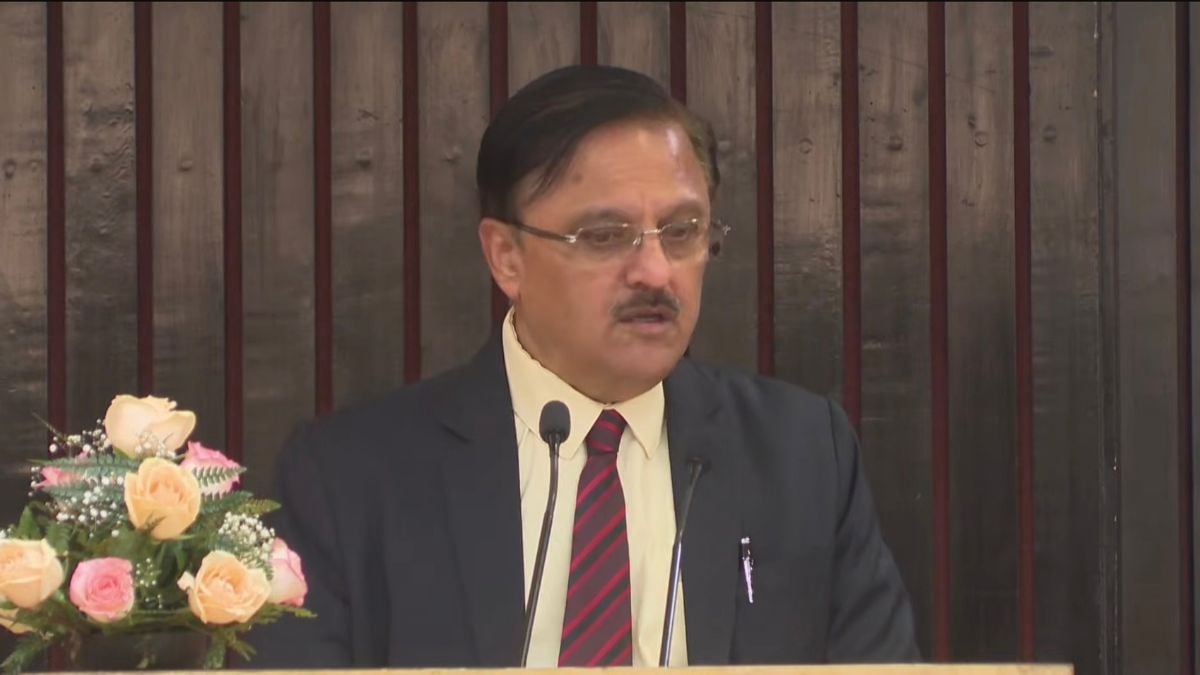
“Can the public prosecutor say no?” Justice Bhuyan asked. Was a prosecutor in a position to exercise discretion and say that “this is not a fit case for withdrawal”?
He said he did not begrudge prosecutors who complied, because “not all prosecutors are that affluent that they can afford to antagonise the boss.”
‘Hold the prosecution to its burden’
If prosecutors were expected to question power and injustice, the defence had a duty of its own, Justice Bhuyan argued: to “hold the prosecution to its burden.”
He cited A.S. Mohammed Rafi v. State of Tamil Nadu (2010), in which several bar associations had adopted resolutions refusing to “defend the accused persons who were policemen, charged for custodial death.”
The Supreme Court struck the resolutions down as “illegal and unconstitutional.” It ruled that, “Every accused, however vile, is entitled to be defended. Refusal is permissible only on recognised permissible grounds such as conflict of interest, prior involvement, incompetence in the subject matter…never merely because the client or a cause is unpopular.”
“Prosecution simply can’t run through it, without any opposition,” Justice Bhuyan said, underlining the importance of a rigorous trial.
Trial by media
Justice Oka drew attention to a trend now taking hold in court cases. Investigating officers, he said, had begun to disclose details of ongoing cases to the press. “Perhaps the police officers [investigating a case] get attracted to journalists standing with a mic in their hand,” he said.
“Earlier,” he continued, “they used to speak only through their final report or charge sheet.” Now, he said, senior officers and investigating officers called press conferences to “disclose details of the investigation carried out by them.” Sometimes, they even told the media that an accused had confessed in custody. This “creates an atmosphere,” Justice Oka explained, “where the public starts believing that the accused who are named are the offenders.”
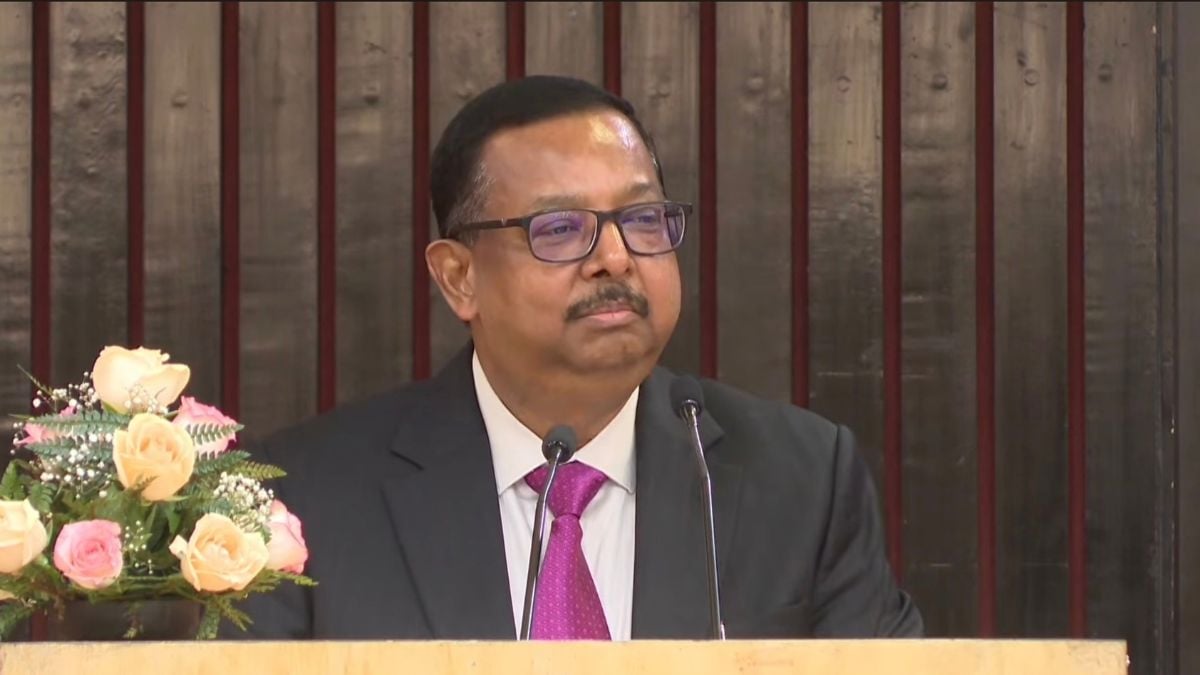
Article 21, he reminded the audience, conferred a fundamental right on the accused to a free and fair trial. “And there is a presumption of innocence which is an integral part of the criminal jurisprudence,” he said.
Justice Bhuyan later offered an example, alluding to the death of an actor from Bihar under unnatural circumstances in 2020. The media, he said, “launched a campaign” to have a woman under investigation in the case arrested. “And when the Mumbai police actually arrested her,” he added, “they [Mumbai police] took credit for that.” When she was granted bail two months later, “the commentators showed as if something has gone gravely wrong with the judiciary.” “So this is the state of discourse,” he lamented.
The pressure did not stop at public opinion, said Megha Saroa, a 29-year-old advocate who drew on her own experience in the legal field. “The media shapes the judges’ minds too,” she told ThePrint.
(Edited by Prashant Dixit)