


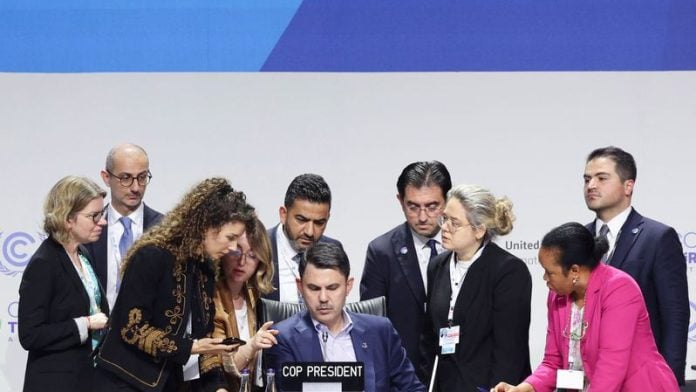
New Delhi: The 31st Conference of the Parties, or COP31, in Turkey’s Antalya showed signs of failure soon after the second draft text released on 20 November removed all mentions of ‘fossil fuels’. Negotiators and climate experts present at the talks said that while there were key areas of diplomatic disagreement throughout the two-week conference, the final nail for many countries was the lack of a stronger commitment to tackle climate change, especially in a year when global temperatures are predicted to overshoot.
On Sunday, the European Union, Panama, and other countries rejected the final draft deal tabled by the Turkey-Australia presidency, insisting that it lacked the strength to advance the fight against climate change.
Representatives from the EU—the strongest opponents of the final draft—stressed that the text did not merely dilute the language on reducing dependence on coal, oil, and gas, but removed every explicit reference to fossil fuels.
Darragh O’Brien from the EU said the talks had been “hijacked by some oil states”.
“We will not endorse a cover decision, or an Antalya Pact, that does not even mention fossil fuels, which is the key driver of climate change,” said O’Brien, climate and energy minister of Ireland, which holds the rotating EU presidency.
An organiser told ThePrint that the fallout started showing more visibly after the second draft was released. After the omission, over 130 countries backed the demand that the final agreement retain a reference to transitioning away from fossil fuels. However, the Turkey-Australia presidency did not restore the language.
“Just to clarify, the final draft does maintain the status quo. It has recalled the UAE consensus, which means that everything that was agreed to, will be followed. But the problem was that ‘fossil fuels’ was not explicitly mentioned,” the organiser said.
The final draft text mentioned “recalling the United Arab Emirates Consensus in its entirety.” This was a reference to COP28, where countries agreed for the first time to “transition away” from fossil fuels in energy systems.
How did things go wrong?
Observers said that the EU, Panama, and the UK, which primarily opposed the final text, argued that countries should have stepped up commitments to control global warming this year. Several countries in Europe experienced a gruelling heatwave this summer and the global climate phenomenon, El Niño, is forecast to increase temperatures.
Organisations such as the World Meteorological Organisation (WMO) have also forecast an overshoot from the 1.5 degrees Celsius mark this year.
Aarti Khosla, Director of Climate Trends, a research-based consulting and capacity building initiative, said that the failure to reach a consensus on the cover decision reflects an abject lack of political ambition and accountability.
“Despite negotiations extending until Sunday, countries failed to agree on a meaningful commitment to transition away from fossil fuels or to talk about climate security,” she said.
This year marks the first time since the Copenhagen climate summit in 2009 that a COP has ended without an overarching political agreement.
Also read: Chinese satellite doubled passes over Pahalgam 6 days before terror attack
How the second draft changed negotiations
The first draft in Antalya, released on 16 November, included two options for stronger action on fossil fuels. One proposed accelerating the implementation of the commitment made at COP28 to transition away from fossil fuels in energy systems in a just, orderly, and equitable manner. The second option called for accelerating the phaseout of fossil fuels.
The draft also acknowledged the roadmaps being developed under Brazil’s COP30 presidency to transition away from fossil fuels and halt deforestation.
The first draft was already a collection of competing proposals rather than an agreed negotiating position. Countries had raised objections to its provisions during consultations, particularly over the extent to which a COP-wide political decision could prescribe national energy pathways.
The revised document removed both fossil-fuel proposals and references to Brazil’s roadmaps. It also dropped a proposed target of $120 billion annually for adaptation finance by 2035 and weakened language on accelerating clean electrification.
The revised document retained a proposal to increase electricity’s share of global final energy consumption to 35 per cent by 2035, but the language encouraging countries to achieve this was softened.
It also retained references to carbon removal and carbon-capture technologies. The Turkish presidency defended the revised document as an attempt to find common ground among countries with competing positions.
“It is clear that there are parties in this hall who oppose this text. We recognise that there is no consensus on this document. Therefore, these decisions have not been adopted,” said Turkiye’s COP31 President Murat Kurum during the closing plenary.
(Edited by Prasanna Bachchhav)