





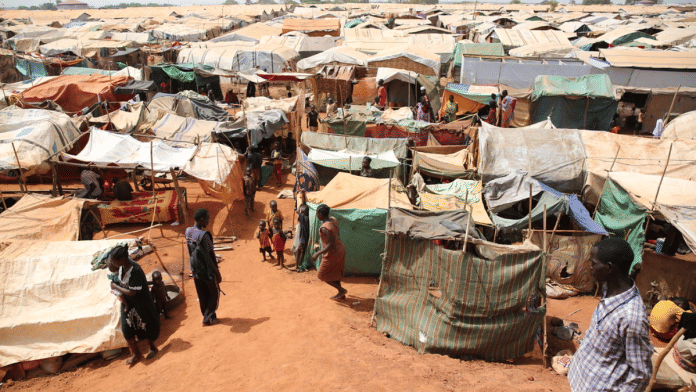


New Delhi: For most of the past decade, the dominant image of displacement had been a weather map showing the repercussions of cyclones battering coastlines, monsoon floods swallowing villages, or wildfires turning settlements to ash. But for the first time, conflict and violence have triggered more internal displacement in 2025 than disasters.
The Global Report on Internal Displacement 2026, released by the Internal Displacement Monitoring Centre (IDMC) Tuesday, found that conflict and violence triggered 32.3 million movements across 48 countries and territories in 2025. It’s a 60 per cent increase compared with 2024, more than double the decadal average, and the highest figure on record. Disaster displacements have declined to 29.9 million, a 35 per cent drop from the high levels recorded in 2024.
The total number of people living in internal displacement at the end of 2025 stood at 82.2 million across 104 countries and territories—a figure that has more than doubled from 38.9 million in 2016. Of the total figure for 2025, more than 68.6 million were displaced by conflict and violence; almost 13.6 million by disasters, IDMC found. The Geneva-based body has been tracking forced movement within countries since 1998.
“Never have we recorded such a staggering number of displacements related to conflict,” said Tracy Lucas, IDMC’s director. “As conflicts are intensifying, it is often the same people who are uprooted again and again. Yet the systems meant to protect them are being dismantled.”
The conflict-related displacement was highly concentrated: Iran and the Democratic Republic of Congo (DRC) each accounted for around a third of the global total. Iran recorded 10 million internal displacements, which have been linked to the temporary evacuations from Tehran. Meanwhile, the DRC logged 9.7 million, its highest figure on record.
Even without including the two countries, the picture is dire: nearly 31.4 million of the conflict–hit people lived in just five countries: Sudan (9.1 million), Colombia (7.2 million), Syria (6 million), Yemen (4.8 million), and Afghanistan (4.4 million).
One of the report’s starkest findings concerns the character of the conflicts driving displacement. International armed conflicts accounted for 46 per cent of the total. And the number of countries recording displacement linked to international conflicts rose from six in 2024 to 13 in 2025.
All regions except the Americas were affected, with border tensions re-erupting between Cambodia and Thailand, Afghanistan and Pakistan, and India and Pakistan.
Indian subcontinent
The Indian subcontinent recorded 548,000 conflict-related displacements and 4.6 million disaster displacements in 2025, accounting for 8.3 per cent of the global total. The region’s displacement burden remains predominantly climate and weather–driven, but the conflict column is no longer negligible.
India-Pakistan tensions, which escalated sharply following the Pahalgam attack in April 2025 and the subsequent military exchange, have been formally documented in the displacement record. It has placed the subcontinent within a global pattern of internationalised conflict that the report describes as one of the defining shifts of 2025.
India recorded 128,000 conflict-related displacements last year, with an additional 672,000 disaster-linked displacements. The latter has been driven largely by storms and floods. This places India among the 10 countries with the highest disaster displacement. The country received a dedicated spotlight section in this year’s report.
Pakistan’s numbers are more dramatic on the disaster side. It recorded 251,000 conflict-related displacements and over 3 million disaster displacements. The country also ranks among the top 10 globally for that category. Its conflict displacement figure, while smaller, reflects ongoing turbulence along its western border and the tensions with India.
Afghanistan has recorded 168,000 conflict–caused displacements and 253,000 disaster displacements in 2025, and carries a cumulative IDP (internally displaced population) stock of 4.4 million—the fifth highest in the world. The report notes that earthquakes in populated parts of Afghanistan have caused extensive damage, and in some cases, affected people already exposed to conflict.
Bangladesh, by contrast, recorded a negligible 220 conflict-caused displacements but 1 million disaster-related displacements, which have been attributed to its vulnerability to storms and floods.
The Middle East and North Africa region has recorded 13.4 million conflict-related displacements. Iran alone accounts for 10 million of this figure.
Palestine has recorded 2.7 million internal displacements. The Gaza Strip receives a dedicated spotlight in the report. It shows how sites of urban displacement became targets in the region, forcing those who had already been displaced to move again.
Also read: Who is Anil Kochhar? Indian-origin man who cleared debt of 176 US graduates
‘Can’t continue like this’
While the picture appears grim, one figure in the report looks encouraging: the total IDP has seen a slight decrease from 83.5 million in 2024 to 82.2 million in 2025. However, the report is careful to contextualise what this means.
“The decline was largely the result of returns in parts of Sudan, the Democratic Republic of the Congo (DRC), and Syria. Returns do not necessarily equate to durable solutions, however, and long-term monitoring is essential to ensure displacement-related vulnerabilities are overcome, particularly in areas where insecurity persists,” the report states.
The document also flags a deterioration in the quality of the data underlying these numbers.
“In 2025, IDMC observed reduced displacement data availability in 15 per cent of monitored countries, three times the share of 2024,” the report states.
For Jan Egeland, secretary general of the Norwegian Refugee Council, which houses IDMC, the numbers signal a “global collapse”.
“Internal displacement of tens of millions is a sign of a global collapse in prevention of conflict and basic protection of civilians. Countless families are returning to destroyed homes and disappearing services — or cannot return at all. From DR Congo and Sudan to Iran and Lebanon, we see millions more displaced on top of the previous record numbers driven out of their homes. We cannot continue like this,” she said.
(Edited by Prasanna Bachchhav)