



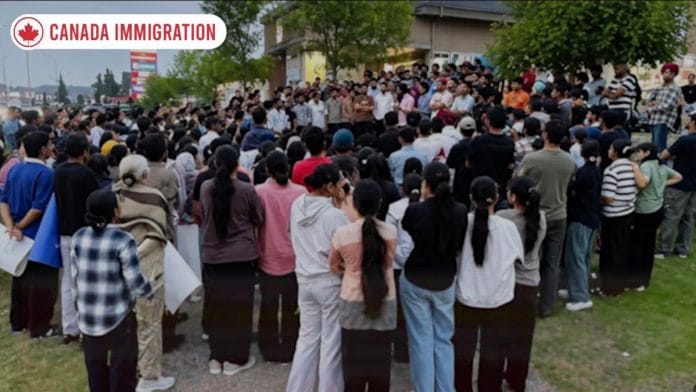

Jalandhar: For three weeks, around 400 international students camped outside a protest site in Calgary, demanding the federal government reverse the rejection of their Post-Graduation Work Permit applications. On 14 August, the protest ended not with a resolution but with Canada Border Services Agency officers moving through the crowd checking immigration status. Officers had been called to verify four people. By the time they were done, they had checked 20 — and flagged 12 as “possibly inadmissible” under Canada’s Immigration and Refugee Protection Act.
Students who came to Calgary asking Canada to let them stay and work left some of their own with a question hanging over them: whether they would be allowed to stay at all.
Most of the protesters were from Punjab, some from Haryana. Many had arrived in Canada on family savings, loans, or money raised by selling property, believing a two-year diploma would lead to a Post-Graduation Work Permit (PGWP) — an open permit that lets international graduates work in Canada after their studies — and eventually a longer-term future in the country.
At the centre of the dispute is a disagreement over rules: what they said, when they said it, and what students could reasonably have understood when they enrolled. Around 1,500 students are connected to the diploma programmes offered by Alberta’s public Portage College.
Some of its PGWP applications were refused because Immigration, Refugees and Citizenship Canada (IRCC) classified the programmes as “non-credit.” The students say they were told — by the college, and by IRCC’s own earlier approvals — that the programmes would qualify. IRCC says nothing changed: its June 2026 update to the PGWP eligibility page was a clarification, not a new rule.
Also read: Drop in study permits to Indian students due to diplomatic row, says Canada Immigration Minister
The changed rulebook
The story goes back to 2024, when IRCC announced a broad overhaul of Canada’s international-student system. One change restricted PGWP eligibility for students in Public-Private Partnership (PPP) programmes — arrangements that let a private college deliver the curriculum of an associated public college. IRCC said these programmes had grown rapidly and created a loophole in the PGWP system, since they carried less oversight than programmes run directly by public colleges.
The government initially set the cutoff at 1 September 2024, then moved it earlier, to 15 May 2024. Students who started a PPP programme on or after that date would no longer qualify for a PGWP; those who started before it could still be eligible, provided they met the other requirements. Many of the students protesting in Calgary say they enrolled before the cutoff.
But there was another issue: their programmes were being treated as non-credit. A PGWP isn’t automatic on graduation — the programme itself has to qualify, and IRCC’s documentation requires proof of a degree, diploma or certificate from a credit-earning programme, with a narrow exception for flight schools. On 24 June 2026, IRCC updated its PGWP webpage to state clearly that non-credit programmes don’t qualify. The department says this didn’t create a new rule — it clarified one that already existed.
For students, the timing is the whole argument. Many say they had already enrolled, paid tuition, and built their plans around the belief that their programmes would qualify — some had applied for their PGWP before the June update ever went up. Portage College itself has said its understanding was that students who enrolled in its non-credit PPP programmes before 15 May 2024 would be eligible to apply, based on the information available at the time.
Also read: Indian vloggers & influencers in Canada have a warning for immigrants—‘the Canadian dream is dead’
“You will get the work permit”
The students’ strongest evidence was that IRCC had already been approving permits for people in identical programmes.
“IRCC updated its website in June, but students had already been receiving work permits for the same non-credit programme. The college also assured them in official emails that they would qualify for a PGWP,” said Jaspreet Singh, Founding President of the International Sikh Students Association.
Singh said students knew the programmes weren’t accredited in the formal sense, but between the college’s written assurances and the government’s own track record of approvals, they had no reason to expect a refusal.
“Everyone knew these were non-credit programmes. But the college assured students they would get work permits, and IRCC was issuing them. There was no clear announcement that these programmes were ineligible. So students had every reason to believe they would qualify. Then, suddenly, IRCC updated its website and began refusing applications,” he said.
That inconsistency — some students approved, others on the same footing refused — became the students’ strongest argument that the June update changed something in practice, whatever IRCC calls it.
Singh estimated that a major mobilisation could draw 300 to 400 students, against a normal evening turnout of around 150 on an ordinary day. It was one of those larger gatherings that drew CBSA to the site, resulting in 12 flagged as possibly inadmissible.
That left the students facing a different kind of fight. Singh said they weren’t people who had arrived in Canada and simply failed to meet a requirement — they had enrolled through a public college, paid between $15,000 and $25,000 for their education, completed their studies, and relied on what their institution and the immigration system told them. With the protest over, that argument now moves from the roadside into legal and political channels.
“The government brings thousands of people to Canada every year because it needs to maintain the population and fill gaps in the workforce. Canada needs to keep its numbers up. Otherwise, the country will have problems sustaining its economy and carrying the cost of everything. That’s why this issue needs to be taken to the Prime Minister and the immigration minister of Canada,” said Parmjit Singh Sandhu, a Canadian politician and former Member of the Legislative Assembly of Alberta.
For the 1,500-odd students, responsibility for what went wrong now sits somewhere between an immigration system that IRCC says only clarified its own rules, and recruiters and colleges who told them something more definite than the rules actually promised.
Also read: Indian students in Canada disenchanted, helpless. New Delhi must spread pre-migration awareness
(Edited by Prashant Dixit)
India must dissuade Canada from deporting these ‘students’. We are happy to get rid of zero-talent worthless fellows. Canadian institutions selected and admitted them and the Canadian government happily handed out student visas to these idiots.
Now they are Canada’s headache. The Indian government must ensure that they do not come back to India seeking jobs.
We are more than happy to get rid of such liablities.