



Vadodara: Every Indian child learns in school how MK Gandhi was thrown off a train in South Africa. Few learn how BR Ambedkar, a Columbia-trained scholar, was thrown out of a Parsi inn in Vadodara because of his caste. The humiliation, recorded in Waiting for a Visa, was a defining moment in Ambedkar’s life.
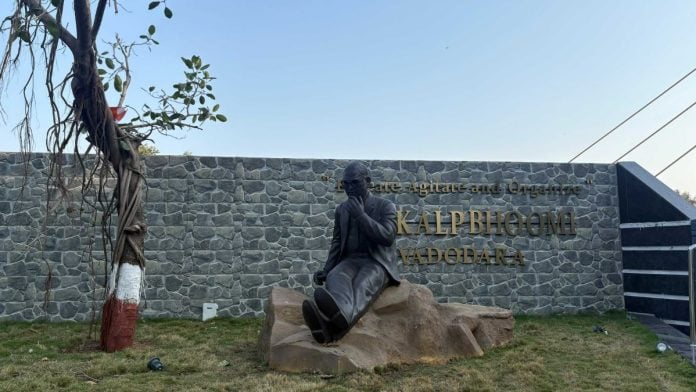
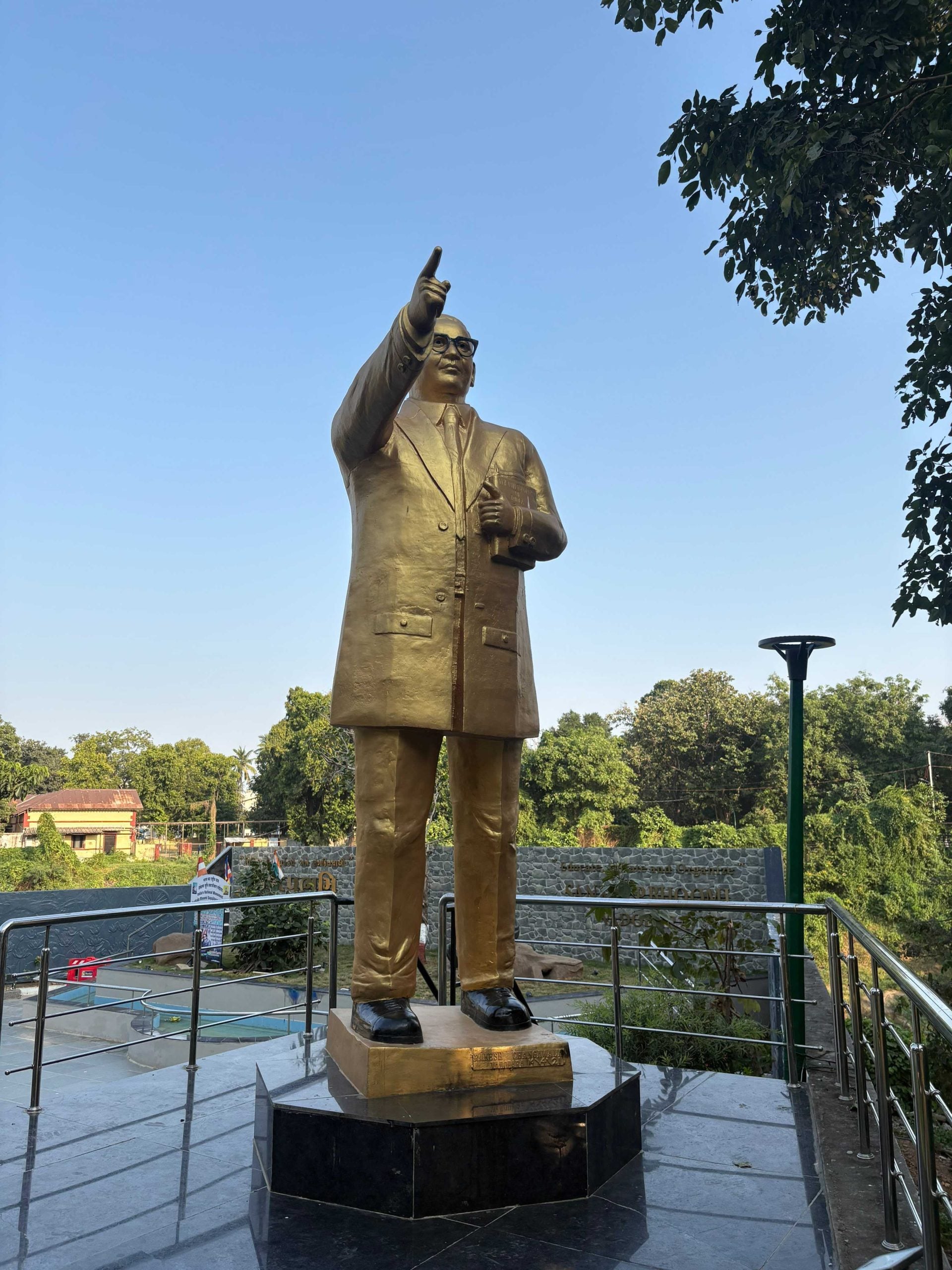
At Sankalp Bhoomi in Vadodara, a 12-foot golden statue of Ambedkar stands holding the Constitution. Nearby, another sculpture shows him seated in a brown suit, his chin resting on one hand, lost in thought. Visitors stop before the statues to pay their respects, bow or take photographs. A placard bearing an image of Ambedkar seated beneath a tree, his books scattered around him, recounts the resolve he is believed to have made here.
“I pledge that I will continue to struggle until this inhumanity ends, to establish equality and humanity among the people of the country,” the placard bears Ambedkar’s words.
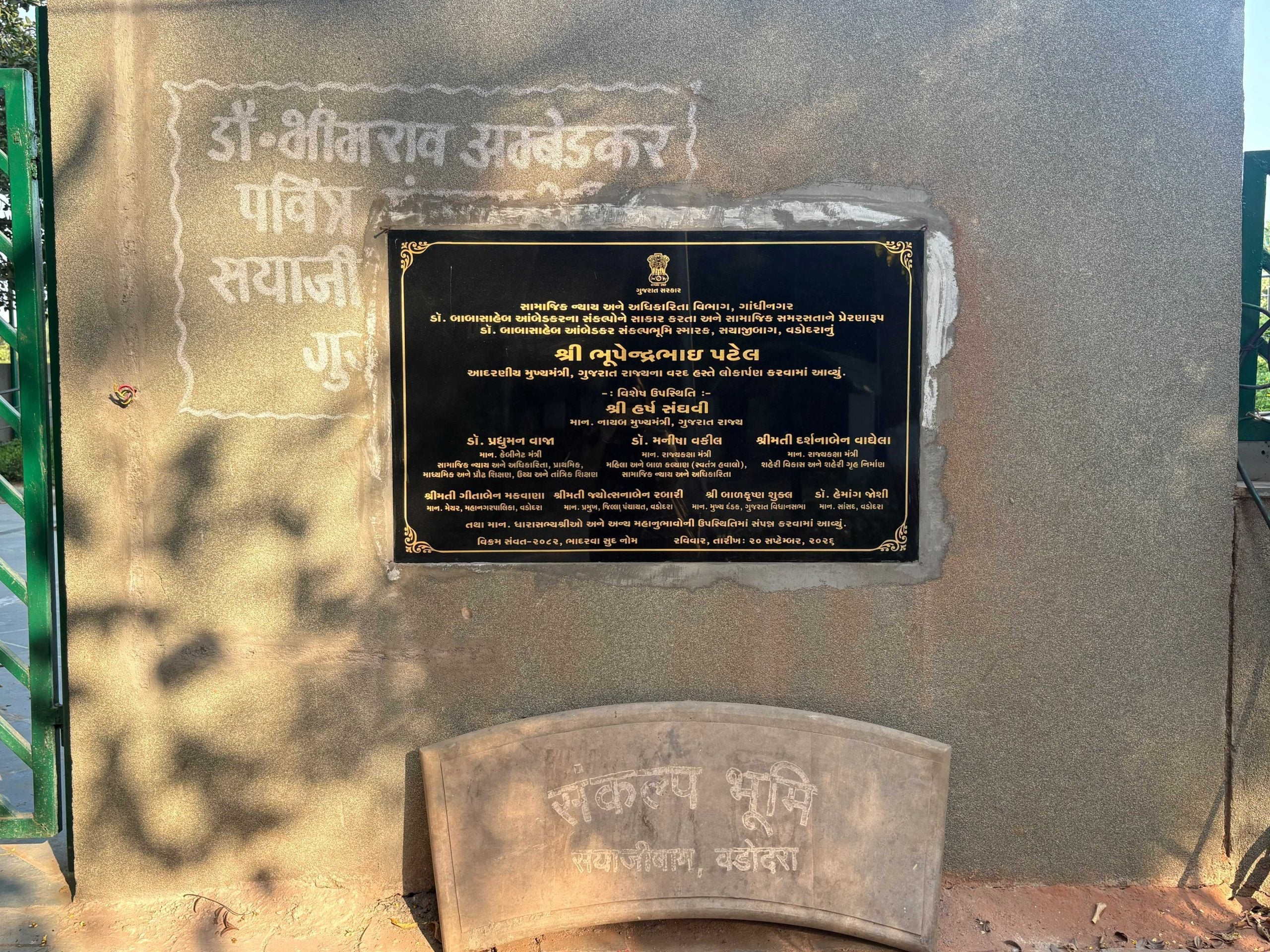
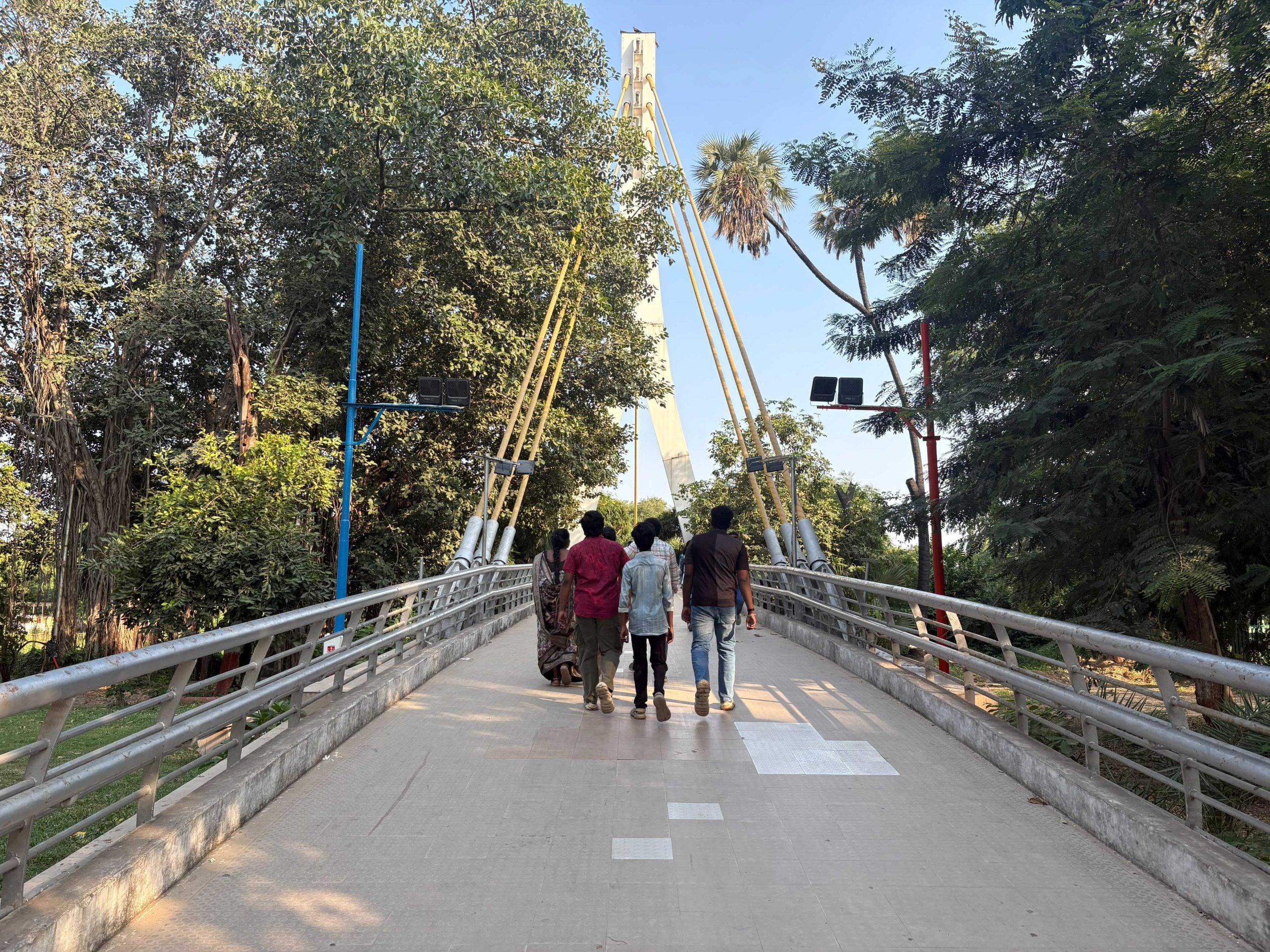
For many, Sankalp Bhoomi honours the man who changed the course of Dalit lives. Every year, Dalits, Buddhists, and Ambedkarite organisations gather here to mark Bhim Sankalp Diwas on 23 September. Visitors also travel to the memorial from other cities to pay tribute to Ambedkar.
Yet, the episode that gives the site its significance barely features in Indian school history textbooks.
That significance also sits alongside the continuing reality of caste discrimination. In February 2026, a 19-year-old Dalit student at Dinsha Patel Nursing College in Nadiad, Kheda district, died by suicide. His family alleged that college staff had harassed him. Police registered an FIR against the principal, three teachers and another person under provisions relating to abetment to suicide and the Scheduled Castes and Scheduled Tribes (Prevention of Atrocities) Act. In May, members of the Dalit community protested outside Police Bhavan over allegations that a constable attached to Bapod police station had used casteist slurs against a young Dalit youth.
These incidents are not the same as Ambedkar’s experience in 1917, but they underline why a place associated with his struggle matters. The promise of education and constitutional rights has transformed Dalit lives.
Dalit communities have historically lacked the institutional and religious spaces around which other communities congregate. Ambedkar has consequently become a central figure in building that collective identity.
“Sankalp Bhoomi has become a space where people gather for programmes, discussions and the exchange of ideas. Organisations set up stalls and distribute publications on Ambedkar, Ambedkarite ideology and issues affecting Dalit communities,” said retired Professor Manubhai H. Makwana of Gujarat University. He was the first dean of the School of Social Sciences at Dr B.R. Ambedkar University of Social Sciences (BRAUSS).
“Dalit literature is growing, and people are reading it and becoming more conscious of their society, their problems, women’s issues, education and unity. Literature plays a very important role in developing this consciousness.”
Memorial building
The Gujarat government first announced plans for an Ambedkar memorial in 2015, as part of its programme to mark his 125th birth anniversary. It allocated Rs 10 crore for the project, but work had yet to begin by April 2017.
The original site, believed to be where Ambedkar sat after being forced out of his accommodation, is in Sayaji Garden, formerly Kamati Baug. Since it was part of a protected public garden, the government chose a separate site at Juna Kalyan Nagar, on the banks of the Vishwamitri River, for the memorial.
On 23 September 2017, a century after Ambedkar visited Vadodara, Chief Minister Vijay Rupani laid the foundation stone. The project was developed in stages, with Rs 11.81 crore allocated for the main structure and another Rs 16.42 crore for the library, museum, statue and other facilities. The museum’s exhibits were developed in collaboration with Dr Ambedkar National Memorial, New Delhi, and approved by the Union Ministry of Social Justice and Empowerment and the Prime Minister’s Office.
In 2022, the National Monuments Authority recommended declaring Sankalp Bhoomi a Monument of National Importance.
This year, in September, Chief Minister Bhupendra Patel inaugurated Dr Babasaheb Ambedkar Sankalp Bhoomi Smarak. Built for Rs 28.59 crore, the complex includes a 12-foot statue of Ambedkar, a museum, library, auditorium, audio-guide facility and multimedia exhibits on his life and work.
But activists distinguish between the original Sankalp Bhoomi in Sayaji Garden and the newly built memorial. Mukeshkumar Helaiya, who led the Sankalp Bhumi Sanrakshan Samiti, said the campaign to identify and mark the original site began with veteran Ambedkarite leader Sunderlal Patel, who encouraged young activists to locate the spot before his death.
In 2006, activists, including Arvindbhai Parmar, Rajkumar Singh, TD Vankar and HR Singh, identified the site and held a naming ceremony with the Vadodara Municipal Corporation’s approval. A trust was registered the same year to organise commemorative programmes and press for the site’s development. From 2013-14, the Sankalp Bhoomi Trust and the Sankalp Bhumi Sanrakshan Samiti, led by Helaiya and the late Mahesh Mahida, also campaigned for additional land within the garden. Opposition to using more public garden land led the government to build the memorial elsewhere.
Both the original site and the new memorial are government-owned and maintained, Helaiya said. The Sankalp Bhoomi Trust does not own either site, and organisations can hold programmes there unless the premises are already occupied for government or civic events.
For the followers, the original site carries the emotional weight of Ambedkar’s experience; the new memorial offers a public space to learn about his life and work.
The contrast between Ambedkar’s experience of exclusion and the memorials built in his honour is not limited to Vadodara, Helaiya said. He drew a parallel with Mahad in Maharashtra, where Ambedkar led a movement for Dalits’ right to draw water from a public tank.
“It is true that Dr BR Ambedkar faced discrimination in Vadodara, and now, in contrast, a memorial has been built in his honour. The same is true of Mahad. He was not allowed to drink water from a public tank, which led him to launch a satyagraha. He and his followers were beaten. Now, in a striking contrast, a large statue of Dr Ambedkar stands in the very same Mahad tank,” said Helaiya.
What happened in 1917
In 1913, Maharaja Sayajirao Gaekwad III of Baroda awarded Ambedkar a scholarship to study at Columbia University in New York. The Maharaja, known for supporting education and social reform, allowed him to pursue higher studies abroad. In return, Ambedkar agreed to serve the Baroda State for 10 years after completing his education.
Ambedkar earned his master’s degree at Columbia and went to London in 1916 to study economics at the London School of Economics and law at Gray’s Inn. He read across disciplines, attended seminars and wrote on caste and economics. But when his scholarship ended, he had to return to India in 1917 to fulfil his commitment to Baroda.
The contrast between his life abroad and in India was stark.
“My five years of stay in Europe and America had completely wiped out of my mind any consciousness that I was an untouchable and that an untouchable whenever he went in India was a problem to himself and to others,” he wrote in Waiting for a Visa.
In Baroda, he struggled to find accommodation. Hindu hotels refused him a room, so he took one at a Parsi inn, posing as a Parsi. On the first day, the caretaker discovered his identity. Ambedkar paid him to keep it secret.
For 11 days, he lived in fear of being discovered. With no one to talk to, he turned to books for company. Reading helped him forget his loneliness, but bats flying around the hall where he stayed repeatedly reminded him of his isolation. When his sister’s son arrived from Bombay with the rest of his luggage and saw his condition, he began to cry. Ambedkar sent him back immediately.
On the 11th day, a group of Parsi men discovered his identity and ordered him to leave the inn. Ambedkar sought help from two friends, one Hindu and the other a Christian. His Hindu friend was saddened and angered by what had happened, but told him that if Ambedkar came to his house, his servants would leave.
With nowhere to go, Ambedkar spent five hours in Kamati Baug, now Sayajibaug.
“I sat there partly with a vacant mind, partly with sorrow at the thought of what had happened to me, and thought of my father and mother as children do when they are in a forlorn condition,” he wrote.
He eventually returned to the inn to collect his belongings and left for Bombay.
“I can even now vividly recall it and never recall it without tears in my eyes. It was then for the first time that I learnt that a person who is untouchable to a Hindu is also an untouchable to a Parsi,” he wrote.
Also read: Delhi Ramlila’s fourth effigy is a pink, moustached man with a cockroach crawling up his chest
Centre of consciousness
There is, however, a caveat to the story associated with Sankalp Bhoomi. In Waiting for a Visa, Ambedkar wrote about being forced out of a Parsi inn and spending hours in a public garden in Vadodara.
But he did not write about taking an oath to fight untouchability at that spot.
Makwana said the absence of a written account or a formal vow did not diminish the significance the community had attached to the place. He said that Sankalp Bhoomi had come to represent not just Ambedkar’s experience of caste discrimination, but also the ideas and struggles that followed it.
“It has become a centre of consciousness,” said Makwana. “People from Gujarat and neighbouring states gather at the site to discuss issues affecting Dalit communities, exchange ideas and build networks. Organisations also distribute books and publications on Ambedkar and Ambedkarite thought, helping spread awareness about education, women’s issues and social inequality.”
But the story of Sankalp Bhoomi is also one of community mobilisation. Activists spent years identifying and marking the original site in Sayaji Garden and pressing for its development before the government built a larger memorial at a separate location.
“Ambedkar is the icon around whom we can mobilise the masses. The community has found him, discovered him, made him its own. That is the intelligence of the masses. People have their own needs, and those needs bring them together. Who could be a better choice than Ambedkar?” said Raju Solanki, a Dalit poet, social activist and writer.
There are also questions among the activists about how much control the community retains over a memorial once the government takes it over.
For Makwana, these questions are part of a wider struggle over who gets to write and preserve history. He argued that Dalit experiences have long remained on the margins because Dalit writers and their work have had less access to the institutions that shape public memory–from publishers and journals to libraries and educational bodies.
The issue, he said, is not only whether such experiences appear in textbooks but also who has the power to decide what gets published, read and taught.
Ambedkar had urged the community to take an active role in its own emancipation. “My final words of advice to you are educate, agitate and organize; have faith in yourself,” he said at the All-India Depressed Classes Conference in July 1942.
At Sankalp Bhoomi, the words “EDUCATE, AGITATE AND ORGANIZE” are inscribed in capital letters behind Ambedkar’s seated statue
Visitors from across Gujarat and beyond stop to read the words, sit quietly and reflect on how far the community still has to go. At Sankalp Bhoomi, Ambedkar’s call to “educate, agitate and organise” serves as a reminder of the need to build collective strength and continue the fight for equality.
That resolution is renewed each year on 23 September, when Dalits, Buddhists and Ambedkarite organisations gather at Sankalp Bhoomi to mark Bhim Sankalp Diwas. Visitors pay tribute at Ambedkar’s seated statue, take photographs and videos, and bow before it. The gathering is both a remembrance of the discrimination Ambedkar faced and a reaffirmation of the struggle against caste inequality.
“Despite being so educated, he still faced this discrimination. He must have thought, how much worse would it be for his community? That is why this place is important. He learned it from here,” said Suresh Ingole, a visitor to the memorial.
(Edited by Ratan Priya)