





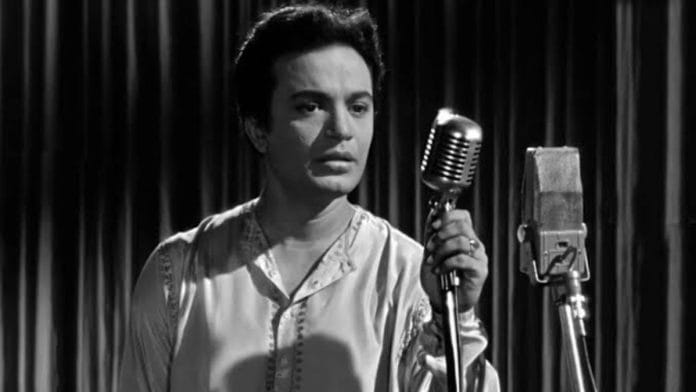

New Delhi: Uttam Kumar would have turned 100 on 3 September. The Bengali superstar, whose screen career spanned more than three decades and over 200 films, died at 53 while shooting his last film. He left behind an unfinished role and a final day on a film set that has since become part of Bengali cinema’s lore.
The story of his last day begins with a stolen tape recorder. On 23 July 1980, Kumar arrived on the set of Ogo Bodhu Shundori (1981) and he was not quite himself that morning. His most loved possession, a tape recorder that he routinely carried to sets, was stolen that morning, affecting him deeply. During breaks between shoots, Kumar would often use it to record whatever he had in his mind: thoughts, ideas, fragments of conversations, or simply things he wanted to remember.
Losing it disturbed him, and the uneasiness stayed with him through the day.
Then came the shoot. A scene was being filmed in which Sumitra Mukherjee’s character, his wife, was supposed to leave her father’s house in anger. Kumar’s character was shaving and trying to stop her from walking away. It was a routine scene in a film, but something was different that day.
While delivering his dialogue, Kumar began sweating profusely. He had already taken seven takes. For an actor of his experience, that was unusual. Soon after, he complained of chest pain. But Kumar, who had spent years working through exhaustion, chose to carry on.
He later went to a party that evening. On his way back, however, the pain returned. This time, he drove himself to Belle Vue Hospital in south Kolkata.
After being admitted, his condition appeared to improve, but it was temporary. As midnight approached, the condition of the man who had played countless heroes began to worsen, and in the early hours of 24 July, Uttam Kumar was gone.
There had been warnings about his health before. Kumar had previously been diagnosed with cardiac asthma and had suffered an attack about two years before his death. In his book Uttam Kumar: A Life in Cinema, Sayandeb Chowdhury wrote that Kumar’s doctor, Lal Mohan Mukherjee, had advised him to follow strict restrictions. Kumar followed some of them but ignored most of them.
Alcohol was another habit he struggled to give up.
Ogo Bodhu Shundori was based on George Bernard Shaw’s 1913 play Pygmalion, which tells the story of a man who attempts to transform a working-class woman’s speech and manners. Shaw’s play was also famously adapted into the musical comedy film My Fair Lady, making Ogo Bodhu Shundori part of a much larger theatrical and cinematic legacy.
Kumar’s last scene remains in the film, with the superstar holding the shaving brush in one hand and a towel draped over his left shoulder as he suddenly clutches his chest in pain. He didn’t stop acting. The moment comes roughly halfway through the film, after which there are only a few scenes featuring Kumar.
To complete the film, a body double named Prabir Kumar was brought in, while Uttam Kumar’s younger brother, Tarun Kumar, dubbed several of his scenes. The film was released in 1981, and the craze for the film kept it in theaters for 26 weeks, becoming one of the highest grossing bengali film of the time.
The next day, on 25 July, the streets were filled with thousands of people who loved and admired Kumar, bringing the whole of Kolkata to a standstill. Kumar’s body, dressed in white and surrounded by flowers, was being carried on an open-air truck. The same day, Anandabazar Patrika carried the news on its front page with the headline ‘Cholochitre Indrapatan’, which means ‘Cinema loses its titan’.
Also read: K Bhagyaraj, the Tamil screenwriter who wrote the rules that others still follow
A gentleman hero
Uttam Kumar’s legacy stretches from the romantic heroes of mainstream Bengali cinema to Satyajit Ray’s Nayak (1966), where he played a film star confronting the anxieties and insecurities hidden behind his public image. Ray used Kumar’s immense stardom to question the very idea of a movie star.
His death, Ray had said in an obituary, was a massive loss to the industry.
“It is the demise of a leading light in the Bengali film industry… There isn’t — there won’t be another hero like him.”
What made Uttam Kumar different was that he was almost always the hero on screen. Even when he worked with the titans of parallel cinema, he rarely abandoned the persona that had made him a phenomenon, the charismatic, romantic, larger-than-life Bengali hero. From Satyajit Ray’s Nayak to one of his earliest major hits, Sharey Chuattar (1953), directed by Nirmal Dey, Kumar carried an unmistakable star quality that few could replicate.
Sharey Chuattar marked the first pairing of Kumar and Suchitra Sen, a collaboration that would go on to become one of the defining romantic partnerships in Indian cinema. The film became an instant hit and began a journey that would span nearly 30 films, including Agni Pariksha (1954), Harano Sur (1957), Indrani (1958) and Bipasha (1962). In film after film, their characters were romantically involved, turning Kumar-Sen into a dependable formula for Bengali filmmakers and an irresistible pairing for audiences.
Kumar, in many ways, became the template for what a Bengali romantic hero — and a gentleman was supposed to be. He was almost the standard against which every romantic hero was measured. His charm and appearance made the image convincing, but they alone did not create the Mahanayak. His first eight films, released between 1948 and 1952, were flops. It was his persistence, acting ability and deep commitment to his craft that eventually changed everything.
Suchitra Sen, a close friend of Kumar, had said there was more to Kumar than Bengali cinema had allowed him to show.
“Uttam is my friend. In a word, he is a great, great artist. But still, sometimes I feel as if he is not properly exploited.”
And when success finally came, Kumar did more than become a star. He created an aspiration which a middle-class man can look up to. The men he played were often well-dressed, well-groomed, middle-class and romantic, but also possessed of the manners and etiquette of a gentleman. His characters represented an ideal of masculinity that audiences admired, a man who could be romantic without losing his dignity, charming without appearing frivolous.
His appeal was not confined to Bengali cinema. Kumar ventured into Bollywood with films such as Chhoti Si Mulaqat (1967), directed by Alo Sarkar and starring Vyjayanthimala. The film was a remake of the Bengali-language film Agni Pariksha (1954). He later appeared in Amanush (1975), directed by Shakti Samanta and co-starring Sharmila Tagore. Raj Kapoor called him “The smart, modern hero of India.” And Dilip Kumar called him “the best of our entire lot. A truly clean person.”
His last film, however, was not Ogo Bodhu Shundori. It was Plot No. 51 (1981), directed by Yogesh Saxena. Released a year after Uttam Kumar’s death, it was the last of his films to be released posthumously.
(Edited by Ratan Priya)