





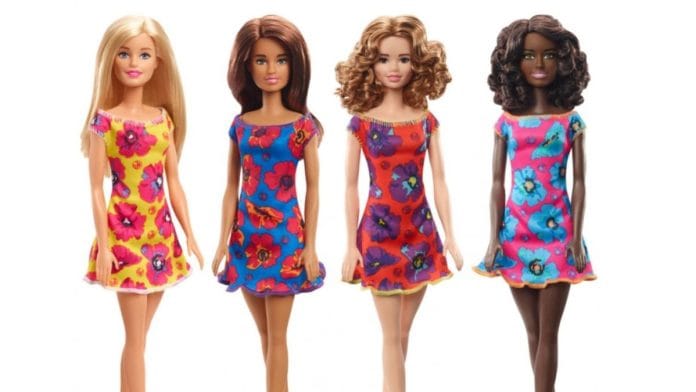


New Delhi: For decades, Barbie’s impossibly narrow waist and exaggerated proportions made her an idealised version of a woman. Now, nearly three decades after researchers first measured her body, a new study finds that Barbie has moved noticeably closer to human proportions, although she is still far from ordinary.
“It was clear from this study that very significant alterations in the Fashionista Barbie dolls’ morphology have occurred,” researchers Sara Grafenauer, Belinda Durey and Kevin Norton write in their study, published in Plos One in June 2026.
The researchers set out to see what had actually changed. Rather than estimating the dolls’ measurements from photographs or appearances, they physically measured four Barbie dolls from the 2016 Fashionista range (Standard, Curvy, Petite and Tall) along with the new Malibu Ken. They compared them with the original Barbie and Ken measurements from a 1996 study and with measurements from young adult men and women.
The newer dolls are closer to real human body shapes than the older ones. For Barbie, 80% of the body measurements and all three proportions studied were closer to the reference group. Curvy Barbie was the closest to the average in most measurements. Ken also became more realistic in most measurements, but his overall proportions were still less typical.
The change becomes clearer when compared with the original dolls. Barbie and Ken’s waist-to-height ratios were so unusual that fewer than one in 10 million people in the reference group had comparable proportions. The newer Fashionista dolls are much closer to real people, but their ratios are still uncommon; about one in 1,000.
“Barbie’s dimensions across 80% of the anthropometric sites, and 100% of the proportions measured, have shifted closer to the reference population,” the researchers found.
How the researchers measured the change
The researchers did not just look at how the dolls appeared. They measured their necks, chests, waists, hips, thighs, calves, arms and wrists, and compared different body ratios.
The biggest change was in Barbie’s proportions. The original Barbie fell well outside the range of the young women in the reference group. The newer Barbies, however, had waist-to-hip and chest-to-waist ratios that fell within the group’s 95% confidence range.
Of the four newer versions, Curvy Barbie was closest to the reference group in most measurements.
Ken has also become more realistic, but the change is less clear. About 90% of his individual measurements were closer to those of the male reference group. However, his waist remained unusually narrow, keeping some of his proportions outside the 95% confidence range.
“Despite the improvements reported here, there is a need for continued scrutiny and dialogue around the impact of toy design on body image,” the researchers noted.
What children think of the dolls
The researchers also examined earlier studies of children’s reactions to the Fashionista dolls, including research in which children were shown the curvy, tall and petite versions.
In one of those studies, children still preferred the thinner Barbie types. Curvy Barbie, despite being closer to the population average in many of her measurements, was described by some children as “big”, “fat” or “chubby”. Tall Barbie was seen as more “grown up”.
Another study found that Curvy Barbie was considered the most likeable but was also judged as less desirable and less attractive, while the thinner versions were more strongly associated with attractiveness and desirability.
The researchers noted that children encounter ideas about bodies everywhere: through television, advertising, films, shop mannequins, social media, peers and family.
One study cited by the researchers found no relationship between Barbie ownership and body dissatisfaction among younger or older children. However, it also found that playing with Barbie could encourage a preference for a thin ideal without affecting self-esteem or body image.
(Edited by Maryam Hassan)