


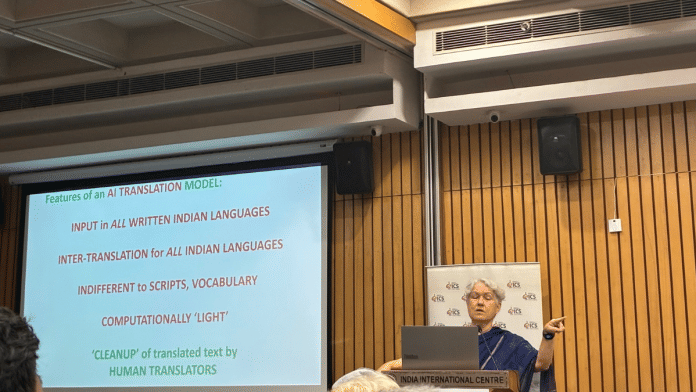
New Delhi: Tamil, Bengali and Hindi have long been considered different languages with distinct scripts. However, author and professor Peggy Mohan argues that there is a similarity at the level of structure, which, when harnessed by artificial intelligence, can lead to the potential of a common medium for texts related to science and technology.
Mohan points to China’s different dialects and underlines that there are lessons to be learned about how they found a common script.
“The idea remains that China is connected in a way…underneath it all, do we (Indian languages) have similarities and what can we learn when looking at China and their long journey… We should not be looking at very modern young countries with a strange colonial past, thinking that these are the only countries we can go looking for ideas,” said Mohan, while delivering the 18th Giri Deshingkar Memorial Lecture, organised by the Institute of Chinese Studies (ICS) at the India International Centre on 16 November.
“When I began this project, I posed the three following questions: how similar are China and India? Are their dialects and our languages similarly close? Can India connect its languages the way China did,” Mohan added.
Tracing the arc of history, Mohan identified multiple milestones in the development of Indian and Chinese societies. Pointing to findings from 9,000 BCE, she highlighted how the stories of “human settlement” in both the countries are “surprisingly alike.” From settlements by early hominids—the family from which humans trace their evolution from—arriving from Africa, to permanent settlements developing around river valleys around 7,000 BCE, the stories, findings and legacies are eerily similar.
Mohan pointed to the settlements around the Yangtze River in China and the Indus River in India to show the similar ages from which the two distinct cultures began to develop. From early milestones, Mohan shifted to the history of languages, specifically the emergence of the first texts around 3000 BCE in China, while the societies in the country started “exploring writing systems around 1250 BCE”.
“In our case, the Rig Veda was an oral recitation. I have my own suspicions as to why it was memorised. I suspect at the very beginning, we were different from China, as we wanted separation, not connection. In China, they did not think about separation. While they did not try to make Chinese (civilians) all illiterate, they did not specifically try to exclude people like we were,” said Mohan.
“Hàn Zi was originally intended for writing Mandarin. Devanagari was originally intended for writing Sanskrit and Prakrit. In early China and India, non-elites were not literate. The development of Hàn Zi, for Mandarin, was for the officer class within the empire…Prakrit (in India) was not for the common people. It was for kings and nobility.”
Language systems
Moving from the historical starting point, Mohan pondered whether Indian languages such as Tamil are different from Bengali and Hindi. She further looked at whether these languages have a “common substratum” or bedrock in structure. In this instance, Mohan clarified that the structure of the language differs from the “vocabulary” used daily.
“If you look beyond vocabulary and writing systems, you will find that Indian language systems are crazily similar,” asserted Mohan.
Subsequent to the early migrations, she pointed to the arrival of Iranian farmers/agricultural migrants, and that this was primarily a “male-driven migration” that intermarried within the individuals present in India, which could potentially be understood as “the original Dravidians”.
Eventually, the third milestone in the development of Indian and Chinese societies arrived— the migration from Central Asia. Mohan specifically pointed to the Uzbek Turks that conquered North India in 1206, setting up the Delhi Sultanate, while around 65 years later, the Mongols conquered China and set up the Yuan dynasty.
“The Uzbek Turks kept the ornate language of Persian as the courtly language, while getting rid of the more commonly spoken Uzbek. They started speaking Dehlavi, the language in Delhi, as it was not called Urdu at the time,” said Mohan.
The next common milestone between India and China, Mohan pointed out was the formation of the Mughal Empire in India in 1526, while the Northern Manchus conquered China in 1644.
“We had disruptions at almost the same times (in India and China). The Central Asians found and adopted spoken Dehlavi in Delhi, discarding Uzbek and retaining Persian as the language of government,” said Mohan.
“Whenever men migrated to India, they kept the high language, their ornate language and let go of the lower language…They threw away Uzbek and adopted Dehlavi…This is not the way it happened in China.”
The Manchus were rather fascinated by Hàn Zi, said Mohan, adding that they focused on keeping the script as the language of government. In India, around the twelfth century, with the collapse of Prakrit, modern languages emerged, the author explained.
Pointing to three language groups—the Maghadan (Eastern India), the Western Indo-Aryan across the North and West, and the Dravidian languages in the South, Mohan said this was when separate scripts began to emerge.
Also Read: In Kolkata’s newest museum, language is not read but felt
British Raj splits Indian languages, China simplifies Hàn Zi
Further tracing the evolution, Mohan pointed out that in 1900, the British Raj sought to split Hindi and Urdu as two separate languages, while in China the reverse was happening, with the government focusing on simplifying the script. At the same time, English became the “Mandarin” of India, the language of government.
“Studies show that English is spoken only by 2 per cent of children between the ages of 14-22 at homes today. Around 18 per cent believe they speak the language fairly well,” the professor said.
The problem that arises, especially in engineering colleges such as Indian Institute of Technologies across the country, is that there are “boys who neither read for pleasure in English, nor did they read for pleasure in Hindi, because no books were there for them.”
“After 70 years, we have created a language similar to Sanskrit, for the Brahmins. We have created a society that is not functioning in all cylinders. We are misusing our democratic demographic. This is no longer about linguistics. This is about politics,” said Mohan.
Pointing to how Indian users prefer to send voice notes, as Indian language interfaces and chat applications are “extremely difficult,” Mohan highlighted that there exists a gap in ensuring that Indians are able to learn scientific terms and modern technologies in their own languages.
“Our languages are not structured as they were in China. We cannot do this now. So how do we do what China managed to do in connecting their languages? If we believe there is an underlying bedrock (to Indian languages) like it is in Chinese…we can do this with a simple algorithm.”
She added: “You leave spoken languages alone. We need to have our written languages easily available.” Underlining that languages evolve, as they come in contact with one another, and their “flexibility” will allow them to become more “alike” in the future.
By using artificial intelligence, Mohan postulated that basic texts, not art of poetry, but important texts for government documentation of science texts, would be able to be directly translated from one Indian language to another in their written form.
The ideas found favour with those present in the hall. One attendee said that the ideas proposed by Mohan “align with India’s Viksit Bharat 2047 goal” and should immediately be taken up at the highest levels of government to harness technology to ensure simplification of Indian scripts using artificial intelligence. Another attendee pondered why this has not been taken up yet by different companies.
ThePrint was a media partner for the event.
(Edited by Insha Jalil Waziri)