



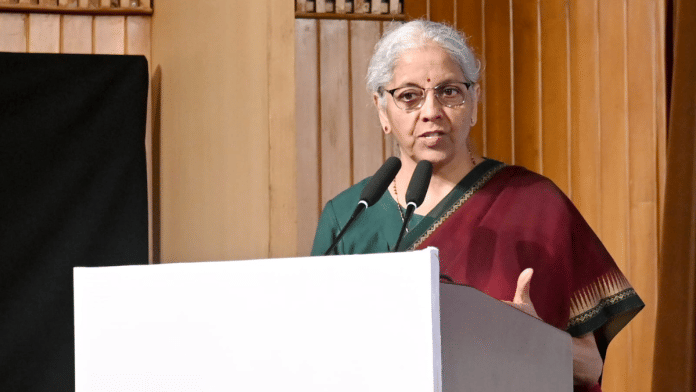
New Delhi: Union Finance Minister Nirmala Sitharaman said a confident civilisation requires its public discourse to function like an open stage.
“There must be room on the left side of the stage, and on the right side, and above all, at the centre, there should be a place. Thinkers must be able to enter from both sides. They are the actors. They will be in the centre to play and talk,” said Sitharaman while delivering the Dr SL Bhyrappa Memorial Lecture on 5 September at Delhi’s India Habitat Centre. The event was hosted by the Foundation for Indian Historical and Cultural Research (FIHCR).
In her hour-long address, the 67-year-old traced a century-long struggle for India’s intellectual freedom and praised Bhyrappa’s fearless engagement with history, faith and civilisational memory.
Sitharaman was joined by Rajalakshmi Aggarwal, chairperson of Ola Foundation and historian Vikram Sampath.
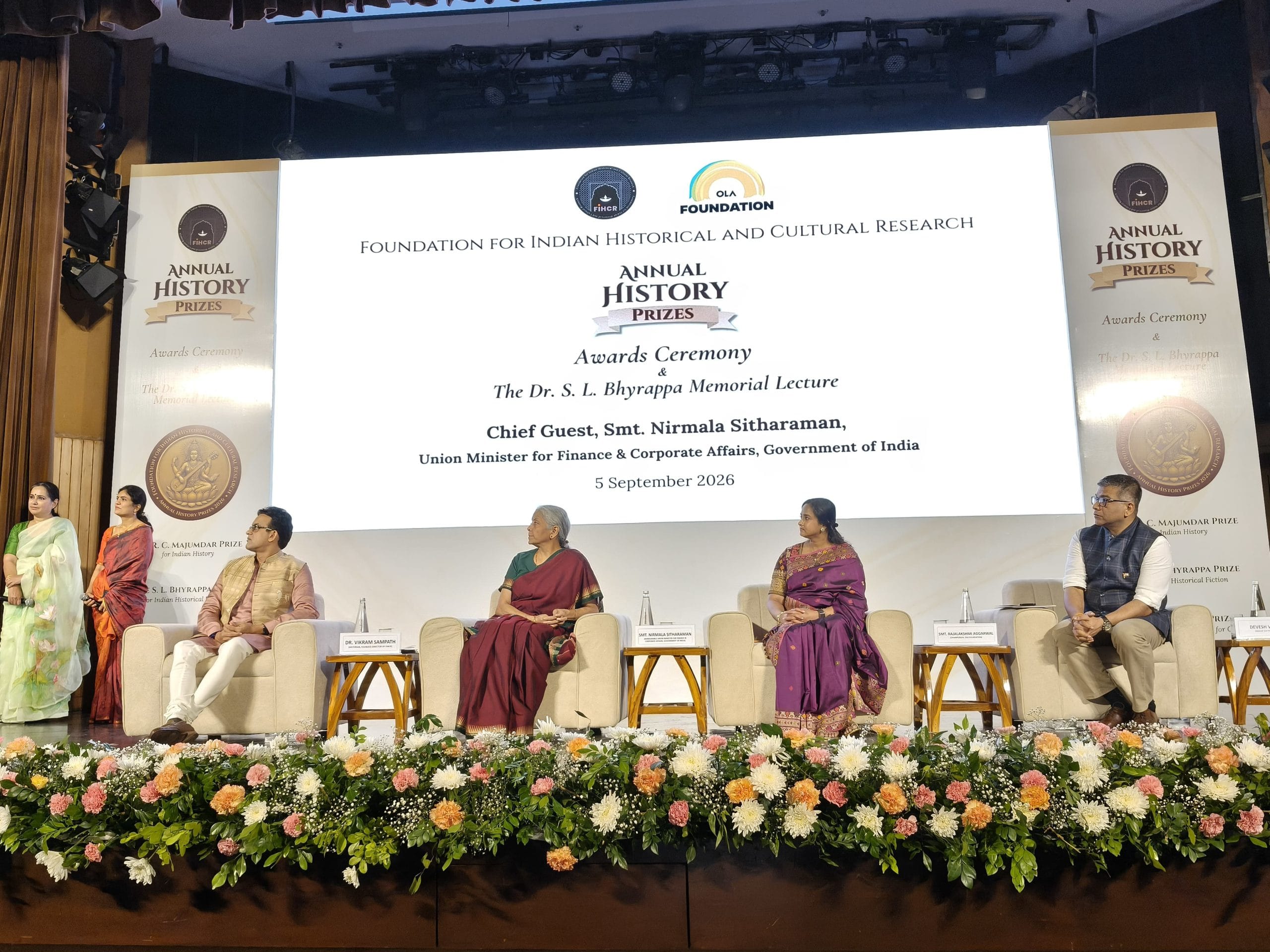
The minister distributed the inaugural FIHCR annual history prize, RC Majumdar Prize for Indian history, SL Bhyrappa Prize for Indian historical fiction, as well as the Anant Pai prize for illustration.
“For the first time, we have put an idea into practice, honouring a historian for uncompromising scholarship, a novelist for the courage to tell difficult truths and an author-illustrator duo for making that history come alive for our children,” said Sampath, founder-director of FIHCR.
Intellectual Samudra Manthan
Sitharaman said that thinkers must be able to enter from both sides, carry their arguments to centre stage and let ideas contend in the open.
“It’s up to the viewers to think and form a view,” she said, calling this a mantra, “an intellectual Samudra Manthan.”
Just as deities and demons took their positions on either side of the churning in the ancient Hindu legend, it was only through the friction of opposing forces that the amrita (nectar) of truth emerged, she said, adding that that’s our philosophy, tradition and in our DNA.
For decades, Sitharaman said, our cultural and intellectual ecosystem allowed one side of the stage to dominate disproportionately, while alternative traditions of thought were pushed to the back.
“Across literature, academia, music, theatre, cinema—everywhere—there was a disproportionate presence of one ideological side, to the extent that it could efface the other in toto, but for a few Bhyrappas,” she said, adding that a stage with actors from only one side does not produce a play. It delivers an ideological monologue.
Bhyrappa’s journey
The minister added that the celebrated Indian thinker and novelist pursued his education through hardship. Karnataka-born Bhyrappa died in September 2025, aged 94.
“These realities that he lived through gave maturity to his writing. He was not picked up. Restraint was a character of his writing. An unsentimental realism,” she said.
Sitharaman said that when we looked at Bhyrappa’s literary trajectory, he experienced two distinct peaks separated by 15 years.
The first was an artistic peak between 1965 and 1979, the era of masterworks such as Vamshavriksha (1965), Gruhabhanga (1970) and Daatu (1973), which earned him the Sahitya Akademi Award in 1975, and finally Parva (1979).
The second was the peak of unprecedented public resonance starting around 2007, when Aavarana sold out to four publications and saw ten reprints in five months—a record in Indian publishing. Meanwhile, Parva reached its 19th edition.
Sitharaman said that Bhyrappa was not suppressed into silence, but that gatekeeping occurred.
UR Ananthamurthy, who pioneered the Navya movement in Karnataka, dismissed Bhyrappa.
“This was sometime in May 2007, when Ananthamurthy thought he should put Bhyrappa down by saying he could only debate; he couldn’t do any writing as a novelist,” she claimed, adding that he was celebrated by the reading public, but not by the institutions.
Sitharaman added that critics who judged him most harshly received the Jnanpith Award, but Bhyrappa never did.
“This brings us directly to a fundamental distortion in the vocabulary of our national and intellectual discourse,” she said.
(Edited by Insha Jalil Waziri)