





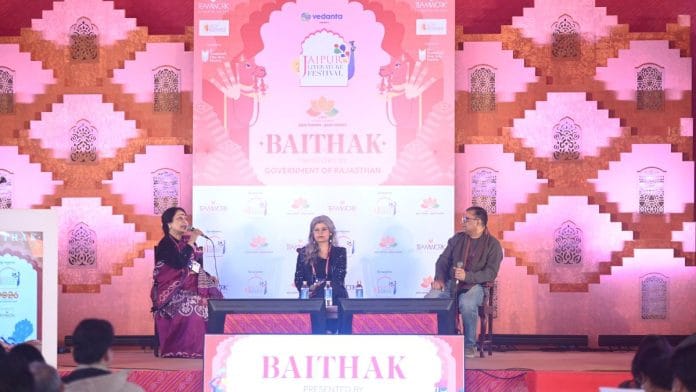

Jaipur: Hindi poet Anamika has created a Sita for the modern world in her book Trin Dhari Ote. She’s inspired by the women in Gaza and others across the world who are caught in the middle of a conflict.
In a conversation with writer Prabhat Ranjan at the Jaipur Literature Festival, Anamika said that her Sita is modelled after women who fight for their rights. The English translation of her book, Sita’s Veil, has been done by Nishtha Gautam. In the book, Sita tells Ram, “You handle the kingdom, and I will handle my school in the forest where I will teach not just our children, Luv-Kush, but also the children of monsters.”
Anamka’s a retelling of the Ramayan is from the perspective of Sita, emerging from her “mother’s version of multiple folk retellings”.
Ranjan asked her whether she had a preferred mother in the book—or in the myth—to which she answered “Mother Nature”.
“All girls come from her, and they return to her, like the girls left in garbage bins and in wells. Sita is like a foundling. Men need to start looking at the world through the eyes of a mother. If they were to do that, then they wouldn’t be so violent or need to fight among themselves,” said Anamika.
The author and translator first discussed the book at an earlier edition of JLF. Gautam was moved to tears by the story.
“If she (Anamika) is from Sita’s land, I am from Radha’s,” Gautam said while explaining how her translations are in sync with Anamika’s story.
“When we look at Sita, we forget that she was a lover first. So the shringars (adornments) in Anamika’s writing were essential,” she added.
Also read: Bipolar disorder, substance abuse & a pretty good brain—what Stephen Fry revealed at JLF 2026
Sita and Ravan
Anamika’s Sita rescues men from the stifling clutches of hyper-masculinity that society foists upon them. “Sita is essentially telling Ravan in one instance that ‘Look, I have spent my entire life teaching Ram to be my equal, and I no longer have the energy to teach you’. It speaks of the invisible border imposed on women by society, where they are responsible for the behaviour of others and are pressured to feel desire for men,” Gautam said.
The poet chose to leave their story open-ended because there cannot be an “immediate and on-demand ending”.
Gautam also noted how it’s become a fashionable thing today for men to assume that an ‘independent, empowered and liberated’ woman must want to run off with the first man that she sees.
“That lens needs to be tweaked a little. Is that a lens or a veil that we are imposing on her?” Gautam asked.
ThePrint is a media partner for the Jaipur Literature Festival 2026.
(Edited by Ratan Priya)