





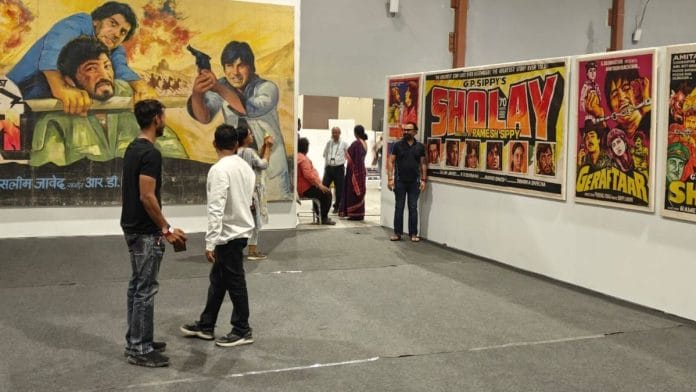



New Delhi: From the opulence of Mughal E-Azam to the cult classic Sholay to the dimpled charm of Shah Rukh in Chalte Chalte, a massive photo exhibition titled ‘The Greatest Extravaganza of Cinema’s Art: Celebrating cinema as critical educational resource’ captured films in all their glory at the Bharat Mandapam. Curated by Neville Tuli, the exhibition was part of the International Film Festival Delhi held between 25 and 31 March.
The largest ever exhibition of posters, film art, publicity material and memorabilia garnered maximum eyeballs during the festival. But Tuli’s intention behind the exhibition was just beyond grabbing eyeballs at the festival.
“The key was the scale because the objective that we have been working towards is how to place the visual at the heart of the knowledge-based systems of our educational processes, with cinema being the first research category to drive home the possibilities of that. Scale defines the nature and quality of the diversity,” said Tuli, who is also the founder of Tuli Research Centre for India Studies.
From massive hoardings of Sholay to coasters and even booklets and awards, the exhibition was a curation not just of Indian cinema but also of iconic films from Hollywood, Polish and Japanese cinema. The focus, however, was on the rich legacy and history of Indian cinema and its stalwarts across departments, from actors, directors, photographers, to cinematographers.
“We have shared a very small percentage of what is in our archive, which consists of film materials from 185 countries, built over 30 years. They are displayed without any caption, because when people come for an art exhibition, the first thing they do is read the caption. Text has become a bully of sorts, as people have forgotten that the visual is also a powerful base of knowledge,” says Tuli.
The exhibition consisted of numerous smaller segments, like ‘Highlights of Indian Cinematography, 1913-1973’, ‘The World of Satyajit Ray through Nemai Ghosh’ and ‘Significant artworks of Landmark Films of Bombay Cinema’.
The hero and the directors
The exhibition ‘From Trinity to Trinity to Trinity | Dev-Raj-Dilip to Ray-Ghatak-Sen to Salman-Aamir-SRK’ traces how different cinematic trios have defined successive eras of Indian cinema, reflecting the changing idea of heroism and storytelling.
“The Indian public is never satisfied with one kind of hero or one kind of vision. So when there were Dev Anand, Raj Kapoor, and Dilip Kumar, even though each of them was a star in their own right and occupied, the country needed all three to feel a sense of satisfaction because that’s the nature of the diversity of thought, emotion, and the expectations that we have from them. It was the same with directors Satyajit Ray, Ritwick Ghatak and Mrinal Sen, and then Shah Rukh, Salman and Aamir,” said Tuli.
Sholay occupied pride of place with various memorabilia from the 1975 film, including life-sized cutouts of Amitabh Bachchan, Dharmendra and Amjad Khan from the film. They had also become the unofficial selfie points for the visitors, who gathered to marvel at them and click multiple photographs.
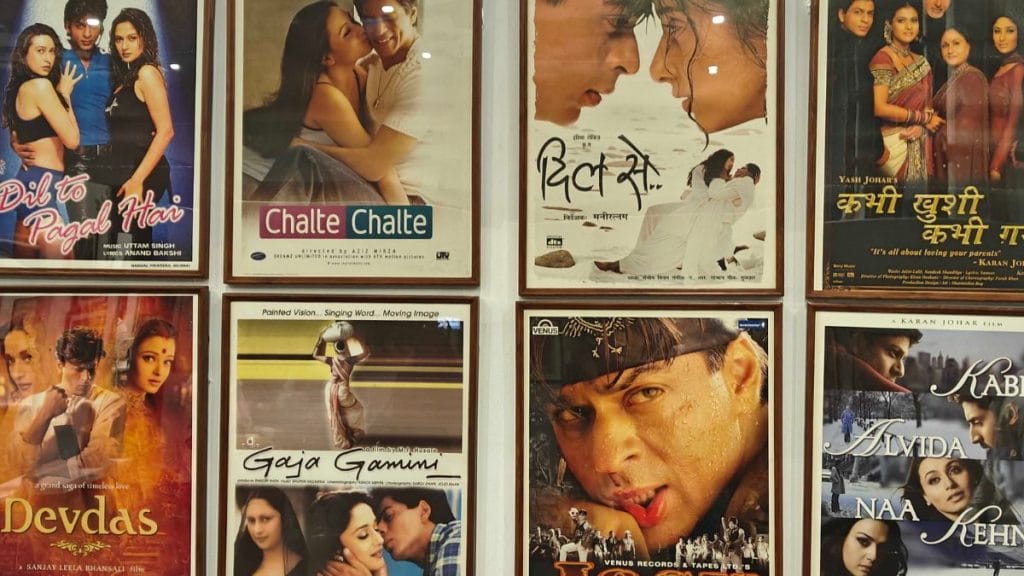
One segment is dedicated to Sharmila Tagore, who has completed 67 years in Indian cinema and was also awarded the Lifetime Achievement Award at the opening ceremony of the International Film Festival Delhi 2026, highlighting the years of experience she has contributed to the entertainment field. From wielding a gun in Do Shatru (1976) to wielding a whip in Paap Aur Punya (1974) and smiling coyly in Daag (1973).
There were also commemorative segments for Dharmendra, who passed away at the age of 89 in November, and the birth centenary of director Shakti Samanta.
The exhibition is not limited to Indian cinema and also includes memorabilia from American, Japanese, and Polish films. A Charlie Chaplin cutout greets visitors as they enter the section titled “The Golden Age of Hollywood”, with posters featuring actors Cary Grant and Katherine Hepburn. The Japanese posters for Sean Connery’s James Bond films are also on display, as are French posters of Guru Dutt’s films like Pyaasa (1957) and Kagaz Ke Phool (1959).
Also read: Tibetan artists reimagine Delhi’s Majnu Ka Tila through murals
Non-poster resources
‘The Heart of Cinema as a Critical Educational Resource – The Song-Synopsis Booklet” revisits a fascinating film artefact that once served as both publicity material and audience guide. Today, these booklets stand as important educational resources that reflect how music and storytelling have always been inseparable in Indian cinema.
A long shelf full of wards showcases the golden bygone years when films would run in theatres for weeks, and they would be commemorated without awards. The segment featured the silver jubilee of Hamraaz (1967) that starred Sunil Dutt and Raaj Kumar, to that of the Sanjay Dutt-Pooja Bhatt starrer Sadak (1991), and fifty weeks of Beta (1992).
“India has this great love and passion for cinema, but she still has a very mediocre cinematic culture and therefore it’s important we, you know, help them understand how many artworks of different forms, different technologies, different sensibilities are created by one film at a point in time, from the glass slides to the work stills, to the posters, to the hoardings, to the lobby cars, to the show cars, to the booklets, to the trophies, you know, these are all different worlds,” said Tuli.
(Edited by Saptak Datta)