





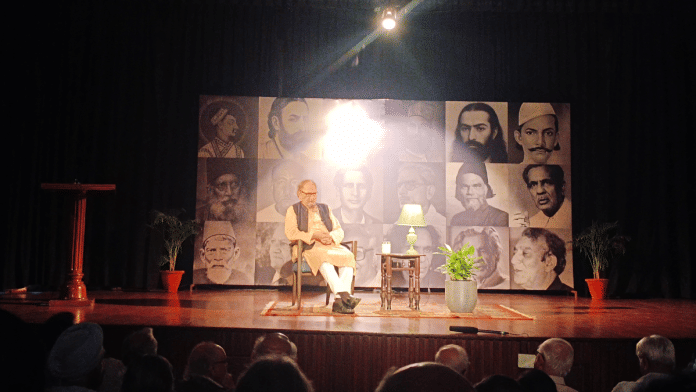



New Delhi: An evening of Urdu poetry at the India International Centre opened not with romance or wit but with the stark realities of conflict. As conversations began, the focus immediately shifted to the ongoing tensions in the Middle East. The audience was reminded that even amid the elegance of poetry, the world’s violence is never far from our collective consciousness.
Senior journalist Saeed Naqvi recalled the powerful tradition of Urdu poetry written on wars and human loss. He emphasized that Urdu poets have never glorified battle, but rather chronicled its human cost.
“Jang maghrib mein ho ya mashriq mein, Khoon apna bahe ya auron ka, Nasl-e-insaan par hai aakhirkaar, Aadmi ka lahu asar karta hai (Whether war is fought in the West or the East, whether our blood is shed or someone else’s, in the end, humanity suffers — human blood always leaves its mark),” Naqi quoted Urdu poet Sahir Ludhianvi.
With this, the hall fell silent, as the weight of human suffering lingered in every line. Poetry, Naqvi said, is not merely a celebration of beauty; it is a reflection of truth, of loss, and of our shared human destiny.
“War only comes with human loss, but Urdu shayari can even make you feel the loss”, he said.
“Zulm phir zulm hai, badhta hai to mit jaata hai, Khoon phir khoon hai, tapkega to jam jaayega (Oppression remains oppression, when it grows, it will eventually fall. Blood remains blood, once it spills, it inevitably congeals),” Naqvi quoted the lyricist.
Celebrating the vibrancy of Urdu poetry, the Raza Foundation organised the event on 27 March, the session was titled “Celebrating Urdu Poetry as an Art”.
“Urdu shayari is not something that is merely written down and preserved: it is something that lives and breathes in everyday moments,” Naqvi said.
Also Read: Munawwar Rana stripped Urdu poetry of elitism, brought it closer to everyday speech
The art of Urdu poetry
He recalled that when he had a headache earlier in the day, his friend said: “Dard-e-sar ke waste shabnam lagana chahiye (For a headache, apply dew (shabnam).” He recalled that when he was having a headache, earlier in the day, his friend said: “Dard-e-sar ke waste shabnam lagana chahiye (For a headache, apply dew (shabnam).”
To which Naqvi responded with another famous couplet. “Usko ghisna aur ragadna, dard-e-sar yeh bhi to hai (Rubbing it in is also a headache),” he quipped.
Naqvi, a distinguished journalist and writer, is widely known for his incisive political analysis and decades of reporting. Beyond journalism, he is also an accomplished author, known for exploring politics, history, and society. His engagement with Urdu poetry, however, reveals a more lyrical, expressive side.
As the evening unfolded, Naqvi recited various shayaris, often weaving in anecdotes about how they came to life. With the mango season around the corner, he shared a delightful piece by satirist Akbar Allahabadi.
“Asar hai tere i‘jaz-e-Masihai ka, ai Akbar, Allahabad se langda chala, Lahore tak pahunch gaya (Such is the effect of your Christ-like miracle, O Akbar, that a ‘lame’ one travelled all the way from Allahabad to Lahore)”, he recalled.
Naqvi also unpacked the humour and wordplay within the verse. The clever metaphor and layered humour had the audience laughing, fully immersed throughout the evening.
“The phrase ‘i‘jaz-e-Masihai’ refers to the miraculous healing powers of Jesus — suggesting that Akbar possesses a similar ‘miracle’, and it shows how to play with words in the poetry”, he said.
Naqvi further explained that the word “langda”, while literally referring to a variety of mango, also means “lame,” creating a clever metaphor: something “disabled” miraculously making a long journey.
Also Read: Poetry, politics to piety—Danish Husain traces the history of Urdu at Jashn-e-Rekhta
Everyday life to scientific findings
It was a packed hall with standing room only but the audience wasn’t there merely to listen, applaud, or admire. As Saeed Naqvi recited familiar verses — people began joining him, their voices rising together in unison, and soon the evening turned into a shared experience.
Naqvi began a well-known modern nazm, pausing midway as if inviting the audience to step in.
“Suna hai log use aankh bhar ke dekhte hain, To uske shehar mein kuch din thehar ke dekhte hain, Suna hai rabt hai usko kharab-halon se, To apne aap ko barbaad kar ke dekhte hain. (I hear people gaze at her with full, longing eyes, so they stay awhile in her city to truly see her. I hear she has a bond with the broken-hearted, so they try ruining themselves to understand her),” he recited the verse.
Smiles spread as people recognized the poet and called out together — it was the timeless work of Faiz Ahmad Faiz.
Moving forward, Naqvi reflected on how poetry evolves with time — how new poets reshape language, themes, and expression, bringing poetry closer to everyday life. He added that while classical poets often celebrated the beauty of the moon, modern poets also responded to humanity’s journey to the moon.
“Dil ko be-tab rakhti hai ik arzu, Kam hai ye vus’at-e-‘alam-e-rang-o bu, Le chali hai kidhar phir na.i justuju (This vast world of colours and fragrance feels too small. A new quest carries us forward),” Naqvi remembered the words of Allama Iqbal.
(Edited by Insha Jalil Waziri)