



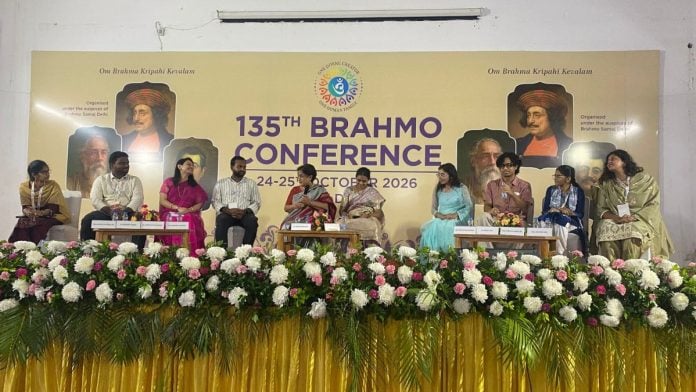
New Delhi: How does a movement that began as a radical move away from Brahminical value systems preserve its relevance in modern India? What does its participation in contemporary political movements look like? And what can members of its community do to make it appeal to the nation’s youth?
A group of eight mostly under-30s attempted to address these questions and more, at the 135th Annual Brahmo Conference held at Delhi’s Raja Ram Mohun Roy Memorial Hall on 25 October. While two of the members, representing the voices of the youth, argued that the Brahmo Samaj had become a ‘relic’ in contemporary India, others passionately championed the movement’s continued relevance even today.
Irrespective of their stances, however, one thing was clear: Brahmos today are grappling with an identity crisis.
The Brahmo Samaj is the societal component of Brahmoism—a reformist movement founded in 1828 to challenge the dominant Brahminical ideology. Led by Raja Ram Mohan Roy, the movement championed monotheism and rational thought, and staunchly opposed caste discrimination. It is best known for its strong opposition to the practice of Sati, and its support of widow remarriage.
Rudrashish Chakraborty, a professor of English at Delhi University’s Kirori Mal College, is not a practising Brahmo, nor is he particularly religious. However, he feels strongly about the significance of the movement in the 19th century, especially considering the conditions of the time.
“You have to understand, the Brahmo Samaj in 1828 had to fight a much more uphill battle. It actually made people believe that there’s a world beyond this limited ritualistic circle,” he said. “Brahmo Samaj gave an alternative Hinduism to people.”
Suggesting a world beyond Brahminism was no mean feat at the time.
Chakraborty had been invited to the conference to judge the debate titled ‘Brahmo Samaj is an Outdated Relic with no Relevance to Modern India.’
‘Historical importance is not contemporary relevance’
The hall, filled with a hundred-something Brahmos, buzzed with excitement. Everyone wanted to know what the young generation thought of their movement and how they planned to take it forward. Some were asking: how can the Brahmo Samaj challenge Hindutva’s communal violence?
For Atrijit Das, 28, growing up as a child of Brahmos did not translate to becoming a practitioner himself. As a socialist, he claimed to be involved in the various people’s movements being carried out in the country. However, he did not see the Brahmo Samaj participate in any of them.
“Do we have any positions on the working conditions of farmers in our country? Does the Brahmo Samaj offer a formal programme for dismantling of caste beyond inter-caste marriage? Do we have a formal programme for emancipating women from domestic roles? Does the Brahmo Samaj provide any scholarship for the rise of Hindu nationalism in the country?” he asked.
Das added that the Brahmo Samaj’s historical contributions to bringing certain reforms in a certain period do deserve study and recognition. But historical importance is not the same as contemporary relevance.
Public Relations professional Rinita Roy Choudhury echoed a similar sentiment. The movement, she claimed, had lost its radical edge in contemporary India, because the oppositional values it once championed had already been enshrined in the Indian Constitution.
“Ask any modern Indian about the challenges or issues plaguing society today. We talk about climate change, global warming, artificial intelligence, gender identity, economic inequality,” she said. “However, the Brahmo Samaj is not strongly relevant to most of these conversations today.”
‘Lacks material analysis’
Das also pointed out that a key area where Brahmo analysis falls short is material analysis. Brahmo analysis, he argued, relies primarily on the criticism of scriptures, and thus falls short of understanding the economic conditions that produce social systems.
Chakraborty, who was judging the debate, complicated this argument, pointing to the Indian Marxist thinkers, such as Susobhan Sarkar, who had emerged from Brahmo families. “Brahmo Samaj was never a mass movement”, he said, “however, it provides you the perfect launchpad to enter mass movements.”
Also read: How the Maharaja of Baroda helped make Raja Ravi Varma an artist of the masses
Opportunity for self-reflection
As the impassioned debate gave way to a collective session of Brahmopasana—a meditative contemplation on Brahman, led by delegates from Indore—several audience members petered out for chai and coffee. Many were third and fourth-generation Brahmos, who had fond memories of visiting the Samaj from a young age with family members.
Roy Choudhury, who had argued for the irrelevance of the movement in contemporary India, reminisced about attending Maghotsav melas with her grandparents in Kolkata.
“We used to be so excited to set up puchka stalls there…and I loved climbing the rickety staircase at the centre,” she recalled.
However, children today, attendees admitted, did not have a similar emotional connection with the movement.
The day’s debate had given them an opportunity for self-reflection.
“It is not their fault that they don’t participate in the movement,” conceded Ayona Dutta, a former music teacher. “We have to figure out better ways to channelise the movement to appeal to them.”
With the Samaj’s bicentenary celebrations coming up in two years, the community left the event with a combined sense of concern and optimism. The upcoming milestone could prove an opportunity for them to align their goals and chart a clear path forward.
(Edited by Ratan Priya)
What was never meant to be will never be.