


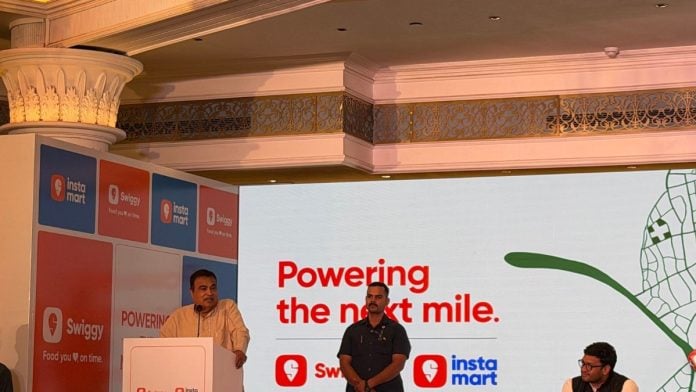
New Delhi: Making a pitch for electric vehicles, Union Road Transport and Highways Minister Nitin Gadkari said the shift from petrol and diesel could lower fuel costs and increase the earnings for delivery partners and platforms while reducing India’s dependence on imported fossil fuels.
Gadkari was speaking at Swiggy’s EV Mobility Conclave at The Claridges on Wednesday, called ‘Powering the last mile’, where the company announced the launch of battery-swapping stations at its Instamart hubs across 25 locations.
At the conclave, Gadkari said India spends a substantial amount on importing petrol and diesel while also dealing with the pollution caused by fossil fuels. According to him, electric mobility, along with alternatives such as biofuels and hydrogen, could help address both challenges.
“Petrol and diesel are very expensive. If we can save on these imports, it will benefit the country and also reduce pollution. Pollution is a big problem, as you know, particularly in Delhi,” he said.
Gadkari also backed battery swapping as a practical solution for electric two-wheelers, particularly for last-mile delivery workers, where time spent charging a vehicle can affect daily earnings.
“Swapping is also a good thing. It will increase economic viability,” he said, adding that the government was working towards reducing the cost of electric vehicle charging.
For the event, Swiggy brought together EV manufacturers, battery-swapping companies, vehicle rental firms, fleet operators, financiers and delivery partners to discuss the challenges involved in shifting to electric vehicles. They pitched electric two-wheelers as a practical and affordable option for last-mile quick commerce delivery partners.
Gadkari also cited the example of CNG two-wheelers to embolden his push
“The running cost of CNG two-wheelers was around Re 1 per kilometre, compared with Rs 2.40 for petrol-powered two-wheelers. The economics of alternative fuels and electric mobility would eventually encourage more people to move away from conventional vehicles,” he said.
He also spoke about the growth of India’s automobile industry, saying the country had moved from the seventh-largest automobile market to the third position. He expressed confidence that India could eventually become the world’s largest automobile market.
The minister also praised Swiggy’s efforts to create employment opportunities through its delivery network, saying innovation and technology could help increase the income of people working in the service sector.
“To create employment potential is the most important agenda of the government,” he said, thanking Swiggy’s founders for the initiative.
Also read: Delhi exhibition brings together embroidery traditions from Kashmir, Bengal, Palestine
Swiggy’s EV push
Swiggy has introduced EV rentals at its Instamart hubs, allowing delivery partners to pick up an electric two-wheeler from the same location where they collect orders.
The platform said a delivery partner visits an Instamart pod around 20 times on a busy day. By placing rental and battery-swapping facilities at these locations, the company hopes to save riders the time spent travelling to separate charging or vehicle-rental points.
The rental facility is integrated with the Swiggy app, with charges deducted from delivery partners’ payouts according to their preference.
Sriharsha Majety, co-founder and group CEO of Swiggy, said the company wanted to make the transition to electric vehicles easier for delivery partners by addressing the everyday challenges involved in using them.
“For those who choose electric, that means taking away the everyday hurdles, so that the transition fits naturally into the way they already work,” he said.
The initiative has been developed with several ecosystem partners, including Indofast Energy, Yulu, Bounce Daily, RIDEV, Baaz Bikes, Motovolt, Shadowfax, BGauss Auto, Veelo Mobility, Hala Mobility and Yuma Energy.
Varun Agni, co-founder and CTO of Bounce, said access to an affordable vehicle remained one of the biggest barriers for people entering delivery work.
He said several riders did not own a vehicle before joining the delivery workforce and that access to an electric two-wheeler, along with battery-swapping infrastructure, could help them save time and money.
Swiggy also felicitated delivery partners who had adopted electric vehicles and companies working on EV rentals, charging and battery-swapping infrastructure.
Umesh, a Swiggy delivery partner who uses a rented electric vehicle, said the rental charges were deducted from his payouts and that he could swap batteries at Instamart hubs while collecting orders.
“I can now make better use of my work hours and I am earning more,” he said.
(Edited by Ratan Priya)