



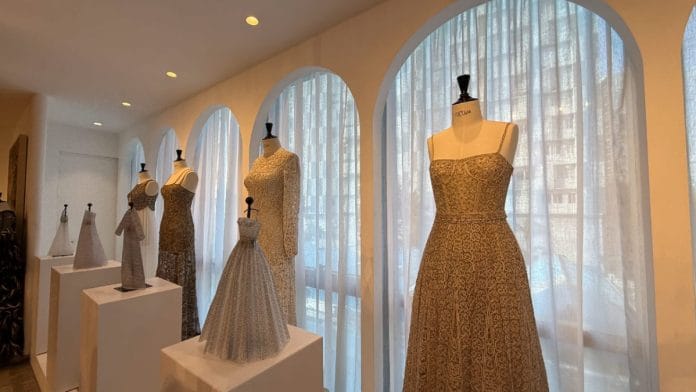
Mumbai: At the Chanakya atelier Tuesday afternoon, guests sipped champagne and ate canapés among couture gowns. The same skills used to make those gowns were on display in the two exhibitions that followed, this time translated into maps, landscapes, and sculptures.
Chanakya International, a Mumbai atelier that works with nearly 40 global couture houses, was marking its 40th anniversary and 10 years of its nonprofit School of Craft. The celebrations began with a preview of Garden of Gestures at the atelier in Byculla, before moving to En Route at the Dr Bhau Daji Lad Museum, just down the road.
A garden built from craft
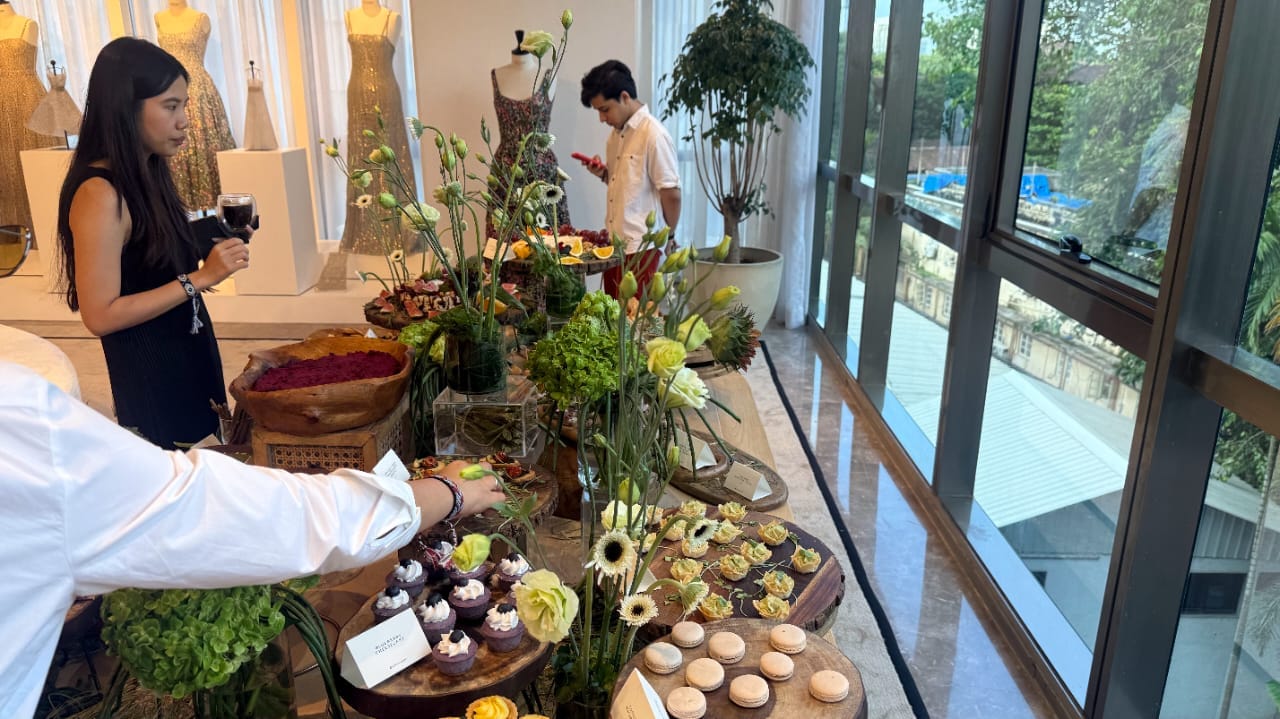
Garden of Gestures was organised around the taxonomy of gardens and groves described in ancient Indian texts. In the Upvan, or “forest brought close”, stone bowls filled with spices, herbs and minerals used to make dyes lined the floor along the walls.
Wooden shuttles and other tools like wooden weaving shuttles, carved blocks, lace-making bobbins, hand rakes and sickles were arranged separately on a table. Embroidered botanical studies of leaves, stems and flowers hung on the walls, while mannequins wore red garments made from raffia, bamboo and other natural materials.
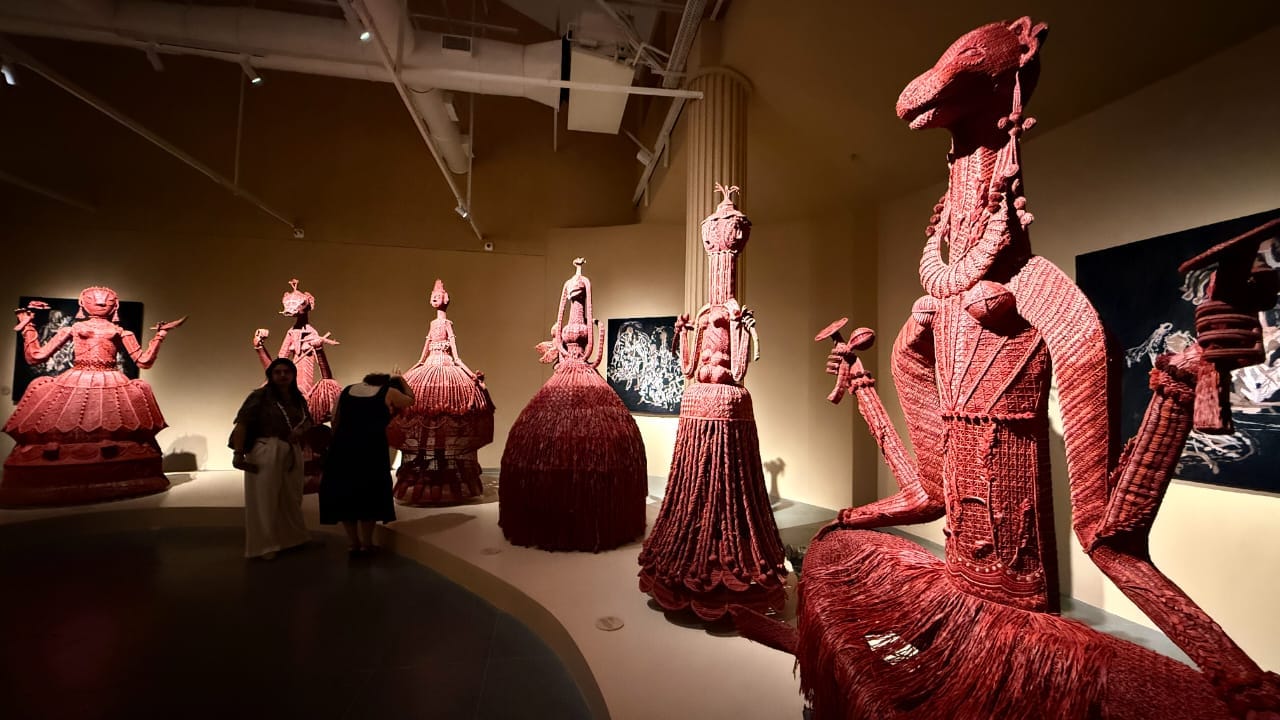
In the Tapovan, the forest of contemplation, seven larger-than-life crimson forms represented the Saptamatrikas, the seven mother goddesses. Bamboo, raffia and cotton had been woven, knotted, plaited and coiled to create them.
“I think this is honestly in a different league. For me, this is when the practice of fashion becomes fine art. It’s the mastery of craft,” stylist Anaïta Shroff Adajania told ThePrint.
The final garden, the Kunj, was enclosed by walls of date-palm raffia. At its centre sat a ninth-century basalt sculpture of the boar-headed Saptamatrika, Varahi, from the Swali Private Collection, encircled by bronze Saptamatrikas. Light entered through gaps in the raffia, while the sounds outside receded.
Mapping Mumbai through textiles
The celebrations continued at the Dr Bhau Daji Lad Museum, where a large cotton map of Mumbai occupied its restored Victorian atrium. Its seven layers recalled the seven islands from which Bombay was formed and paid tribute to the mills and textile trade that shaped the city.
The map began with Heptanesia, the name used by the Greco-Roman geographer Ptolemy for the archipelago, and moved through later periods of Mumbai’s history.
“It’s a city where 26 million dreams coexist. I hoped to somehow capture the chaos, and also the collective energy of the city,” said Karishma Swali, artistic director of Chanakya and founder of its School of Craft.
A textile work inspired by the Elephanta Caves stood behind the map; the two works were displayed back to back.
Before the walkthrough, managing trustee Tasneem Zakaria Mehta joked that she was “one of the antiquities” at the museum.
The collaboration between Chanakya and the Dr Bhau Daji Lad Museum began after Swali invited Mehta to the Chanakya atelier. “When I went and saw the works, I was blown away. I was seeing amazing work. It was so conceptually strong,” Mehta said.
Interested in “how craft is making the transition to become art”, Mehta opened the museum’s collection of rare maps of Bombay to Swali and the Chanakya collective. The maps became source material for the textile work about Mumbai in the atrium.
Opened in 1872 beside what is now the Veermata Jijabai Botanical Gardens and Zoo, the museum documented the city alongside natural history and craft. Its history also shaped the other works made for Mumbai.
A city seen in layers
By 6 pm, guests in the warm atrium were using their programmes as fans. Upstairs, the air-conditioned Kamalnayan Bajaj Mumbai Gallery offered relief. The exhibition occupied three rooms.
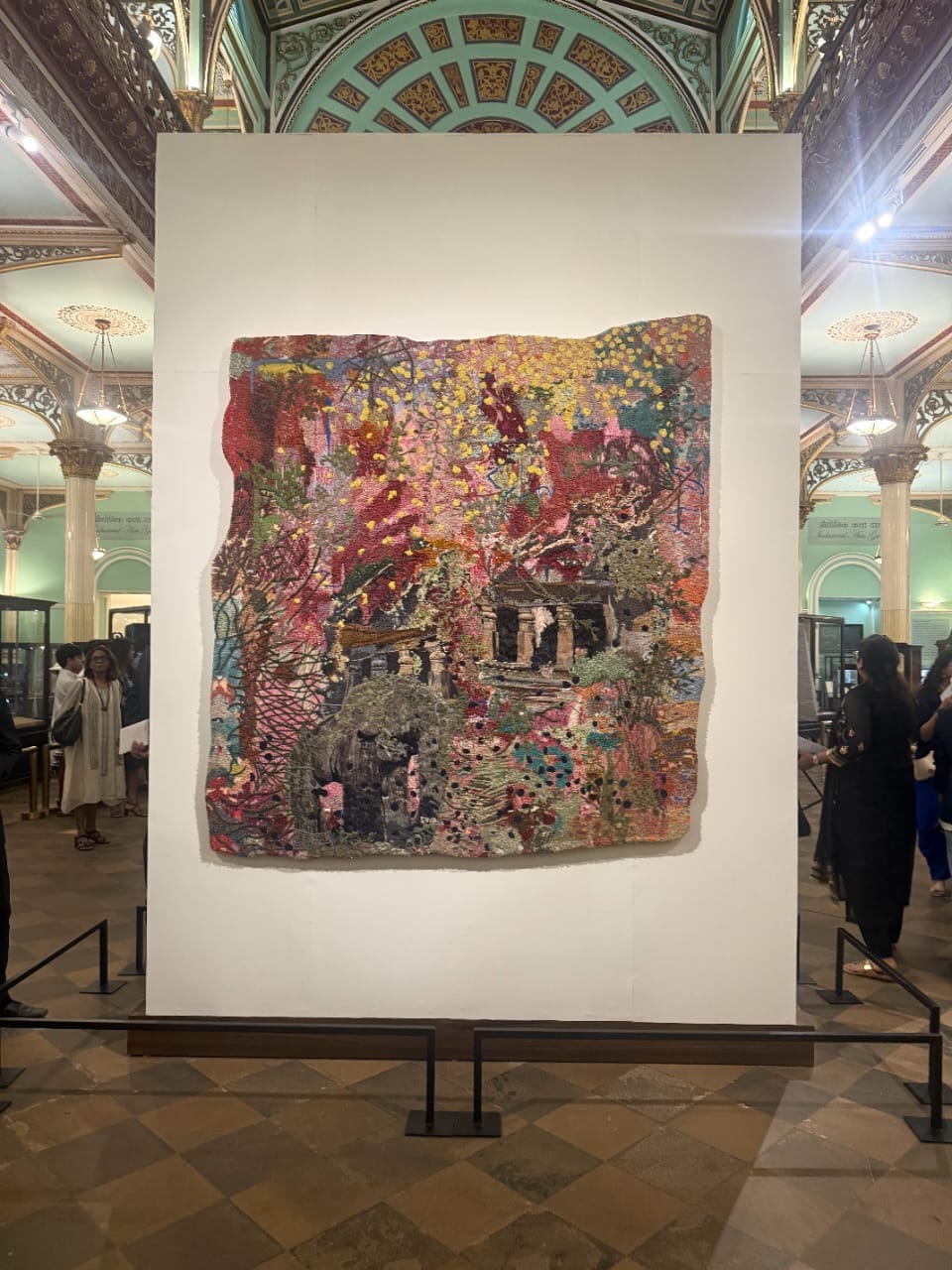
The first held Crossings and Kanheri Caves. In Crossings, the museum’s pale colonnaded façade appeared amid blue-green vegetation, flashes of burgundy and long white stitches.
Beside it, Kanheri Caves used organic jute, cotton, linen and raw silk in greens, blues, black and cream. The caves only became clear when the work was viewed as a whole, emerging behind layers of vegetation and the city’s landscape.
“The layers of the city come together only when you’ve lived here, experienced it,” Swali said.
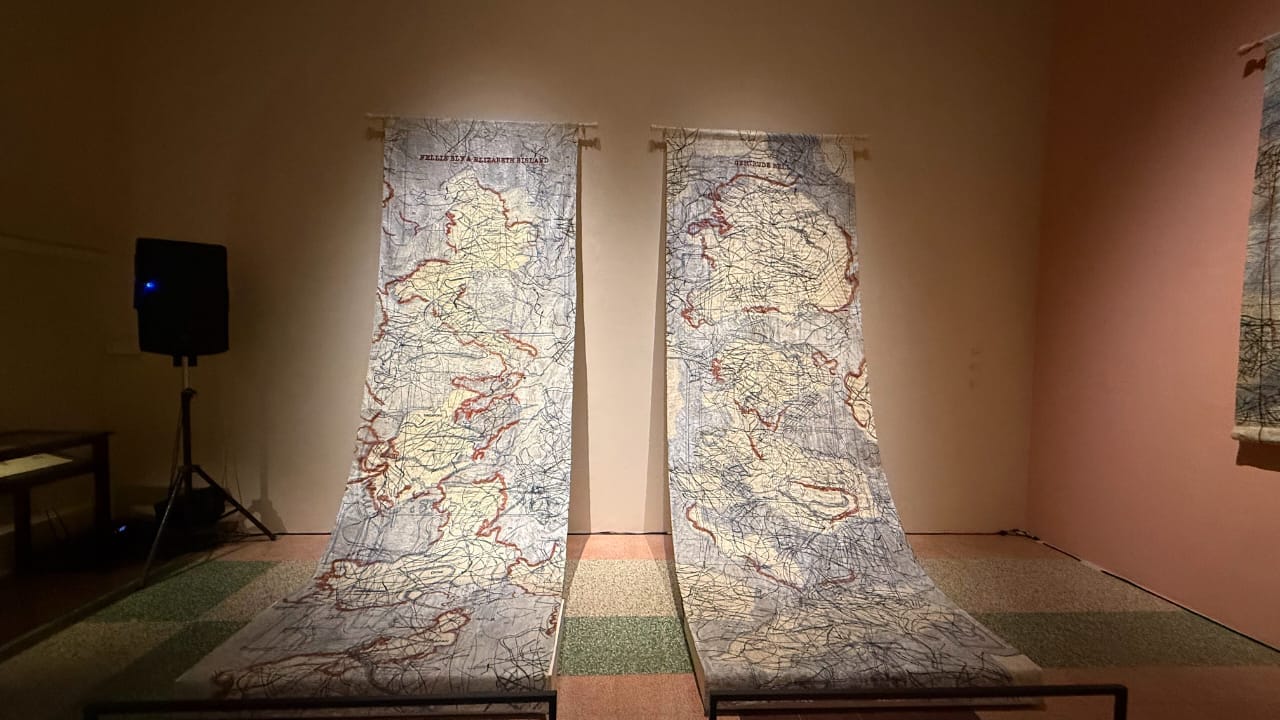
The second room held four monumental panels tracing the journeys of six women. American journalists Nellie Bly and Elizabeth Bisland raced around the world in opposite directions, adventurer Annie Londonderry circled the globe by bicycle, train and steamship, and English writer Gertrude Bell travelled through Europe, India and the Middle East.
Twins Agnes Smith Lewis and Margaret Dunlop Gibson journeyed across Europe and the Middle East to Mount Sinai in search of ancient manuscripts.
From across the room, four monumental panels looked like ageing maps. Up close, their surfaces were filled with red routes, portraits, handwritten text and clothing patterns.
Made from linen and hemp, they used running stitch derived from kantha, a Bengali embroidery tradition in which layers of cloth are joined with rows of running stitches. The historical maps and documents used to reconstruct the journeys were displayed nearby.
“Femininity: A Trap”, drawn from Simone de Beauvoir, was embroidered across one panel in red. Beneath the words, maps and thread ran under and across the outline of a corset.
The final room held a large embroidered landscape and two handcrafted globes, Vasudhaiva Kutumbakam and Antrik Vishwa. Vasudhaiva Kutumbakam, meaning “the world is one family”, brought together 88 textile traditions, including kantha, zardozi and phulkari. Antrik Vishwa, meaning “inner universe”, depicted mountains, rivers, temples and other landscapes imagined by artisans from the Chanakya School.
From the Vatican to Mumbai
En Route was first presented at the Vatican Apostolic Library in 2025. Maria Grazia Chiuri, Swali and the Chanakya School of Craft spent more than a year researching it there.
“We researched for more than a year in the Vatican Bibliotheque. I’m very excited also that all the community of the school can come visit the museum and see the works that they have worked on,” Chiuri told ThePrint.
Walter Ferrara, the Consul General of Italy in Mumbai, had seen the exhibition at the Vatican. “We have to bring this to Mumbai. We have to close the circle,” he remembered telling Swali.
Founded by Swali in 2016, the Chanakya School of Craft has trained more than 1,400 women in over 300 techniques, including embroidery, macramé, papier-mâché and beading. For Swali, the school’s first decade was only a beginning.
“There is so much to do. I feel like we’re at the beginning of an exciting time in India, and we need to come together and really champion what we have as a subcontinent. Individually, collectively, take it forward,” Swali told ThePrint.
Edited by Maryam Hassan