


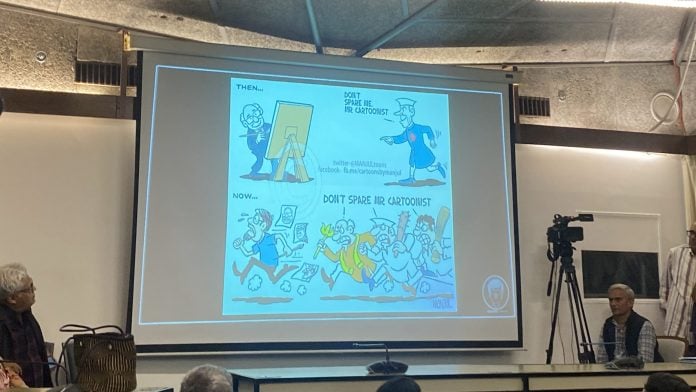
New Delhi: At a panel discussion with fellow political cartoonists, Manjul recalled a phone call with a Maharashtra-based newspaper that used to carry his cartoons. The newspaper had recently decided to change its policy. “Now we are going to support Hindutva and the government,” the editor allegedly informed Manjul. “We would like you to make cartoons that align with this ideology,” Manjul recounted the editor as saying.
The room, full of around 60 journalists, media enthusiasts, and students burst into laughter. “So cute!” an audience member cooed from across the room. The anecdote, recalled without any hesitation, had finally put a name to what the panel had been skirting around all evening: censorship of political cartoons under the current political regime.
Held at Delhi’s India International Centre on Friday, 20 November, the panel included veterans such as EP Unny, Chief Political Cartoonist, The Indian Express; Sandeep Adhwaryu, Chief Cartoonist, The Times of India; and Manjul, who worked at various publications before branching out independently. Among them was also Samim Akter Sheikh, the self-proclaimed voice of “Gen Z cartoonists”, who largely publish their work on Instagram.
“Cartoons are never made in support of anyone,” Manjul allegedly told the editor in question, before ending his association with the Maharashtra-based newspaper. His remark summarised the spirit with which all cartoonists in the room work.
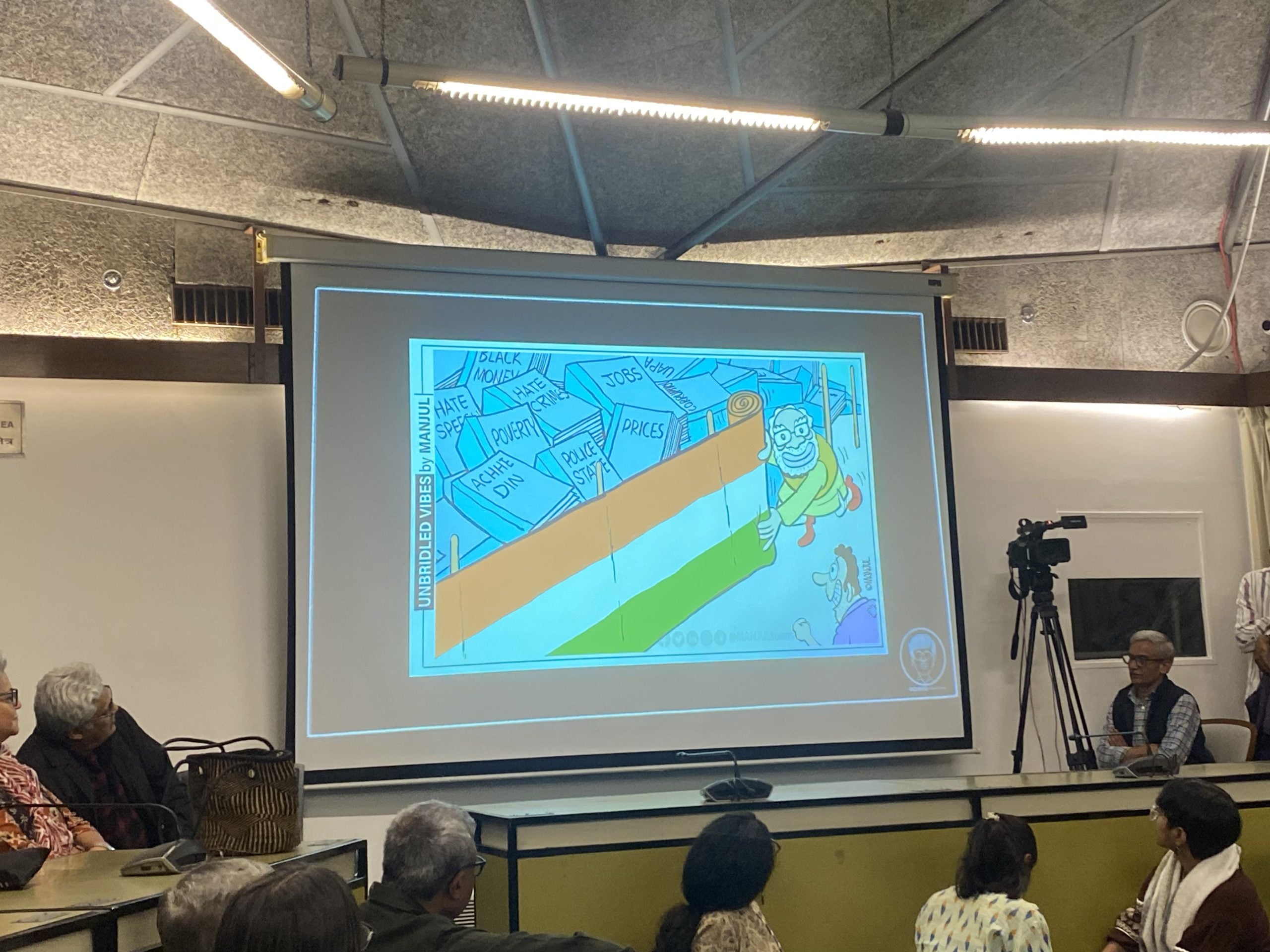
“Cartoons basically show the emperor without clothes,” explained R Srinivasan, former Editor of Business Line, who was moderating the panel. “They make you laugh,” he added. “And once someone starts laughing at you, they don’t fear you,” he said.
It is perhaps this power of political cartoons that has long made them the subject of state censorship. Censorship that was highly prevalent during the Emergency era, continues even today, albeit in a different form. “Now you cannot show (PM Narendra) Modi or [Union Home Minister Amit] Shah’s face in your work. You cannot paint someone’s kurta saffron,” Manjul claimed. “We have to see what the yardstick for censorship is now,” he added.
The event was organised by The Media Foundation, as part of their series of dialogues on contemporary media.
A new kind of censorship
Cartoons, contended Srinivasan, “are tailor-made for the social media era.” “They are visual. They have very little text, and don’t take too much of your time to get to the point,” he said. However, somehow they fail to do as well as memes.
For Adhwaryu, the answer to this conundrum lies in the ecosystem surrounding social media. “Cartoons provoke people into thinking,” he said, “but these days thought is the enemy.”
Be it the mindless consumption of information through algorithms, or the way TV news debates are conducted, “there has been a progressive decline of nuance,” he said, which affects people’s appetites for political cartoons.
Other contradictions pervade the medium too. What should have been a space that is devoid of state-censorship, has found different ways to curtail expression. Sheikh claimed that his Muslim identity is often the point of target for online trolls.
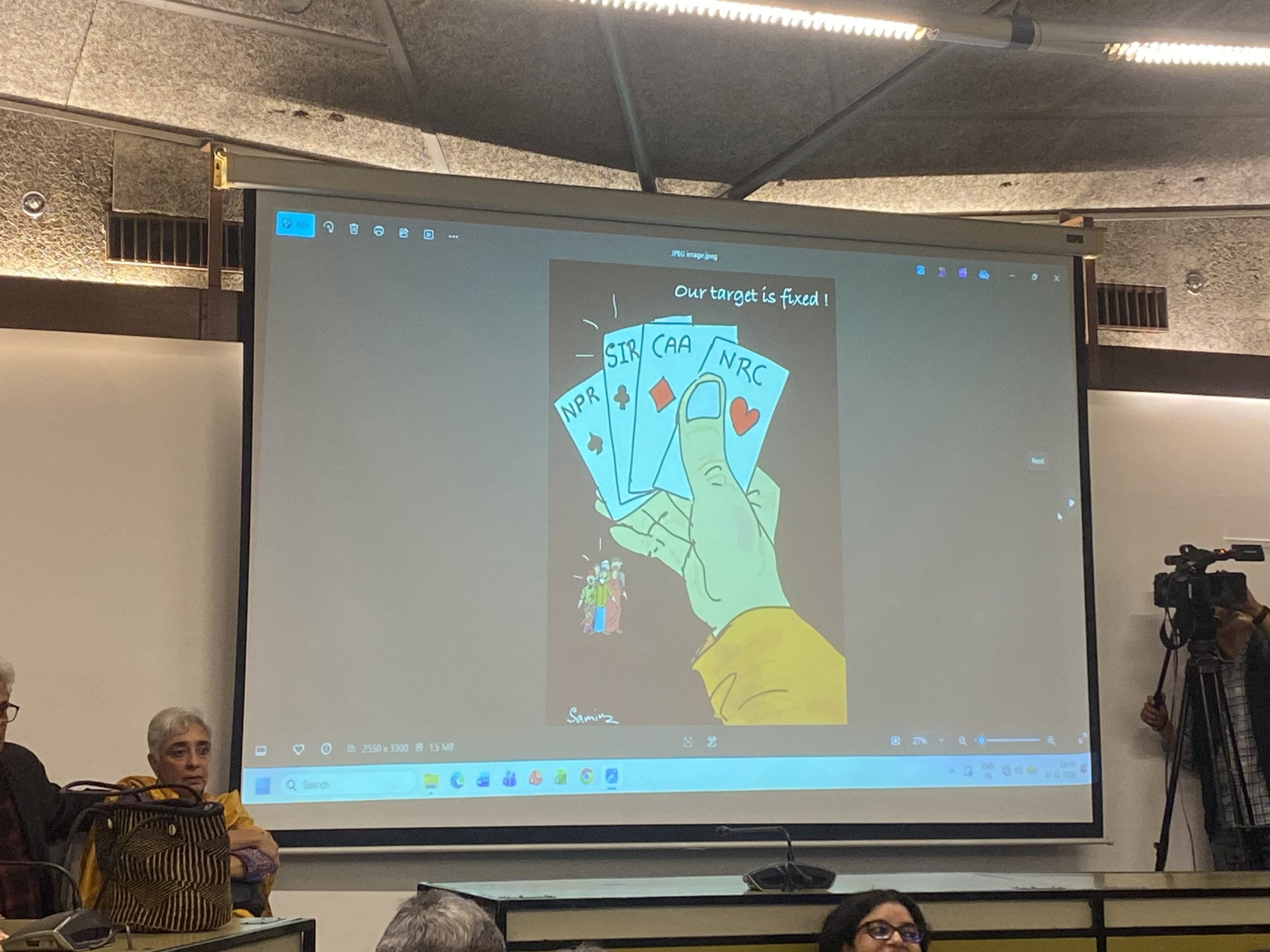
“None of my works has been taken down,” he said, despite his being critical of the government. “Authorities don’t come to me directly. Their force comes to my comment box,” he alleged. He claims that there’s an expletive waiting for him in his inbox every morning. Their problem, however, is not with the cartoon itself. “Their problem is that the cartoon was coming from me, because my name is this,” he said.
Besides, social media has its own opaque forms of censorship which often evade explanation. “When Meta takes down your post, all you will see is a red dot, that tells you that your post has been taken down in accordance with existing Indian laws,” Manjul said. There’s no way to challenge this other than going to court.
“We may feel that platforms are expanding, but they are only expanding as long as you are very careful about what you say,” he added.
A changing news ecosystem
The cartoons displayed on the screen during the discussion spared no one. From a near- naked Fakhruddin Ali Ahmed, the Emergency-era President; to an agnostic film industry, which loves to toe the line of the government; and a Prime Minister who never misses an opportunity for good optics, everyone was the butt of the cartoonists’ jokes.
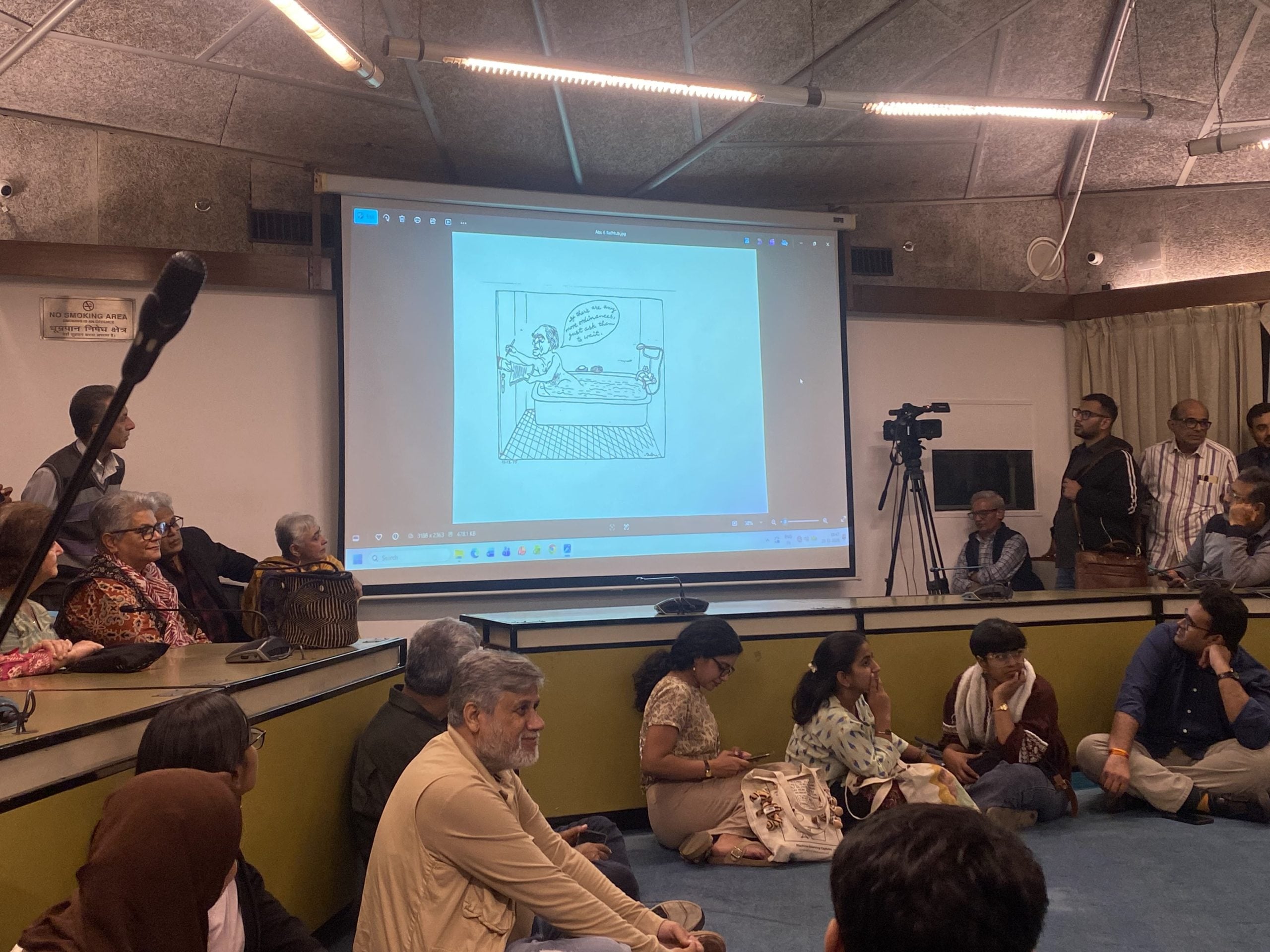
However, the consensus in the room was that something had shifted in the field of political cartooning.
For Unny, this shift lies in the broader ecosystem of news itself. “Cartooning does not happen in a vacuum,” he said. A veteran in the field, he has always worked as part of a newsroom and in tandem with the latest news of the day.
Today, Unny often finds himself following a piece of news for half a day, only to find out that the news itself was fake. “This clarity of news, where you are sharing the same platform with your readers, and they know exactly what you are talking about– that’s when a cartoon pays off,” he said.
With the explosion of social media, and diverse sources of news, however, it has become increasingly difficult to be on the same page as the reader, and for them to “know what you are talking about,” Unny added.
For Bharat Bhushan, who heads The Media Foundation, “cartoons are essentially sharp opinions by an individual. And that opinion has as much value as the main opinion on the edit page,” he said.
However, these days cartoons rarely appear on the front page. “They appear on page 16, page 18,” he added.
With newspapers turning away from political cartooning, young cartoonists have very few avenues to monetise their craft. “I cannot earn money from making political cartoons on social media,” Sheikh added, “and so I started stand-up comedy last year.”
Not all doomsday
Still, in true cartoonist fashion, the panelists ensured that the room erupted into frequent laughter– both on their comments as well on the work displayed on screen. They discussed emerging challenges facing the medium, but were not entirely pessimistic about its future.
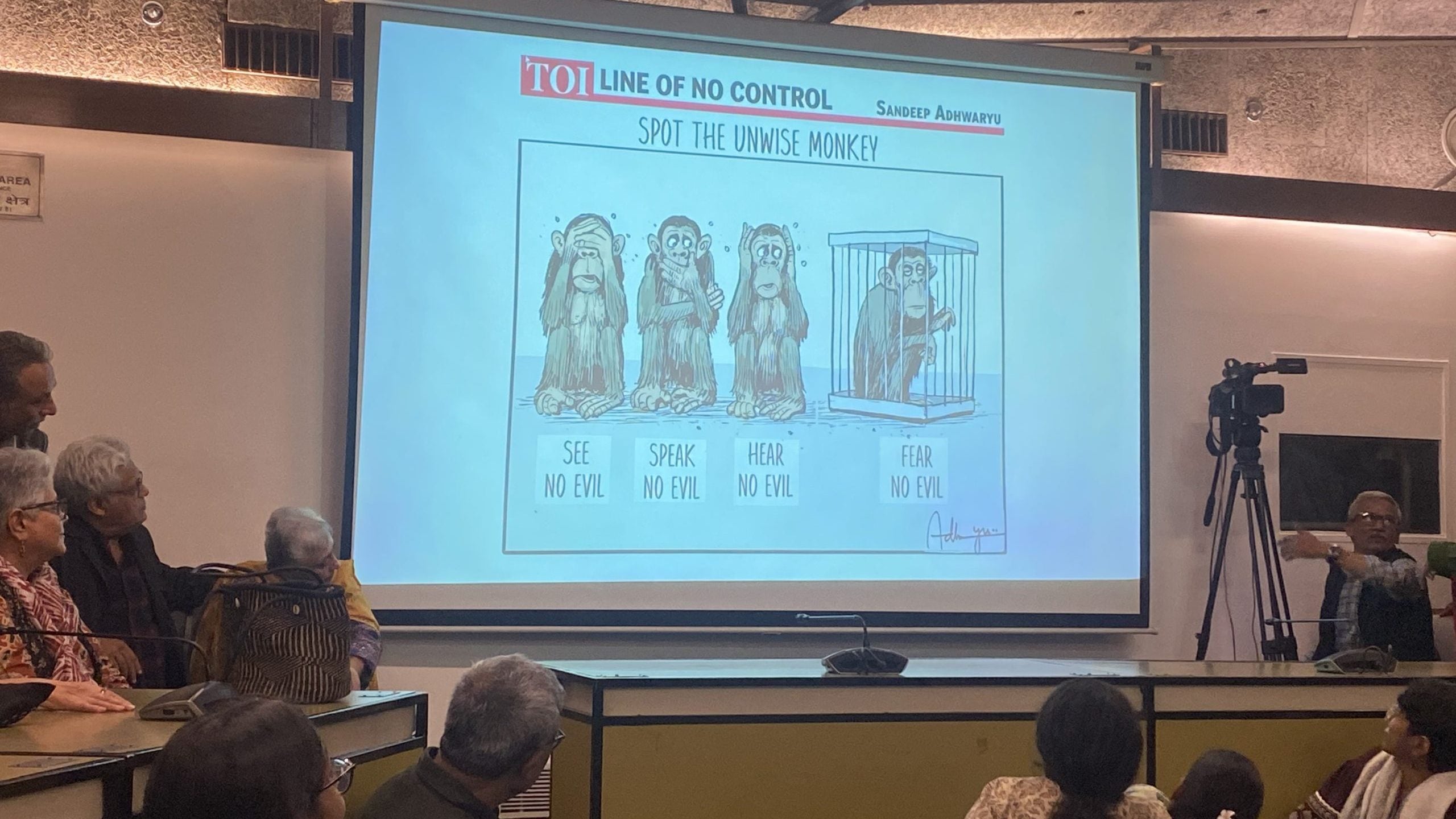
Responding to a remark which called political cartoons from the 1970s ‘timeless’, Manjul said, “the credit for that goes to the government.” “Very little about them has changed,” he added, alluding to general political neglect of the common people’s problems.
“R K Laxman’s cartoons about potholes in the 60s and 70s are still relevant today,” Manjul said.
But it is perhaps these incompetences that creates the need for cartooning in the first place, and lends the medium its continued relevance.
“Why we are surviving against all the odds in India, is because every editor, every publishing house, every censor knows that this is a popular medium. Not only in India, but across the world,” said Unny.
(Edited by Aakriti Handa)