





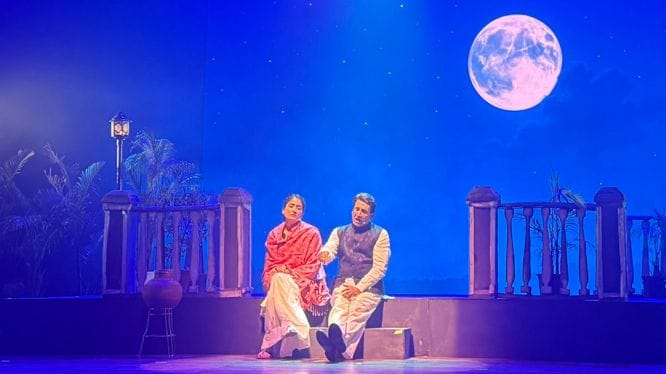


New Delhi: Ek Mulaqat, Saif Hyder Hasan’s long-running play on an imagined final meeting between Sahir Ludhianvi and Amrita Pritam, returned to Delhi with Shekhar Suman as Ludhianvi and Geetika Tyagi as Pritam.
First staged in 2014, the play has travelled across India and abroad in different versions, Hasan told the audience before the show began. He was speaking at the second performance of the day at New Delhi’s Kamani Auditorium. It was packed with a largely older, mostly Punjabi audience who were seemingly already familiar with the world of Sahir, Amrita and the songs as well as poems that made them part of public memory.
It seemed to be a crowd that had come not just for a play, but for the people it had come to remember.
Even before the performance began, Ludhianvi was being discussed in the rows. An older woman leaned towards the teenage girl beside her, listing his songs from Hindi cinema.
“Did you know he wrote ‘Abhi Na Jao Chhod Kar’? And ‘Main Zindagi Ka Saath Nibhata Chala Gaya’, ‘Jinhe Naaz Hai Hind Par’, ‘Kabhi Kabhie Mere Dil Mein’, also,” she said.
‘Uff Dadi, how many times will you tell me the same thing?’ the teenager replied.
That was the mood in the hall. Sahir did not need much introduction here.
Before the play began, Hasan addressed the room with a small warning. Delhi audiences, he said, are often too ‘polite’, careful not to disturb a performance with applause. But for Ek Mulaqat, he asked them to put that restraint aside. If a moment moved them, they should clap. Whistles, too, were welcome.
The packed auditorium obliged immediately, with applause and a few whistles.
Also read: ‘Cook like it’s 1975’—A women-only Gurugram workshop on food, memory and heritage
The missed trunk call
The play opens on a cold winter evening, on the day Ludhianvi died, though the audience does not know that yet. Pritam is on the terrace of her house in Hauz Khas, knitting, when a phone rings. It is a trunk call from Bombay, Imroz tells her from behind the scenes. By the time she goes in to answer it, the line has disconnected. When she returns to the terrace, Ludhianvi is there.
Suman’s Ludhianvi and Tyagi’s Pritam immediately slip into a familiarity that betrays the closeness of their relationship without having to spell it out. The conversation moves between the ordinary and the unresolved. He asks her why she is with Imroz. She says he completes her, that she feels at peace with him. But peace, in her telling, does not have to mean surrender. It does not mean she will bow to society’s expectations and marry.
The play is strongest when it lets them circle each other without resolving too much. There is affection, irritation, old hurt, and the slight cruelty of people who know each other too well. At one point, she asks him how he truly feels about her. He moves around the question instead of answering it, as if clarity is still too much to ask.
The hall became still when the play turned to Partition. Pritam recited from Ajj Aakhaan Waris Shah Nu, her lament for the violence of 1947. Ludhianvi answered with ‘Jinhe Naaz Hai Hind Par’, his indictment of a nation that had failed its own people.
As the two poems met on stage, the packed hall seemed to hold its breath. For a few minutes, the usual sounds of an auditorium—coughs, whispers, people shifting in their seats—dropped away.
By the end, the missed call from Bombay returned. This time, the line connected. Imroz told Pritam that Sahir had died in Bombay. She refused it at first, insisting he was with her on the terrace. But when she turned, he was gone.
For a long moment, there was quiet. In the front row, someone reached up to wipe her eyes. Then the silence broke into applause, whistles and a standing ovation.
(Edited by Saptak Datta)