





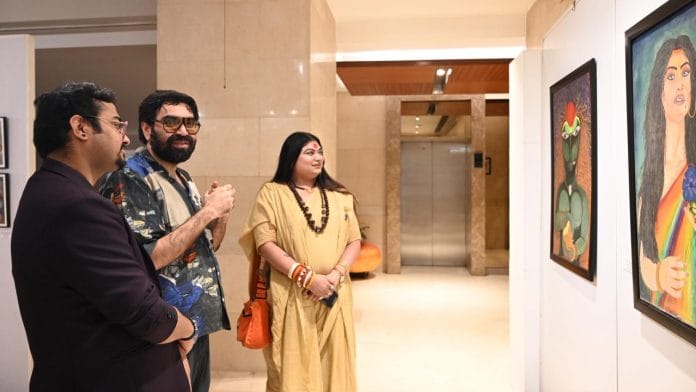

New Delhi: Across the walls of the Art Junction gallery at The Lalit, photographs of the night, paintings of everyday objects and self-portraits come together to explore queer identity. Instead of relying on familiar symbols of queerness, the artworks draw on personal experiences to tell stories of self-discovery, rejection and strength.
For photographer Renu Dhiman, whose work explores the stillness of the night, that search began years before she had the vocabulary to describe herself.
“When you begin to develop your own identity, you start thinking about yourself and how you want to grow. The night gives you that space. Everything becomes minimal–there is no extra sound, no extra light. That’s when you can connect with yourself,” said Dhiman.
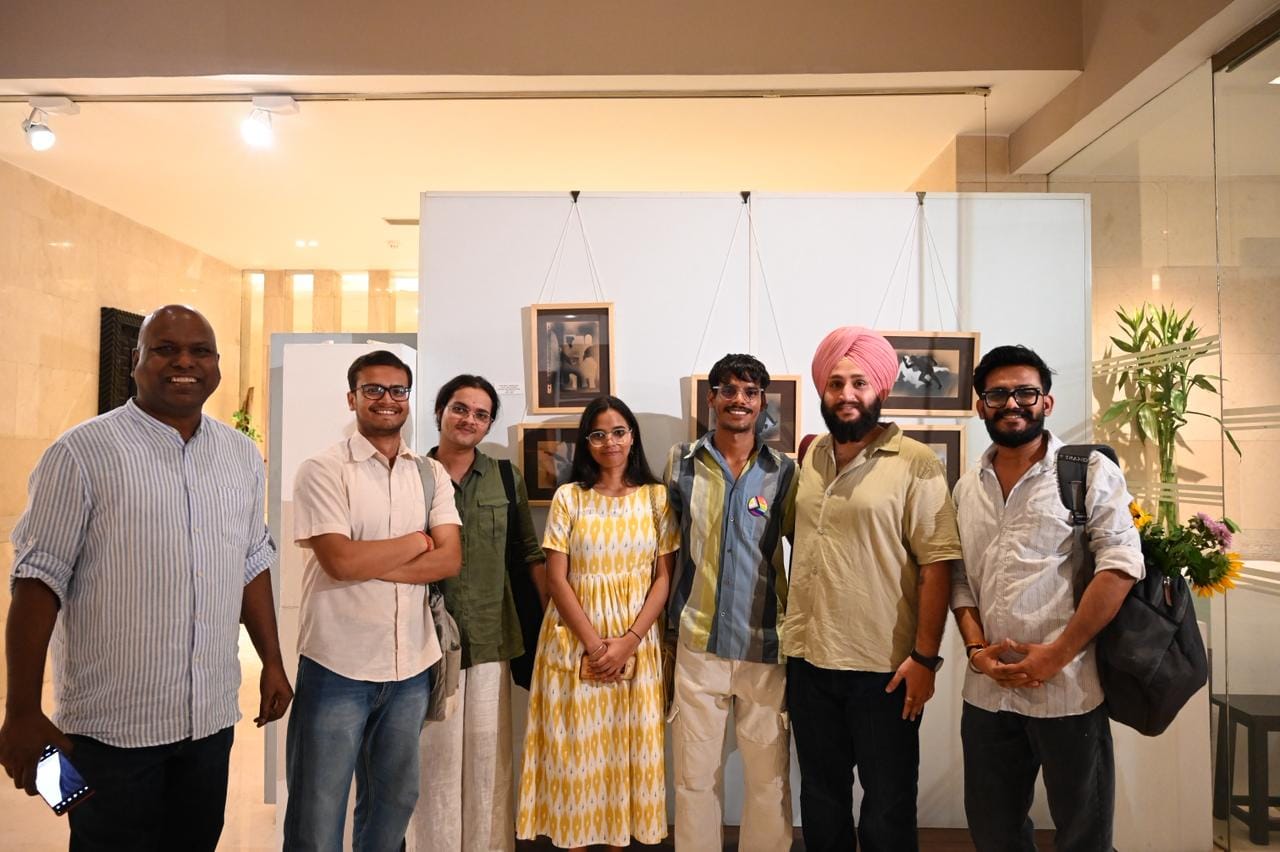
Unboxed 2.0: The Queer Art Exhibition, organised by the Keshav Suri Foundation, brings together queer artists whose work spans photography and painting. Yet the exhibition is not simply about representation. It is about reclaiming authority over lives too often explained by others.
The exhibition, which is free to enter and will remain on display until 15 July, has been curated by Naresh Kapuria, Praveen Mehto and Shashi Baghwar. It brings together more than 20 LGBTQIA+ artists from across the country.
“We are very talented people. This platform is to show society through our artworks that we also have art,” said Vaishnavi Jagdamba Nandakiri, one of the exhibiting artists and Mahamandaleshwar of the Kinnar Akhara.
Finding identity in silence
Most of Dhiman’s photographs were taken from the roof of her old home in Kaithal, Haryana. Yet the images carry the weight of years spent searching for herself.
Before becoming a professional photographer, she said she struggled to understand why she felt different.
“Around 2012, I was still trying to understand my identity. I knew something was different, but I didn’t yet have the language to describe it,” she said.
Growing up in a small town made that journey even more challenging. But after years of struggle, she found acceptance–for both her identity and her profession
The photographs were taken in 2012, and they trace the moon’s journey across the night sky, capturing its shifting light and changing moods. Dhiman explained that the wooden platform is a metaphorical space of illumination–a place where she confronts and understands herself, embraces every facet of her identity, and experiences the rare comfort of being fully seen and accepted.
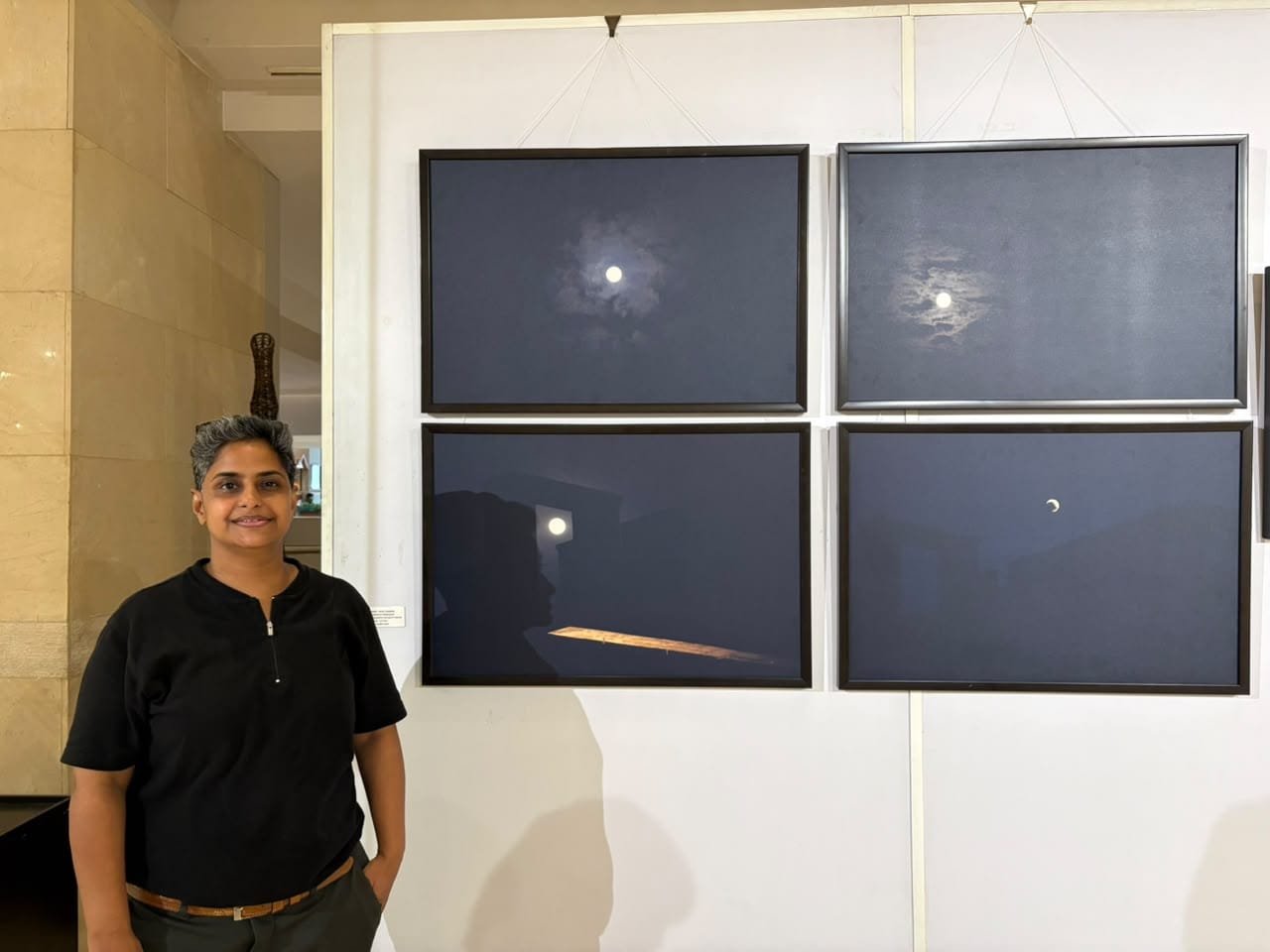
“It’s like a path to the moon. You have to shine,” she said.
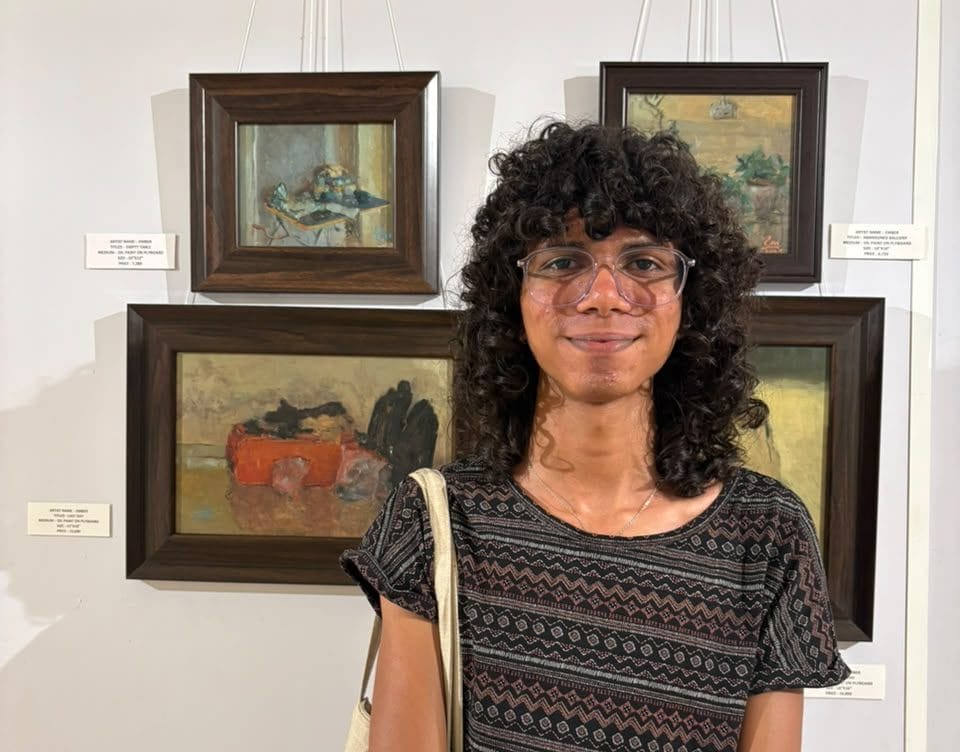
For another artist, Ember, everyday objects become repositories of memory–a cluttered table, an abandoned balcony, or a set of paintbrushes.
“Most of my body of work is about mundane life. It is about the stories that every object in our lives carries. It can also be interpreted as anti-consumerism—because everything we already have holds so many stories. We don’t need more; we just need to recognise the value in what is already around us,” she said.
One painting, ‘Empty Table’, draws a contrast between an object’s intended purpose and the histories it carries over time. She saw the neglected table covered with clutter and dust at a relative’s home in Mumbai. The sight made her reflect on how the table had lost its original purpose of creating, working, and imagining.
Turning joy into a performance
Nandakiri holds a Bachelor of Fine Arts degree, and this exhibition marked her first opportunity to showcase her two artworks publicly.
Her self-portrait, ‘Unmade Desire’, portrays a transgender woman whose deepest wishes and desires remain unrealised despite a lifetime spent searching for love and understanding.
In the painting, she presents herself with an unwavering, almost confrontational gaze. Draped in a rainbow-coloured sari—a symbol of queer pride and identity—she takes the space confidently. Her face looks strong yet thoughtful, while her long, untamed hair speaks of a wild, free spirit. The flowers in her hand add tenderness and symbolise hope, vulnerability, and the delicate nature of love.
“This painting is my story. It holds the ups and downs of my life, the betrayals I have faced, and the experiences that have shaped me. Yet we continue to wear colourful clothes, smile, and bring happiness to others,” she said.
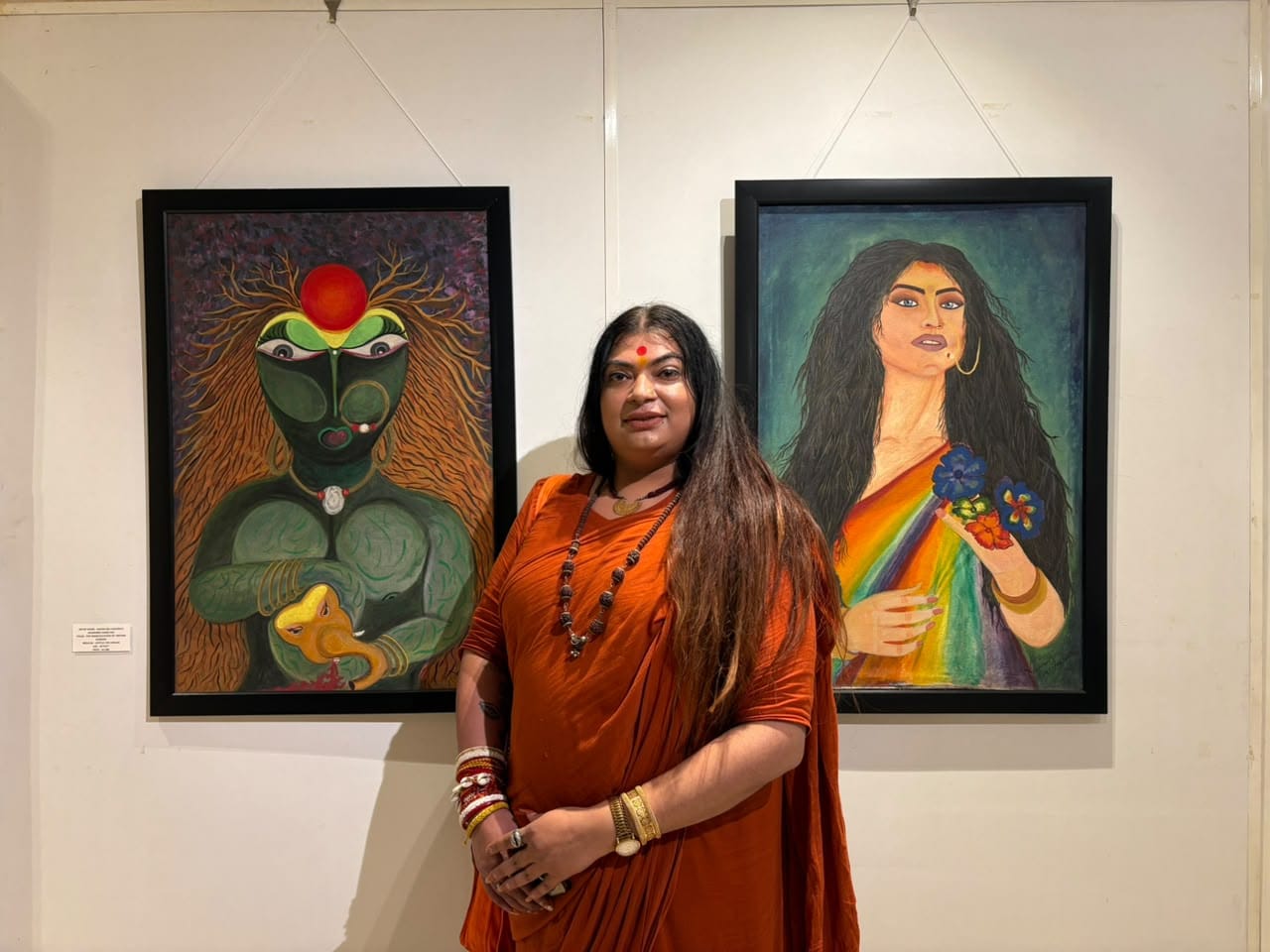
The contrast between vibrant colours and grief becomes central to her work. Society often assumes happiness because queer communities celebrate Pride publicly. But, she said, joy can itself become a performance.
“Whatever happens to us, we still have to be happy. If someone hurts or betrays me, I will not show them that I am breaking inside. I will show them that despite everything, I will live my life, grow, and do better. But the pain and desires we carry within–no one truly understands them,” she said.
Unboxed 2.0: The Queer Art Exhibition will be on display at The Lalit, New Delhi, until 15 July.
(Edited by Prashant Dixit)