



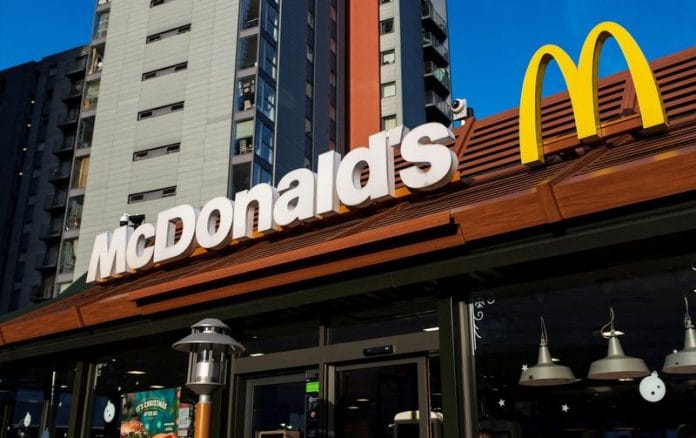
New Delhi: Earlier this year, McDonald’s chief executive Chris Kempczinski appeared in a promotional video tasting the chain’s new Big Arch burger. His reaction quickly became the subject of social media ridicule, prompting comments assuming he doesn’t like his own burgers. But the bigger problem for Kempczinski is whether Americans still think McDonald’s is worth paying for.
On 4 August, McDonald’s reported just 0.8 per cent growth in comparable US sales in the second quarter of 2026.
Its shares have fallen about 13 per cent this year. The weakness comes as the broader US quick-service restaurant industry struggles with falling traffic, with consumers becoming increasingly sensitive to prices.
Data from Placer.ai shows that visits to quick-service restaurants were down 1.3 per cent in the first seven months of 2026 from a year earlier.
The industry’s response has been remarkably consistent: most fast-food giants are now rolling out menus built around “value.”
But the more restaurants compete on value, the more complicated that word becomes.
Why Fast Food Lost Its Edge
For years, fast food’s basic proposition was simple: it was cheaper and more convenient than other restaurant options. That advantage has weakened after years of price increases.
Citing Gregory Francfort of Guggenheim Securities, The Economist reported that US fast-food chains have raised prices by roughly 15-20 percentage points more than grocery stores over the past decade.
That has hit lower-income consumers particularly hard. Many are eating at home more often, while supermarkets and convenience stores have expanded their ready-to-eat and ready-to-heat food ranges.
The discounting arms race
Restaurants have responded with discounts. McDonald’s introduced its $5 meal deal in 2024 and has since expanded its value offerings. But while discounts can attract customers, they can also squeeze already-thin margins.
As CNBC reported, restaurant executives have described the current environment as an unusually intense discounting period. Cava co-founder and CEO Brett Schulman called it “the most intense discount environment since the Great Recession.”
McDonald’s has also had to persuade its franchisees to participate. About 95 per cent of the company’s US restaurants are franchised, and it has supported operators by helping fund discounts and marketing. But that support is being scaled back, while new franchising standards will now assess whether operators’ prices are too high if they hurt traffic or customer satisfaction.
The strategy is increasingly about getting customers through the door cheaply and then persuading them to spend more.
Taco Bell, for example, has expanded its Luxe Cravings Box from a $7 (Supreme) option to $5 (Classic) and $9 (Discovery) versions. The objective is not simply to lower prices but to move customers towards higher-value purchases.
Technomic analyst Rich Shank told CNBC that if a chain cannot increase traffic, getting a customer to spend $9 instead of $7 can still lift sales.
This might explain why some rivals are doing better than McDonald’s. Taco Bell has reported a 7 percent rise in same-store sales in the second quarter, while McDonald’s US comparable sales grew only 0.8 percent.
Beyond the price war
The industry’s challenge, therefore, is no longer simply offering the cheapest meal.
Consumers increasingly want a combination of price, quality, convenience, and novelty. McDonald’s is responding by expanding its chicken menu, as demand for chicken grows and beef remains relatively expensive. It is also testing drinks beyond its longstanding Coca-Cola partnership.
Other chains are turning to fan-created menu items, collectibles, and social-media stunts to generate interest. These include KFC’s Supergirl Krypto-themed toy buckets and Burger King’s emoji-branded domino sets.
(Edited by Maryam Hassan)