


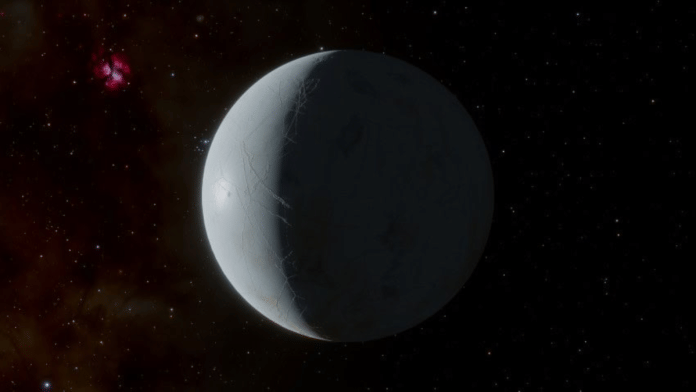
New Delhi: There could be another planet lurking in the far reaches of our Solar System, and it could be twice as massive as Earth. A new study suggests that the existence of this undiscovered planet far beyond Neptune could explain some of the most puzzling orbital patterns in the outer Solar System.
The study, published on 23 November in Monthly Notices of the Royal Astronomical Society, used computer simulations spanning 4.5 billion years to investigate how a hypothetical planet, nicknamed Planet X2, could influence the orbits of icy objects beyond Neptune.
Researchers led by Patryk Sofia Lykawka of Kindai University in Japan found that a planet approximately twice Earth’s mass, orbiting at an average distance of 350 to 500 astronomical units (AU) from the Sun, could reproduce several orbital patterns that existing models struggle to explain. For perspective, one AU is the average distance between Earth and the Sun, approximately 150 million kilometres.
Explaining unusual orbits beyond Neptune
Beyond Neptune lies the Kuiper Belt, a region containing icy remnants from the Solar System’s formation. While many of these objects follow relatively predictable orbits, astronomers have discovered others travelling along unusually elongated or highly inclined paths.
One example is Sedna, a distant object whose orbit takes it far beyond Neptune’s immediate gravitational influence.
To investigate these irregularities, researchers compared simulations involving smaller planets scattered during the Solar System’s early formation with those featuring a distant planet in a stable orbit. They found that smaller planets were generally ejected from the Solar System within a few million to tens of millions of years and failed to reproduce the observed distribution of distant objects.
However, simulations involving Planet X2, with approximately twice Earth’s mass, produced orbital patterns resembling those observed among detached objects, which remain relatively isolated from Neptune’s gravitational influence, and objects travelling at unusually steep inclinations.
“Our model reproduces several of the unusual orbital patterns,” Lykawka said in a statement issued by the Royal Astronomical Society. “although there are still differences between the model and observations that we need to investigate further,” he added.
In the preferred simulations, the hypothetical planet followed an elliptical orbit with a semi-major axis of 350 to 500 AU, coming no closer than approximately 200 AU to the Sun.
Is this Planet Nine?
The proposed planet differs from the better-known Planet Nine hypothesis, which suggests that a much more massive planet, approximately five to ten times Earth’s mass, could explain certain orbital patterns in the outer Solar System.
Although the Planet X2 simulations reproduced several observed features, the researchers found discrepancies in the distribution of orbital sizes when comparing their models with data from the Dark Energy Survey. The findings lend weight to the possibility of an undiscovered planet but do not establish its existence.
The researchers hope that the Vera C. Rubin Observatory in Chile, which is conducting an extensive survey of the sky, will help test their predictions by discovering additional distant objects.
“The exciting thing is that we now have an opportunity to put this idea to the test,” co-author Jonti Horner said. “As the Rubin Observatory surveys the sky, we will find new clues that help us understand the distant reaches of the Solar System – and whether another planet is still waiting to be discovered.”