





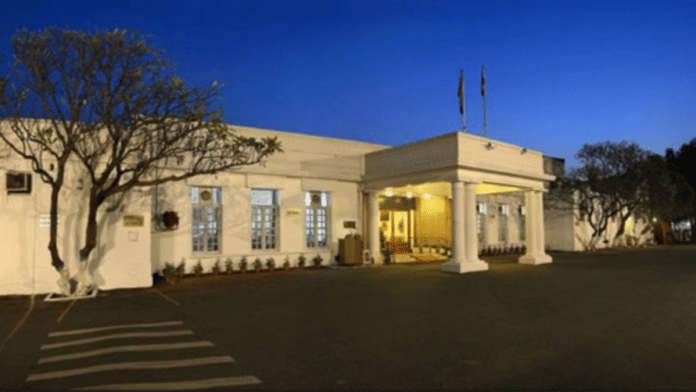


New Delhi: Fifty retired Armed Forces members of the Delhi Gymkhana Club recently wrote to Prime Minister Narendra Modi, asking him to intervene against the proposed closure of the club. The letter states that its loss would have profound human consequences for thousands of veterans and retired public servants who depend on the club as a social lifeline.
“We, the undersigned retired officers of the Armed Forces of India, write to you with the deepest respect and utmost faith in your leadership,” the letter, which was given on 8 July, reads. “Over the decades since Independence, it (the club) has evolved into an Indian institution that has welcomed generations of soldiers, civil servants, diplomats, judges, academics, sportspersons and distinguished citizens.”
The appeal comes as the club faces an uncertain future after the Centre, in a 22 May notice, terminated its perpetual lease and asked it to hand over the 27.3-acre premises by 5 June. The Centre subsequently issued a fresh eviction notice under the Public Premises Act on 29 June.
“For senior defence and civilian officers in their 70s and 80s, this club is like a second home,” said Nalin Kohli, one of the non-government members of the club.
He said the public image of the Gymkhana as an elitist institution misses the retired officers who make up the majority of its membership. Many spent their careers away from Delhi, at border postings and non-family stations, and had little opportunity to use the club while serving. Retirement changed that.
“Now that they have retired, they are senior citizens and pensioners. This is a very important social place for them because now they have time to go to the club. Many of them have lost their life partners; for them it is all the more important and therapeutic that they go and meet their friends. There are more than 2000 defence officers; The majority of them are veterans,” said Kohli.
Also read: Barnes & Noble scraps one-size-fits-all approach, adopts the ‘You’ve Got Mail’ strategy
‘Reconsider the proposed closure’
During the service years of the Armed Forces, frequent transfers and postings meant that even those who held membership rarely had time to use the club. In retirement, when professional life ends, the club becomes part of a new routine.
“Now that the Defence officers have retired, they have the time to do so. Their children have grown up, and they are often living on their own as couples. And, as I said, unfortunately, in some cases, they have lost a spouse,” said Kohli.
The same, he said, applied to retired civil servants. He said that when government officers retire, many of them live in smaller homes in Gurgaon, Noida and elsewhere. Most of them cannot even afford a house in Delhi. There are so many former government secretaries among them.
Kohli also said that the Gymkhana’s long waiting lists need to be understood as part of a larger problem in Delhi. Demand for established social institutions has grown faster than their capacity. There is a long queue for good schools, colleges, and clubs.
The retired officers’ letter to Modi makes an appeal that acknowledges the government’s authority to reclaim public land for genuine public purposes or national security. It recognises that the matter is before the Delhi High Court, but it asks that the welfare of veterans and retired public servants be considered before an irreversible decision is taken.
“We therefore earnestly request your kind intervention to direct the concerned Ministry to reconsider the proposed closure, explore constructive alternatives, and preserve this institution in a manner that balances public interest with the welfare of those who have served the Republic with honour and distinction,” reads the letter.
(Edited by Saptak Datta)
I completely disagree with such views that never justify such huge land occupation by a certain group of people for their own convenience.
If the land is not belongs to any group of people,
Such eviction is necessary .
Intervention of PM for this type of peculiar request is not appropriate and may not be considered.
No wonder it’s published in The Print