





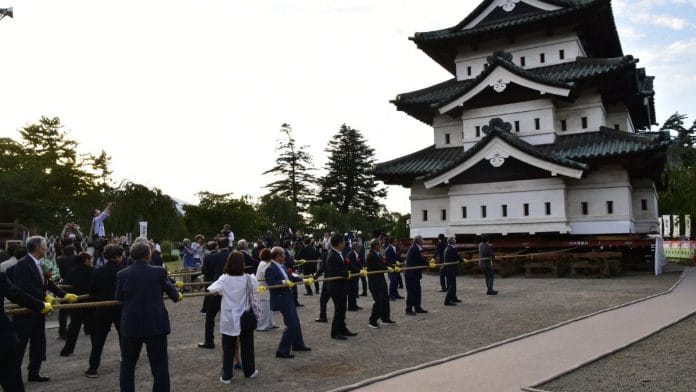

New Delhi: Around 1,800 volunteers gathered in Aomori Prefecture, Japan, to manually pull a 360-tonne keep, a fortified tower within a castle, of Hirosaki Castle over two metres back toward its original stone base.
“We had about 8,000 applications for the 1,800 slots over the last two days, roughly four times oversubscribed, so not everyone could participate,” Kensuke Hayasaka, head of the parks and green spaces division at Hirosaki City, told the Guardian.
Apart from Japanese citizens, many participants joined from overseas, including several from south-east Asia, Europe, and North America.
“The opening ceremony of the Hirosaki Castle Main Keep Relocation Event “Hipparé! Kepparé! Hirosaki Castle,” which will be held until August 28, took place. Her Imperial Highness Princess Kazuko of Hitachi attended the ceremony, and Mr. Shin Tsugaru, the 15th head of the Tsugaru clan, also graced the event, where the initial pull of the main keep was carried out,” the mayor of Hirosaki posted on X.
The volunteers worked in rotating teams of 80 people, heaving on a 30-metre rope tied to the keep of Hirosaki Castle, the Guardian reported. On Saturday, they towed the building set on rails by 1.13m, while on Sunday it was moved by another 1.09m.
“Because the keep is a nationally designated important cultural property, we didn’t take it apart,” Hayasaka said. “We’re using hikiya, a building-relocation method that has existed in Japan since ancient times.”
Hikiya is a process where buildings are put on rollers and moved, instead of being dismantled and rebuilt.
Also read: Yahoo wants to woo Gen Z with AI now. It doesn’t want to be ‘uncool’ anymore
A 200-year-old structure
In 2015, the first citizen-driven hikiya was carried out. It was the first-time when the technique was used to move a castle in a century.
Preservation work had been going on at the castle since then. After the walls were completed in December 2024, with all 2,185 stones restacked at their original positions, the city officials asked for the citizens’ help for a second round of hikiya, to pull the keep back into place.
Pulling the keep by hand will continue until the end of August, with about 4,100 people scheduled to move it a total of 5m. The citizen-led hikiya is a symbolic effort toward building a community. The remaining 73m shift will be carried out using machinery by the end of the year.
The keep at the Castle is one of 12 such structures in Japan, and the only one in the north-eastern Tohoku region. The castle was completed in 1611 and was the seat of the Tsugaru clan. However, the original keep burned down after a lightning strike ignited a gunpowder store in 1627.
The current structure was rebuilt in 1810, and the castle is now the centrepiece of a park that draws about 2 million visitors each year during cherry-blossom season.
However, tourists will not be able to access it because of the renovation.
“As things stand, we expect it to reopen to visitors in 2033,” Hayasaka noted.
(Edited by Saptak Datta)