



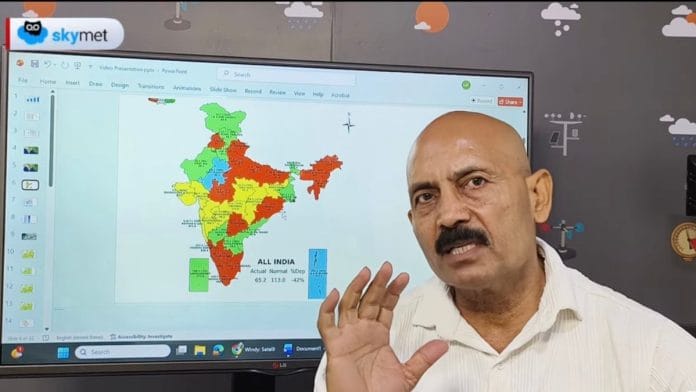
New Delhi: Every day at 6:30 PM, Mahesh Palawat uploads a video about the day’s weather on YouTube and generates anywhere between 1,00,000 and 2,00,000 views. The daily weather update videos uploaded by the India Meteorological Department rarely clock a thousand views.
Palawat is the vice president of Meteorology and Climate Change at Skymet Weather, India’s largest private weather forecasting company. His weather update videos, featuring visual graphics running on a TV screen in the background, shot him to fame during the Covid-19 pandemic. Since then, Skymet has amassed a following of 1.72 million subscribers on its YouTube channel, compared to IMD’s 97,800.
From El Niño explanations to monsoon updates from across the country, Skymet’s videos and social media feeds cover it all. But it wasn’t the only channel that Indians waiting for the southwest monsoon turned to; several other forecasters received massive traction from viewers looking for weather udpates.
“My take on monsoon onset dates for Delhi NCR is 4 – 8 July, much delayed compared to normal onset date,” says a post on X by Weatherman Navdeep Dahiya, a young weather blogger with a dedicated social media following.
India’s meteorology sector has grown beyond the IMD, with several private companies, institutions, research centres, and even individual forecasters now looking to the skies. While some, like Skymet Weather, have a well-established database and their own automatic weather stations (AWS) across the country, others, such as the Centre for Climate Studies at IIT Bombay, use global weather models and statistical analysis for specialised forecasts.
Then there are individual ‘weathermen’ like Dahiya who collate data from the IMD and international websites like Windy.com and provide localised forecasts to their audiences. Other individual forecasters include Weatherman Shubham in North India, and YouTube channels such as Mumbai Rains, Chennai Rains, and Namma Karnataka Weather.
“Everyone is concerned about the weather – be it farmers, insurance companies, energy companies or even just residents planning their daily commute,” said Palawat. “This is why there is a demand for our data.”
How do they get their data?
Globally, the largest accumulators of weather data are government agencies like the IMD, the European Centre for Medium-Range Weather Forecasts (ECMWF), and the Global Forecasting System (GFS) in the US.
These agencies operate weather stations and rain gauges, send up weather balloons and satellites, and collect raw weather data. The IMD, for example, has a network of around 1200 AWS and also Doppler radar stations on the ground, in addition to space-based satellites. They measure the temperature, wind speed, humidity, cloud cover, and a host of other factors required to calculate weather changes.
These measures are then used as inputs for numerical weather models devised on supercomputers by each forecasting agency.
“A model is essentially like a set of complex equations devised by meteorologists, which can represent what is happening in the atmosphere based on current conditions,” explained Akshay Deoras, a scientist at the Department of Meteorology, University of Reading.
Each organisation has its own models designed for short-range, medium-range and long-range weather forecasts, with different input requirements and different resolution levels. Since the 1960s, when weather forecasting systems began to develop, data collection and models have only improved, leading to statistically better forecasts.
However, most private companies or forecasters do not collect their own raw data or create their own models, since it is both cumbersome and expensive. An automatic weather station costs anywhere between Rs 50,000 and Rs 10 lakh, and supercomputers are only available to a handful of organisations worldwide.
Also, the World Meteorological Organisation’s (WMO) policy says that countries should try to make as much of their core meteorological data open-access as possible, so accessing IMD, ECMWF and GFS data and models is much easier.
Some companies like Skymet operate their own network of around 6,000 AWS, and individual forecasters like Dahiya also have an AWS and a rain gauge. But for accurate forecasts, they too rely largely on existing data from international organisations and the IMD.
Most of the value addition provided by private players comes from analysing data, not collecting it.
Same weather, better packaged?
In the weeks before the southwest monsoon reached Mumbai on 23 June, private forecasters were in a frenzy to accurately determine the arrival date. On 8 June, the IMD announced that the monsoon had advanced into southern Maharashtra and would reach Mumbai in the next few days. However, soon enough, private forecasters began sharing their own theories.
“IMD has declared monsoon over South Maharashtra but I’m not fully convinced yet,” said the Mumbai Rains page on X. “The real test will be whether monsoon winds remain active ahead. Mumbai, Pune still far from monsoon onset due to existing dry air intrusion which will dominate in coming days,” it added.
Meanwhile, Athreya Shetty, another forecaster, said in May that Mumbai would see an early onset of monsoon by 1 June. However, he revised his forecast after 8 June, hedging his bets on late June like other forecasters.
The admins of pages like Mumbai Rains or Weatherman Navdeep Dahiya usually post clips from IMD’s press releases and weather visualisation apps like Windy and Meteologix, which offer seamless side-by-side analysis of existing models by ECMWF and GFS. For most individual forecasters, it becomes about studying different sources of data and localising them to their regions.
For example, if the IMD uploads daily rainfall deficiency percentages of each district in the country in a map, individual forecasters would localise this information to their regions — North India, South India, specific states, or even cities — and share it with their audience.
“Often, people won’t even need to go through the raw data from the IMD or any other source. There are enough applications doing that and providing ready-made analysis,” said Deoras. “So the game just becomes about communicating it well, and on time.”
However, Deoras argues that just analysing different sources of data is not equal to weather forecasting. Actual weather forecasting, he said, requires more than temperature and rainfall analytics. From surface winds, jet streams, relative humidity, moisture transport to atmospheric stability, professionally trained meteorologists take into account many factors.
Communicating vs forecasting
During the Mumbai monsoon debate, one of the only forecasters that accurately forecast the date of 23 June was the Centre for Climate Studies at IIT Bombay. The centre is working on an experimental forecasting model, which uses artificial intelligence and the base Global Forecasting System model of the US.
“The Global Forecast System (GFS) model struggles to forecast extreme rainfall in Mumbai, resulting in low hit rates and high false alarms in predictions,” said their recent study.
They used rainfall data from 36 stations in Mumbai, as well as GFS model variables such as humidity, air pressure, and precipitation, and trained an AI model to identify days of extreme rainfall in Mumbai.
“Globally, the skill of weather forecasting is just going up, and it is a combination of more data and better models,” said Dr Raghu Murtugudde, former professor at the IIT Bombay Centre for Climate Studies. “But the thing is, weather is always tricky. Even if you are right 80 per cent of the time, 20 per cent of the time you won’t be.”
While the Centre for Climate Studies conducts weather forecasting for academic purposes, Skymet Weather does so for commercial reasons.
The company, founded in 2003, is the oldest private weather forecasting company in India and counts among its clients farmers, insurance companies, oil and gas companies, retail and travel companies, and power companies.
Initially, Skymet relied largely on IMD data, but within a few years it started establishing its own AWS network and now has a 6,000-strong base across the country. Its daily general weather forecasts are available to the public online, but it also conducts specialised forecasts for its clients on an hourly basis and even transmits live weather data for worker safety.
“People want quick and reliable data, companies want specialised forecasts, and since there’s a market, there are people to provide it,” said Murtugudde. “But most people — be it companies or private forecasters — are not doing end-to-end forecasting; only IMD does that.”
(Edited by Prashant Dixit)