





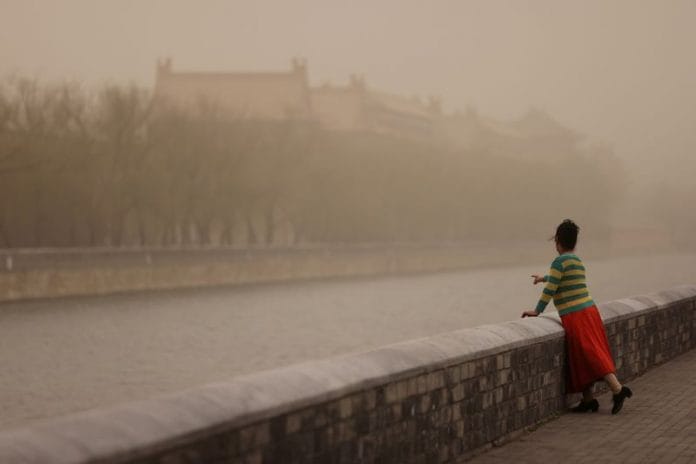


(Reuters) – Thick sandstorms will hit Beijing and several provinces through Wednesday, and Chinese forecasters have advised citizens of respiratory dangers and very low visibility while travelling, state media reported.
The capital Beijing has seen regular air pollution and an unseasonal number of sandstorms over the past few weeks.
Forecasters issued a blue weather alert warning for sandstorms. China has a four-tier, color-coded weather-warning system, with red representing the most severe warning and blue the least severe.
On Tuesday morning, smog and misty grey clouds could be seen enveloping Beijing and the city’s real-time air quality index was at a serious pollution level, according to the website of the Beijing Municipal Ecological and Environmental Monitoring Center.
The concentration of fine particulates in the air in Beijing is currently 46.2 times the World Health Organization’s annual air quality guideline value, according to IQAir, a website that issues air quality data and information.
A dozen provinces, including Shaanxi, Shanxi, Hebei, Shandong, Jiangsu, Anhui, Henan and Hubei, Inner Mongolia and metropolis Shanghai, will be affected by sandstorms and major dust until 8 a.m. (0000 GMT) Wednesday, the Central Meteorological Observatory said.
The sandstorms were again a hot dicussion topic on Weibo, China’s Twitter-like social media platform, racking up 2.178 million chats.
One user wrote, “What! When I wake up, why doesn’t anyone issue a holiday notice, do you still have to go to work in the dust today!”
Beijing has regular sandstorms in March and April as it is near the large Gobi desert.
A Chinese government official at the Ministry of Ecology and Environment recently said the number of sandstorms was now four times higher than in the 1960s, a consequence of rising temperatures and lower precipitation in the deserts of north China and neighbouring Mongolia.
(Reporting by Bernard Orr; Editing by Sonali Paul)
Disclaimer: This report is auto generated from the Reuters news service. ThePrint holds no responsibilty for its content.