





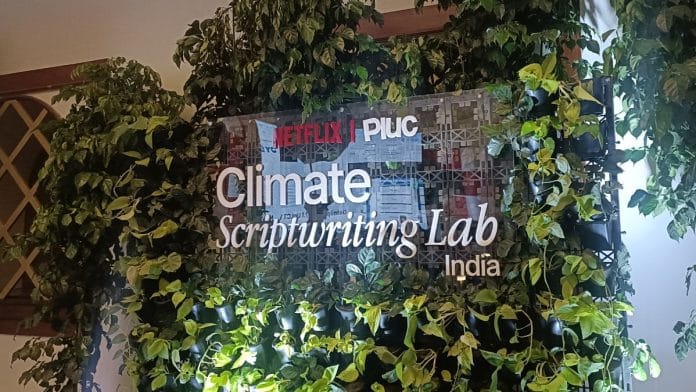



New Delhi: India’s first climate scriptwriting lab wants people to submit stories that aren’t about climate; instead, they want to explore one question: how do you integrate climate into narratives that aren’t about it?
Netflix India and PLUC on Thursday launched a new, first-of-its-kind Climate Scriptwriting Lab, which will engage 60 scriptwriters from across India, provide them with mentorship, and support them to bring to the fore stories about climate, sustainability, and related themes.
“India has no shortage of climate stories; they are playing out every day, in every part of the country. What we have lacked is a structured pathway for writers to bring those stories into mainstream cinema,” said Mahima Kaul, Director, Global Affairs, Netflix India.
The lab was launched on 9 April in New Delhi’s Ambassador Hotel, bringing together people from the environment, sustainability, and creative industries. The event was hosted by Tamseel Hussain, Founder and CEO of People Like Us Create (PLUC), a creative storytelling platform which is co-leading the lab.
“There are over 350,000 creators at PLUC – people from across the country, from small towns, people who repair solar panels during the day and write scripts at night,” said Hussain, during the launch event. “This lab is aimed at helping people tell their own climate stories to the world.”
Netflix and PLUC also introduced the illustrious panel of six mentors who will guide the writers through the Climate Scriptwriting Lab for eight months. The list includes Sumit Roy, the screenwriter of Homebound (2025) and Rocky aur Rani ki Prem Kahaani (2023), Akshat Verma, the writer of Delhi Belly (2011), and Saiwyn Quadras, the writer of Mary Kom (2014), Maidaan (2024), and Neerja (2016).
The screenwriting lab will select 60 writers from across the country, with a hybrid model of mentorship over eight months. There will be in-person sessions in four cities — Delhi, Mumbai, Hyderabad, and Guwahati — for the writers, who will face an eight-member jury at the end of their lab.
“A (climate scriptwriting lab) is a trailblazing venture, and at the same time, it is way overdue. Mass media and Bollywood do have this power to tell you a story with emotional depth without lecturing,” said Sumit Roy, one of the mentors, during the event. “What Taare Zameen Par did for dyslexia, or what Toilet Ek Prem Katha did for sanitation … we can do the same for climate themes too.”
Also read: Soil near Delhi-NCR battery recycling sites have high levels of lead, finds Toxics Link study
Why climate writing now?
While introducing the lab, Kaul spoke about how, when she would scroll through Netflix, she would often veer toward nature and environment documentaries. She said that Netflix’s own data showed that audiences are interested in looking at climate beyond documentaries, because climate “is now integrated in our daily lives.”
“This lab is our commitment to building that, finding voices from across India and giving them the tools, mentorship and industry connect to tell stories that millions will actually watch,” said Kaul.
For Hussain, this isn’t the first tryst with environmental storytelling. In 2017, he founded LetMeBreathe, India’s largest climate change and sustainability stories platform, and he had been toying around with the idea of the Climate Scriptwriters Lab for a while now. The partnership with Netflix came at the right time, with the right resources.
“Netflix runs a Fund for Creative Equity, which is meant to reach out to underrepresented writers and creators, to allow them to participate in labs like this and get the tools and mentorship to tell the story,” said Kaul. “The writers will get the support to develop their scripts across feature films and short fiction formats.”
During the panel discussion, Kaul, Hussain, Roy, and Verma spoke about the need to explore climate stories across different genres of films. From unexpected climate themes in Fukrey 3 (2023) and Delhi Belly to the importance of feature films as a medium in themselves, the panellists delved into popular culture and looked at climate change beyond its preconceived notions in audiences’ heads.
The evening began with Kaul, Hussain, and Suman Chandra, Director, Ministry of New and Renewable Energy (MNRE), officially opening the applications for the lab to the public. By the end of the night, they already had 21 scripts submitted by writers from around the country.
(Edited by Aamaan Alam Khan)