





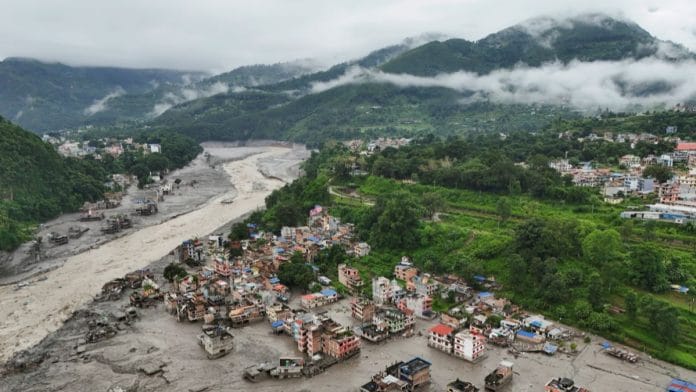

New Delhi: As Nepal’s Bhote Koshi River wreaked havoc along its path on Wednesday, Nepali authorities said an ice-rock avalanche may have triggered the disaster. But how do solid rock and ice transform into a several-meters-high slurry of mobile debris?
An ice-rock avalanche often begins as a solid mass, but it does not need to “melt” to start behaving like a fluid. As the mass accelerates downhill, rock fragments and ice collide and rub against each other. That mechanical energy converts into heat, which can partly melt the ice, producing water inside the moving mass. This water changes the avalanche’s mechanics, according to a Cambridge study that modelled rock-ice avalanches.
“The dynamics that distinguish these types of flows from other geophysical flows are the ice melting. This process is responsible for mass and momentum transfers between the solid and liquid components of the mixture and for the effects of lubrication and fluidisation that reduce the mixture strength,” states the study.
Water from nearby streams also gets incorporated into the mass, increasing its volume and making it more fluid. As water mixes into the moving earth, it acts as a lubricant. Water plays an important role here in reducing friction between the solid parts of the avalanche.
An avalanche is not just a melting block of ice and rock flowing down a valley. It is also consuming everything in its path. As it picks up loose sediment, rocks, soil, ice, and material from the valley floor, it only grows.
Also read: Nepal flash floods UPDATES: Death toll climbs to 150+, over 100 Indian pilgrims still unreachable
‘Erosion increases destructive power of landslide’
Research on landslide mobility shows that areas that have already experienced erosion can increase the volume of such an ice-rock avalanche. Erosion makes it easier for the moving mass to collect more soil and debris.
“Erosion can significantly increase the destructive power of a landslide by amplifying its volume, mobility and impact force,” wrote Shiva P Pudasaini and Michael Krautblatter.
At this point, the mass is not unlike liquid concrete. It is dense, can flow, can carry even enormous boulders, and can exert a huge force on the structures it encounters.
As the Bhote Koshi swells, India is also preparing for the effects of the flash floods. While the river does not directly enter India, it joins the Sun Kosi in Nepal, which eventually joins the larger Kosi River network before entering India in northern Bihar near Bhimnagar.
On Wednesday, devastating flash floods in Rasuwa district, Nepal, triggered by a glacial collapse, have left hundreds missing, including many foreign and Indian nationals.
(Edited by Saptak Datta)