





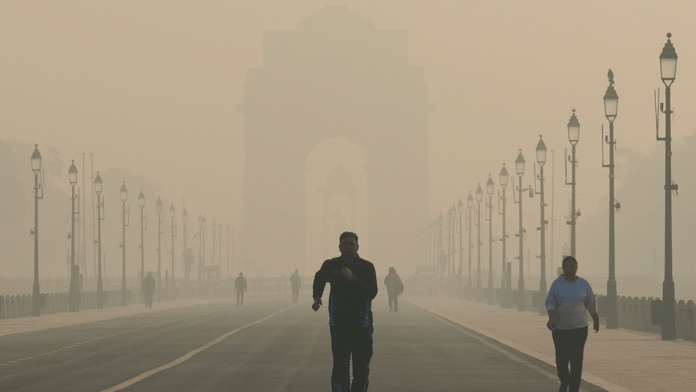



New Delhi: The Graded Response Action Plan for air pollution was imposed in Delhi a total of 17 times from January 2025 to January 2026, with Stage III restrictions lasting 53 days and Stage IV restrictions lasting 15 days. According to the Commission for Air Quality Management’s guidelines, GRAP measures should be planned as “advance action” and invoked based on AQI forecasts ahead of pollution-heavy days. However, ThePrint’s analysis of GRAP orders and a CEEW study from October 2025 showed that GRAP impositions largely relied on real-time AQI numbers, instead of on forecasts.
In the ten years since it was first conceptualised, GRAP has been reworked from being an emergency ‘reactive’ measure to a ‘pre-emptive’ measure, despite that it still seems to be failing in its ability to curb the rise in air pollution in the Delhi-NCR region. The reason, according to experts, lies in poor implementation and an increasing reliance on GRAP as the only pollution control measure.
“The logic of GRAP is immediate emissions reduction—when the environment’s carrying capacity is breached, and public health is endangered,” explained D Saha, former Head of Air Quality Management, Central Pollution Control Board (CPCB). “As soon as the carrying capacity improves, GRAP is lifted.”
GRAP came into being ten years ago, after the Great Smog of November 2016 in Delhi led to a spate of judicial orders to evolve the city’s response plans in case of air emergencies. It was initially supposed to be just that—a list of emergency reactive measures, to be implemented sparingly during pollution-heavy season.
However, according to experts, GRAP is now being treated as the sole panacea of Delhi’s air pollution crisis, despite not being designed to do so.
“We need to understand the real purpose of GRAP. It was meant to inform citizens and raise awareness during severe AQI levels, and take some actions to limit AQI rise,” said Anumita Roychaudhary, Executive Director, Research and Advocacy, Centre for Science and Environment. “But now, it is as if winter comes and we enact GRAP and then nothing else. It’s not enough.”
ThePrint has reached out to the CAQM Chairperson over the phone and by email for comments. This copy will be updated once he responds.
Also read: Have pollution policies helped Delhi AQI? What the decade’s data shows
GRAP measures this year
GRAP measures are divided into four stages depending on the severity of the AQI: Poor (201-300), Very Poor (301-400), Severe (401-500), Severe+ (450>). The measures increase with severity, from proper storage of construction materials to complete bans on construction and even vehicle entry into Delhi.
Between January 2025 and January 2026, all four stages of GRAP were invoked at least once to combat rising air pollution in Delhi. While Stage III GRAP restrictions were imposed for a total of 53 days in this period, Stage IV restrictions lasted for 15 days, with the longest streak for 11 days from 13 to 23 December.
2025 was also the year that the CAQM amended its GRAP schedule to increase the severity of actions. On 21 November 2025, the revised schedule moved restrictions from Stage IV to Stage III, from Stage III to Stage II, and so forth. This meant that policies such as allowing state government offices to work from home, which previously came under Stage IV, were now moved to Stage III.
Despite these measures, most GRAP invocations last year happened post facto. While the CAQM document states that Stage III measures should be invoked immediately when the AQI crosses 350, observable trends show that Stage III was often imposed when the AQI was much higher than 350, and sometimes even higher than 400. 13 out of 17 times, GRAP orders were passed after the AQI levels had already reached the threshold of that particular stage.
For example, on 3 January 2025, the AQI was recorded at 350 in the morning and crossed 371 at 4pm. The CAQM passed the order to impose GRAP III in the evening of 3 January, despite the Supreme Court’s order in 2024 to impose GRAP-III as a ‘precautionary measure’ when AQI is at 350. Similarly, on 10 November 2025, AQI was recorded at 362, which indicated conditions from GRAP-III imposition. However, it was only on 11 November, after AQI crossed 425, that the CAQM decided to impose GRAP-III norms. According to the 2024 Supreme Court order, however, AQI above 400 means that the CAQM should impose GRAP-IV restrictions as a precautionary measure.
According to an October 2025 report by CEEW, titled ‘How Well Can Delhi Predict Its Air Quality?’, the issue lies in Delhi’s Air Quality Early Warning System and Air Quality Decision Support System, which are designed to forecast AQI before it turns too severe. The report found that while the systems could predict ‘poor’ and ‘very poor’ AQI 80 per cent of the time, they lag behind in ‘severe and above’ categories.
“While GRAP intends to be pre-emptive, it often lags behind because forecasting isn’t always about emissions but also meteorology,” said Professor Mukesh Khare of IIT Delhi, who specialises in Air and Vehicular Pollution Modelling. “These factors are highly volatile. Not to mention, if the government pre-emptively imposes GRAP-IV rules and then the air clears up, there will be an outcry about economic loss. So, the action often becomes reactive because authorities try to avoid false positives.”
The current version is the 9th iteration of GRAP, which has undergone revisions almost every year since its inception. After being conceptualised in 2016, GRAP was first implemented in 2017 by the Environmental Pollution (Prevention and Control) Agency (EPCA), before it was disbanded and the CAQM came to take its place in 2021.
According to Sunita Narain, Director of CSE, between these iterations and revisions, somewhere along the way, GRAP lost its original purpose.
“When we took the idea of GRAP to the Supreme Court, it was supposed to be a temporary, emergency action plan,” she wrote on LinkedIn in December 2025. “But sadly, GRAP has become a proxy for action. This is not going to work. We need round-the-year action.”
Also read: Road-dependence, poor EV charging infra key hurdles to India’s net-zero transport push—NITI Aayog
What needs to change?
As a measure against pollution, GRAP can only do so much before destabilising the economy, and therein lies the problem.
“If the public wants, we could impose very stringent GRAP measures and almost shut down the city, like during Covid-19. Sure, that would lead to an improvement in AQI, but is it possible to live like that?” asked Roychaudhary. “No, the better, more viable way would be to enact long-term, systemic measures so that we don’t need harsher and harsher GRAP impositions.”
GRAP was never supposed to work alone or take on more than its share of the burden to alleviate Delhi’s air pollution. In 2016-17, when the Supreme Court had directed CPCB and the Union Government to formulate emergency measures like GRAP, it had also insisted on a long-term, comprehensive air pollution action plan for the city. This includes measures such as source apportionment and tackling everything from vehicles to fuel to construction to biomass burning.
“The action plan was supposed to be the pre-emptive long-term measure, while GRAP was supposed to be the short-term reactive measure,” said Roychaudhary. “But while we have steadily imposed GRAP, the scale and speed at which we are enforcing the action plan is too slow.”
Without long-term measures that work round-the-clock, GRAP seems a little more than firefighting, said Roychaudhary. Another major issue with GRAP, according to Mukesh Khare, is the lag in implementation.
“While the GRAP policy is centralised, its implementation is fragmented. Some measures like enforcing bans on construction might be easier to manage than, say, paving of roads, polluting vehicles, or short-term biomass burning,” said Khare. “Also, GRAP might be enacted by CAQM, but it has over 20 enforcing agencies, from the traffic police to municipalities, and it becomes difficult to coordinate.”
In its nine different iterations across the decade, GRAP has seen a lot of changes in its form and structure. However, this also meant that there are very few government-sanctioned studies and reports that analyse the real impact of GRAP measures on AQI improvement.
This is a need that CAQM itself acknowledged in its review of the actions by State Pollution Control Boards and Delhi Pollution Control Committee on 19 January 2026.
“The review of actions taken during GRAP Stage-III and Stage-IV reveals serious deficiencies and wide gaps in implementation, with shortfalls ranging from 7% to 99.6% across key mandated actions,” read the review document. “CAQM noted that such recurring gaps and failure in implementation under GRAP seriously compromise the collective efforts towards abatement of air pollution.”
(Edited by Theres Sudeep)
By the time Pollution … starting all the way from Kanyakumari… reaches NCR… it is already too late for NCR Residents. Al the vehicular and other pollutants generated in NCR just make it worse….
The ONLY SOLUTION is for Modi and his “army of Lutyens Babu’s” to Plan a ZERO POLLUTION BHARAT…. and then Implemment it… ASAP…
Just FYI… Pollution in India, today, causes 2.5 Million Premature Deaths annually and 35Million DALY of Suffering… much higher than COVID… with 2/3rd from Air Pollution….but Modi & his army… want to fight Climate Change… with no real victims today…
YOU…. FIGURE OUT THE NEEDS OF THE PEOPLE… and then DEMAND ACTION & NOT JUST WORDS …. WORDS …. AND WORDS… !!!