



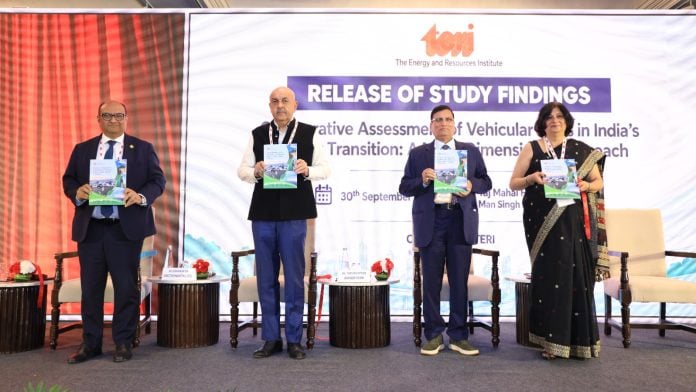
New Delhi: Compressed Natural Gas currently has the lowest environmental impact in most vehicle categories in India, outperforming even electricity, finds a new study by The Energy and Resources Institute.
Titled the ‘Comparative Assessment of Vehicular Fuels in India’s Energy Transition: A Multi-Dimensional Approach’, the study was formally launched at the Taj Mahal Hotel, Delhi, along with the Petroleum and Natural Gas Regulatory Board (PNGRB).
It is one of the first comprehensive analyses of five fuel types—petrol, diesel, CNG, LNG, and electricity—across six vehicle types and 10 regions. To understand which fuel type can help advance India’s energy transition, the researchers looked at economic competitiveness, technological superiority, infrastructure readiness, environmental burden, and the geopolitical assessment of each vehicle type.
“One main finding of this study is that India’s ideal fuel mix is segmented for each vehicle type and scenario, rather than one fuel for all use cases,” said Ritu Mathur, Senior Fellow and Director, TERI, at the press release on 30 September. “Even with EV incentives, CNG is still economically competitive, and environmentally friendly too.”
While the study did not result in a single fuel recommendation for India’s energy transition, its findings indicate that across vehicle types and most social, economic, and environmental indicators, CNG is a clear winner compared to other fuels.
Also read: From Bible study to prayer, Americans are asking AI questions about faith and spirituality
Life-cycle assessment
In two-wheelers and three-wheelers in urban regions, EVs are the preferred option because they’re affordable, have high utilisation, and also have some charging infrastructure in place already. However, for cars, taxis, buses, and goods vehicles, CNG is the most favourable option—considering cost, overall performance, affordability, and environmental concerns.
“In terms of greenhouse gas emissions, CNG is actually better than EVs, given India’s current electricity mix,” said Mathur. “Until we figure out a way to decarbonise the electricity sector, we can’t say that EVs are environmentally the best option currently.”
The study does not just look at tailpipe emissions for the environmental assessment of each fuel; it performs an entire life-cycle assessment (LCA), also accounting for elements such as air pollution and waste generation. While EVs outperform other vehicles in terms of pollution control, their LCA includes coal-dependent electricity generation and energy-heavy battery manufacturing.
On the other hand, CNG currently has the lowest environmental burden considering life-cycle emissions. New schemes such as GOBARdhan would increase compressed biogas production and blend it with CNG, making it even cleaner, said the study.
The paper explained that while current infrastructure and technological maturity benefit petrol and diesel, economic benefits favour EVs in the two-wheeler and three-wheeler market. However, an overall, balanced option is provided by CNG since it has a low life-cycle cost in most fleets, has lower emissions than petrol and diesel, and also has strong infrastructure present in cities like Delhi.
The geopolitical realm also favours CNG since it reduces dependence on imported petroleum and international price conditions, though it is impacted by natural gas supply chain issues.
“The proposed policy approach therefore is not to replace one universal technology with another, but a sequenced transition,” said the study. “Infrastructure, investment, and policy support should evolve with changing fleets,” it added.
(Edited by Prasanna Bachchhav)