



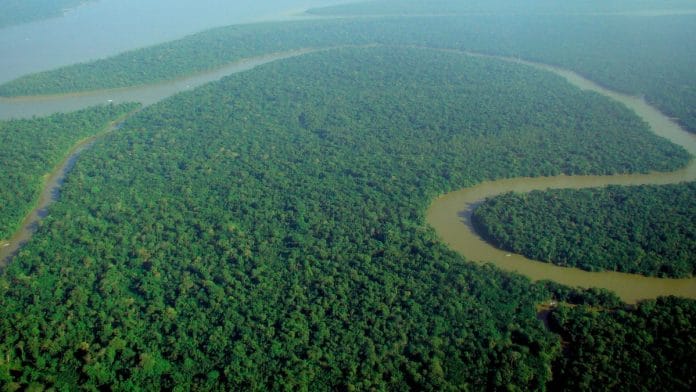
New Delhi: A new study published in the journal Nature on 21 October found that human activity and atmospheric changes are turning the Amazon rainforest into a carbon emitter, rather than a carbon sink.
The study found that human clearing of the forest land in the Amazon alone leads to 430 million tonnes of carbon dioxide released each year, equal to the emissions from major global drought events.
The study, conducted by US and Brazilian researchers, used 15 years of atmospheric carbon dioxide data from the Amazon basin to understand the net carbon balance of the forest — how much carbon it emits every year through fires, logging, and droughts, and how much carbon it absorbs through its existing trees.
They found that currently, the Amazon rainforest, the world’s largest tropical rainforest, is leaking more carbon into the atmosphere than it is absorbing. The net carbon balance of the forest is +340 million tonnes of carbon dioxide each year, meaning it is contributing that much more CO2 to the atmosphere.
One of the main reasons for this is vast, devastating forest fires in the region, which alone release 400 million tonnes of CO2 every year. Meanwhile, the surviving trees in the forest are unable to absorb all the emissions from the fires, leading to an imbalance of carbon dioxide in the world.
CO2 emissions highest during El-Nino years
The researchers drew their CO2 data by directly flying planes over different parts of the rainforest and measuring air samples from different altitudes. They measured carbon dioxide and carbon monoxide, with high CO2 and CO levels indicating fire and smoke together. They then compared the air coming in from the Atlantic Ocean against the air leaving the forest to assess whether the Amazon as a whole had cleaned the air or added extra carbon to it.
The authors of the study grouped the 15 years between 2011 and 2024 into three distinct time periods to show how atmospheric changes and human activity led to an increase in the Amazon’s emissions.
Years like 2011-2014 and 2017 and 2018 had higher precipitation, as well as lower human activity, such as deforestation. The emissions during this period were closest to balanced. Between 2019 and 2022, emissions increased sharply because of mild climate stress and elevated land clearing, degradation, and fire driven by weakened environmental governance.
However, the highest emissions were observed during El Niño years such as 2010, 2015-16, and 2023-24, due to increased climate stress that led to droughts and massive, uncontrolled wildfires.
Even during climate-stressed years, though, the authors studied how wildfires weren’t always caused naturally. In fact, only 1.6% of wildfires in 2023 and 2024 were caused by lightning, while 98% were deliberately lit by humans for pasture management or land clearing, and then turned into uncontrolled fires.
This shows that even though global climate events set the stage for the Amazon rainforest to turn into a dry, drought-stricken region, human activities contributed to the actual emissions.
(Edited by Aakriti Handa)