


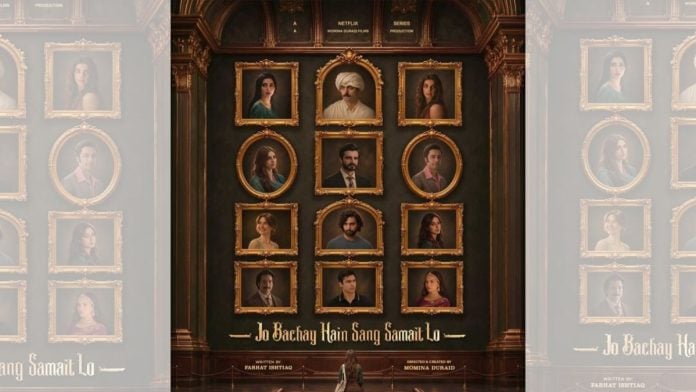
New Delhi: The trailer for Netflix’s first Pakistani original series, Jo Bachay Hain Sang Samait Lo, has generated excitement over its ensemble cast and international release.
The trailer, released on 24 November, introduces six interconnected love stories spanning three generations.
The series also stars Fawad Khan as Mehmood Akhtar, Samina Mumtaz as Rahat, and Hania Aamir as Umme Mariyam, aka Sam. Its trailer was released on Tuesday and has sparked conversations in Pakistan as well as India.
In India, the All India Cine Workers Association has written to Prime Minister Narendra Modi, demanding that the series be barred from release and calling for a permanent ban on Pakistani entertainment content on Indian screens.
Reacting to the AICWA’s demand, Pakistani media outlet Brandsynario pointed out that Pakistani dramas continue to attract Indian audiences.
“Dar-e-Nijaat currently generating considerable attention across the border. It remains to be seen whether the demand will affect the Indian release of Jo Bachay Hain Sang Samait Lo,” the article read.
A star-studded cast
At the centre of one of the storylines is Sikandar Sheheryar, played by Ahad Raza Mir, a Pakistani lawyer based in Rome who studied at Harvard and struggles with insomnia and nightmares following a traumatic experience.
He meets Liza, played by Iqra Aziz, an artist with a complicated family history. Their relationship unfolds alongside the stories of other characters dealing with love, heartbreak, and family conflicts.
Based on Farhat Ishtiaq’s Urdu novel of the same name, the story was first serialised in Khawateen Digest in 2009 before being published as a book in 2013. Ishtiaq has also written the screen adaptation. The series is directed and produced by Momina Duraid, in collaboration with Hum TV.
A Milestone for the industry
The trailer has been received as a significant moment for Pakistan’s entertainment industry, with local outlets highlighting the production’s scale, cast and potential to take Pakistani storytelling to a global audience.
“There is also the excitement of watching actors take on characters that readers have already imagined in their own ways. With such a beloved literary work at its centre, expectations are naturally going to be high, particularly from those who have spent years attached to its characters,” Pakistan-based outlet, Fuschia Magazine, wrote.
Brandsynario also described the series as a major moment for Pakistan’s entertainment industry. However, it expressed concern about the show’s six interconnected love stories and the number of characters and subplots.
“Although the trailer is highly dramatic, it lacks both dialogue and context. Hopefully, the show will present a more emotionally engaging offering than this,” the outlet wrote.
Also read: Netflix’s first Pakistani series faces India hurdle. AICWA writes to Modi for permanent ban
Pakistani fans react
Pakistani fans on X celebrated the ensemble cast, particularly the return of familiar actor pairings.
“A massive win for Pakistani stars who have already proved their acting prowess time and again. And those OG pairings are back Fawad & Sanam, Maya & Hamza. Pure Nostalgia!!!” one user wrote.
Another commented, “Sanam and Fawad i low key missed them too after fahira.”
Some viewers have also been discussing the central romance and the adaptation’s potential.
“Since I saw people talking about the storyline here’s my two cents on one thing that I absolutely love & one thing that I absolutely hate about ‘Jo Bache Hain Sang Samait Lo’. What I love: Sikandar & Liza’s individual healing journeys and the constancy of their love. Yes I love them,” one user wrote.
Another user connected the series’ international release to the commercial potential of Pakistani entertainment, writing, “Exactly, and we can only do that if out 1st product is profitable for them. Romance is a very profitable genre across the globe. Combine it with the nuances our industry plays with and our music. We have a solid shot at this with Jo Bachay Hain Sang Samait Lo.”
The series is scheduled to premiere on Netflix on 4 December.
(Edited by Maryam Hassan)