



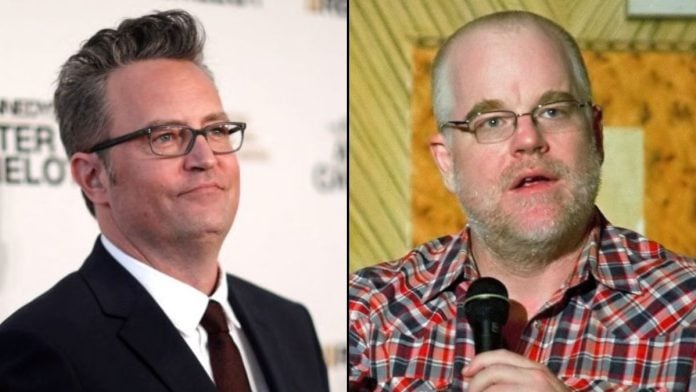
New Delhi: Netflix’s The One About Matthew Perry, a three-part documentary released on 27 October, revisits the actor’s decades-long struggle with addiction, repeated attempts at recovery and his death in 2023. Through interviews with his sister, close friends and former partners, the series explores the man behind Chandler Bing, one of the main characters of the cultural phenomenon sitcom FRIENDS, and the toll his battle with substance abuse took on his life.
Perry was 54 when he died from the acute effects of ketamine. His death was ruled an accident. While law enforcement later launched a criminal investigation that led to charges against five individuals for illegally distributing the ketamine to him, the medical classification of the physical event remains an accidental drug-and-drowning incident.
The documentary also revisits his efforts to help others struggling with addiction, a cause he championed publicly.
But Perry’s story is not an isolated one in Hollywood. Over the decades, several actors have paid the price due to drug and medication overdoses.
Heath Ledger
Heath Ledger’s legendary performance as the Joker in Christopher Nolan’s 2008 masterpiece of the Batman universe, The Dark Knight, remains one of the most revered comic book film portrayals in cinema history and the DC universe. His portrayal of Batman’s nemesis earned him a posthumous Academy Award and cemented his reputation as an actor capable of extraordinary reinvention.
Ledger died on 22 January 2008 at the age of just 28 in his New York apartment. The medical examiner determined that his death resulted from the accidental combination of six prescription medications, including painkillers, anti-anxiety drugs and sleeping aids.
He had reportedly been experiencing difficulties with sleep. His demise led to intense speculation about whether the psychological demands of playing the Joker had affected his mental health.
In 2017, the documentary I Am Heath Ledger, directed by Adrian Buitenhuis and Derik Murray, gave an intimate look at the actor’s life through personal footage he had filmed himself, along with interviews with friends, family and people from the industry.
River Phoenix
River Phoenix was just 23 when he died on 31 October 1993, cutting short a career that had already established him as one of Hollywood’s most promising young actors.
Phoenix earned an Academy Award nomination for Running on Empty and appeared in several films, including Stand by Me, My Own Private Idaho and Sneakers. He was an outspoken animal-rights and environmental activist.
His death came as a shocker to Hollywood. Phoenix collapsed outside the Viper Room, a nightclub on Los Angeles’ Sunset Strip, where he had been spending the night with friends and family. He died from an accidental drug overdose involving cocaine and morphine, with a toxicology report also listing other substances.
Phoenix’s story has been explored in documentaries, including an episode of The Final 24, a series examining the final hours of celebrities.
Also read: ‘I’ll always and forever be an actor’, Patrick Stewart in his last interview
Philip Seymour Hoffman
Philip Seymour Hoffman was one of the finest actors of his generation. From Capote, for which he won the Academy Award for Best Actor, to The Master, Doubt and The Hunger Games franchise, Hoffman moved between independent cinema and mainstream productions effortlessly.
Hoffman had spoken publicly about struggling with substance use earlier in his life. After maintaining sobriety for many years, he reportedly relapsed in 2013. On 2 February 2014, he was found dead in his New York apartment. He was 46 years old.
The medical examiner ruled his death an accident caused by a mixed-drug intoxication involving heroin, cocaine, benzodiazepines and amphetamines.
Hoffman’s life and career have been revisited in biographical programmes and documentaries about his work, like Autopsy: The Last Hours of Philip Seymour Hoffman and Too Young To Die: Philip Seymour Hoffman.
His legacy remains rooted in his body of work, his contributions to theatre and cinema.
Cory Monteith
Cory Monteith became a household name because of Glee, in which he played Finn Hudson, the high-school football player who discovers a passion for singing.
Monteith had spoken openly about his history of substance use, revealing that he began experimenting with drugs as a teenager. He had entered rehabilitation at a young age, and he later spoke about the difficulties of maintaining recovery.
In March 2013, he voluntarily entered a treatment facility. Four months later, on 13 July, Monteith, who was 31, was found dead in a Vancouver hotel room.
The British Columbia Coroners Service determined that he died from mixed-drug toxicity involving intravenous heroin and alcohol. His death was ruled accidental.
Monteith’s life and death have been covered in television documentaries and retrospective programmes, including The Final 24.
Chris Farley
As a cast member of Saturday Night Live in the 1990s, Chris Farley became popular for his physical humour and characters such as Matt Foley. Then, films like Tommy Boy, Black Sheep and Beverly Hills Ninja helped cement him as a Hollywood comedy star.
But not many knew he was battling drug and alcohol dependence. Farley reportedly entered rehab multiple times as he struggled to get his substance use under control. His career continued to flourish, but his personal struggles remained.
On 18 December 1997, Farley was found dead in his Chicago apartment. The medical examiner revealed that the 33-year-old had died from an accidental overdose involving cocaine and morphine, with advanced heart disease contributing to his death.
His death drew comparisons with that of his comedy idol, John Belushi, who had also died from a drug overdose at the age of 33.
The 2015 documentary I Am Chris Farley, directed by Brent Hodge and Derik Murray, revisited his life through interviews with family, friends and people from the industry, including David Spade, Adam Sandler and Mike Myers.
Charlie Sheen
Charlie Sheen went from being one of Hollywood’s most sought-after actors to a tabloid controversy as his struggles with substance abuse came out in public.
Known for films such as Platoon and Wall Street, and later the sitcom Two and a Half Men, Sheen became the face of a very public spiral in 2011, when his feud with the show’s creator, Chuck Lorre, and his infamous “tiger blood” declarations made headlines worldwide.
Sheen has spoken about his cocaine and crack use, multiple stints in rehabilitation and an overdose in the late 1990s. He said he stopped drinking in 2017 and has since worked toward rebuilding relationships damaged during his addiction.
In 2025, Sheen revisited his past in Netflix’s two-part documentary, aka Charlie Sheen, directed by Andrew Renzi.
(Edited by Saptak Datta)