





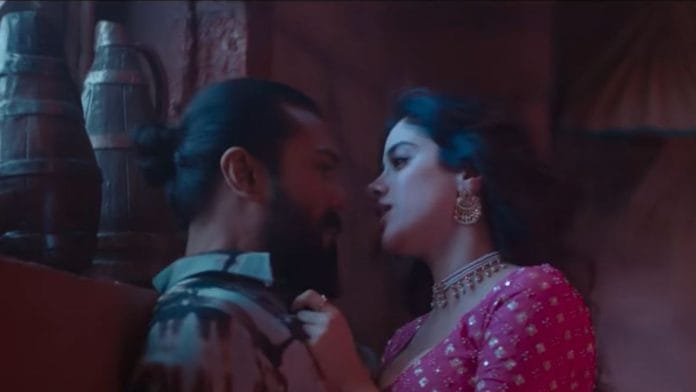


New Delhi: Since Peddi released in theatres on 4 June, criticism of Janhvi Kapoor’s portrayal in the Telugu film has grown into a wider debate on how women are filmed in commercial cinema.
The Ram Charan-starrer, directed by Buchi Babu Sana, has been called out for the way Kapoor’s character, Achiyyamma, is written and shot. Viewers have objected to close-ups, camera angles, dialogues, and romantic scenes that they say reduce her to an object of desire.
On Instagram, users also questioned the way Kapoor’s role had been conceived. One wrote, “What’s wrong with the mainstream Indian movies nowadays? Are we not going to see any female roles which make sense any time soon?”
While another asked, in a reel, why only Kapoor had been styled that way: “I don’t understand the thought process of showing her this way. Even if it’s some sort of fashion trend, why aren’t the other women dressed the same way, why is only Janhvi Kapoor portrayed in such a weird manner?”
Responding to the row in an interview with Deccan Chronicle, veteran actor Jaya Bachchan recalled pushing back against a director during her own career. “Nobody ever dared to cross the line with me. I had only one unpleasant experience of being objectified by the director. I never worked with him again,” she said, according to reports published on 8 June.
Kareena Kapoor Khan, also speaking to Deccan Chronicle, amid the debate, said sensuality and objectification were not the same thing. “I believe being sensual on screen has nothing to do with wearing revealing clothes or being objectified,” she said, citing Kajol in ‘Suraj Hua Maddham’, Sridevi in ‘Tere Mere Honthon Pe’, and Sharmila Tagore in ‘Roop Tere Mastana’ as examples.
Singer Sona Mohapatra addressed the Peddi backlash in a video on Instagram. “The hero always lives a dignified life. And the heroine is just an extension of that story. Decoration to be sexualized, objectified. Toxic masculinity is called romance in such films,” she said.
She also referred to the way such scenes are shot. “Disrespect becomes swagger. Some slow-motion shots, some strategic camera angles… We know the deal,” she said, adding that in many cases “misogyny wins in the box office”.
‘The root of the problem’
National Award recipient Nithya Menen, speaking to Variety India, said she had not watched Peddi, but saw the debate as part of a larger problem. “I feel the root of the problem lies in the hyper-commercialization of cinema,” she said. “Whatever works commercially and titillates the audience is often indulged in for mass success.”
Menen also said actors should be able to set clearer boundaries. “I wonder if actors should actually have better boundaries and the person who’s performing the scene should be able to put their foot down and say they are not okay with being objectified,” she said.
Kapoor’s earlier remarks have also resurfaced. In an interview with Raj Shamani, she had said she was not okay with being sexualised without consent and that if a cinematographer placed the camera in a way she was uncomfortable with, she should be able to object without being seen as unprofessional.
Director Buchi Babu Sana, in an interaction with SCREEN after the backlash, said he had not expected the scenes to be received so negatively.
“The idea was to showcase a playful romance story between Ram Charan and Janhvi Kapoor. However, we’ll be more careful and make better representations,” he said. The team later removed some scenes, with Sana saying a few shots had “turned misleading”.
(Edited by Aamaan Alam Khan)