





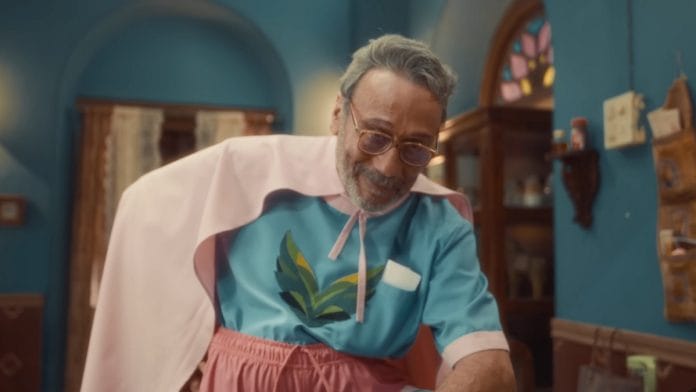


New Delhi: Jackie Shroff’s The Great Grand Superhero is slated for a theatrical release on 29 May, and it looks nothing like most Hindi films in theatres now. In a season of gunshots, bloodshed, and morally grey heroes, it has a grandfather with superpowers. It is also unapologetically a children’s film, at a time when Hindi cinema can barely drum up something “kid-friendly”.
“With The Great Grand Superhero, we’re fulfilling every child’s dream… Kids’ dreams should always come first,” Shroff has said about the film.
But the dedicated children’s film in Indian cinema has all but disappeared, barring rare exceptions such as Boong. The catchall family entertainer has taken its place, with “something for everyone” and very little meant just for children and their imaginations.
Directed by Manish Saini, The Great Grand Superhero stars Shroff alongside Prateik Babbar and Bhagyashree. Going by the promos, it promises colourful masala for children and a message about intergenerational bonding. The film is about a retired superhero grandfather who teams up with his grandson to fight aliens.
Children’s films still appear now and again, but their visibility is not what it used to be, and it has been that way for years.
The decline of children’s cinema reflects a deeper social change, according to Himanshu Vyas, an author of children’s books and visiting faculty for visual aesthetics at IIMC Delhi.
“Children’s films are actually an expression of the entire society, which no longer recognises childhood as a complete stage, and instead views children as miniature grownups. It’s not just a matter of a director, scriptwriter, or producer deciding to make a children’s film,” he told ThePrint.
Also Read: Why indie filmmakers are going back to pre-1950s frame of 4.3 in India
A steady decline
The Great Grand Superhero is not Jackie Shroff’s first brush with the children’s genre. In King Uncle (1993), inspired by the Hollywood musical Annie (1982), Shroff portrays Ashok Bansal, a strict industrialist who is emotionally disconnected from his younger brother, played by Shah Rukh Khan. The story follows Bansal’s bond with an orphan girl he adopts.
Despite its emotional warmth and child-oriented storytelling, the film failed commercially and gradually became a nostalgic television favourite rather than a theatrical success.
This pattern followed several children-centric Hindi films over the years. Ajay Devgn’s Raju Chacha (2000), mounted on a massive budget with visual effects and fantasy elements, struggled at the box office. Vishal Bhardwaj’s Makdee earned critical appreciation for its storytelling and performances, but films of its kind rarely received strong theatrical support. Bollywood slowly began treating children’s cinema as financially risky rather than culturally important.
The government-backed Children’s Film Society of India (CFSI) once made children’s films, including classics such as Jaldeep (1956) and Halo (1996), but it was merged with the National Film Development Corporation (NFDC) in March 2022. Today, animation and dubbed regional content fill some gaps on OTT, but even Hindi children’s films are scarce compared to regional efforts such as Manipur’s Boong (2024) and the Telugu film 35-Chinna Katha Kaadu (2024).
“Children’s films are being made but because they are not released in theatres, people are not aware of such films,” said filmmaker Anurag Kashyap, while promoting the movie Kastoori (2019) which won Best Children’s Films Award in 67th National Film Awards.
For Vyas, the lack of children’s films represents a creative block within the industry. He said commercial success has created a repetitive culture in Bollywood, where one successful trend is endlessly copied and pasted.
“Mostly in films, if one person does something and it becomes successful, then a game of one-upmanship starts. Okay, one slap is being praised? My film will have five slaps,” Vyas added.
(Edited by Asavari Singh)