





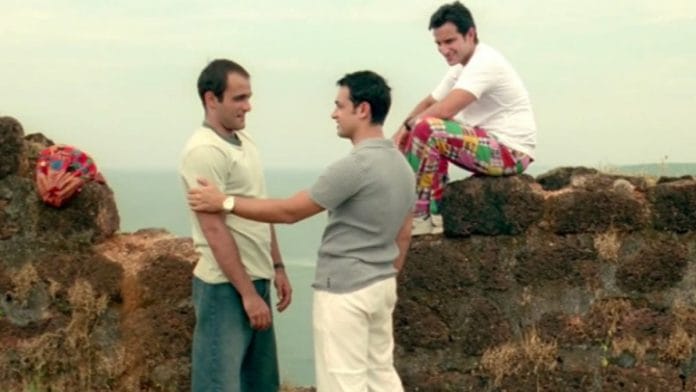


Dil Chahta Hai turns 25 this month. But while most Goa plans since have stayed limited to college WhatsApp groups, it was Farhan Akhtar’s 2001 directorial debut that first made Goa feel less like a destination and more like an essential chapter of being young.
Played by Aamir Khan, Saif Ali Khan, and Akshaye Khanna, the characters, Akash, Sid and Sameer, were not simply enjoying themselves in the beauty of Goa. They were also discussing how everything would change after the trip. They even planned to visit Goa for one week every year. But, as the film itself shows, that plan somehow failed, as such plans often do.
Before Dil Chahta Hai, Goa was mostly a backdrop in songs and mainstream Bollywood films like Bombay to Goa (1972), Ek Duuje Ke Liye (1981) and Kabhi Haan Kabhi Naa (1994). But this 2001 movie changed it all. It made Goa a character in itself and turned it into a goal on the college bucket list, something that has remained, and probably will remain, for a long time.
The film showed Goa beyond what was and still is seen in other films; beyond the beaches, Sid, Sameer and Akash driving on the roads, with green fields on both sides, in the early hours of the morning in their Mercedes-Benz, became the ultimate dream. While most people couldn’t afford to recreate that exact trip, there was now, at least, a desire to make the journey and visit the places where the trio had once roamed and talked about how horrifying adulthood was going to be.
That feeling is what everyone experiences when they leave college: the responsibilities of building a resume, finding a job, wondering if the pay is good enough, dealing with taxes and everything else that comes with adulthood. But the film told its audience that there is still a life to live beyond all of that, and one can live it on a good trip with friends in Goa.
While most people can argue that college-goers cannot afford a trip in a Mercedes, it was never really about the car – it was what it signified. The car was a convertible, top down, making the characters feel unburdened and giving them the ‘azaadi’ to do whatever they wanted, at least for one week in a year.
One thing the film did was make it clear to the Indian youth that there is a need to go out and have fun, and if it is in Goa, even better. Goa was an escape for the characters who were no longer stuck in Mumbai’s concrete jungle. They entered a world of seemingly never-ending coastal highways. It stripped away the protective shell in which these three urban friends were living.
After their visit to Goa, everything changes. They become more serious about their lives. The trip is not simply a holiday; it becomes a transition.
The Chapora Fort Effect
The transition happens at the old, sun-baked, Chapora Fort. Search for its name today and you will find hundreds of photographs of friends sitting on the edge, recreating the frame where the Dil Chahta Hai trio discussed their lives.
Chapora Fort is much more than a selfie point. It was a 17th-century military stronghold, built amid a history of invasions, but now it seems almost frozen in time.
Like the youthfulness of the trio, it eventually surrenders to time.
But the film romanticised the fort. The conversations the trio had there became something visitors want to recreate with their own friends. Not word for word, but the feeling of it: sitting somewhere beautiful, talking about things that actually matter. It created an optimistic place where people could express themselves against a beautiful view, something they were often unable to do in the crowded concrete jungle.
The same is true for real friend groups today. Most Goa trip plans never leave the chat – but the moment one is actually confirmed, everything changes. In a way, those friends are fulfilling a cultural promise that Dil Chahta Hai set in motion nearly 25 years ago.
Goa, for the Dil Chahta Hai trio, comes at a time when the three friends are standing at the edge of adulthood. Its open roads, vast sea and empty fields represent a freedom they are about to lose. That is why these images have stayed even as travel trends have changed. Farhan Akhtar, perhaps without intending to, created a visual language for friendship that audiences have wanted to repeat for 25 years.
(Edited by Maryam Hassan)