





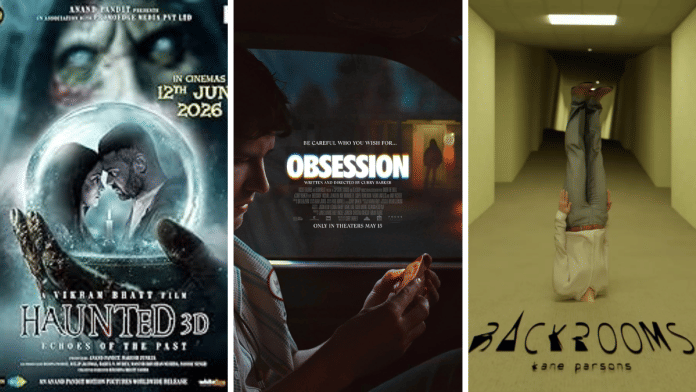


New Delhi: A new age of horror has begun. With Obsession and Backrooms scaring audiences in theatres worldwide. Both films have emerged as major box-office successes, grossing hundreds of millions of dollars against modest production budgets, while simultaneously earning critical acclaim.
Their success is not merely because both directors first gained popularity on YouTube, but rather they reflect a broader trend in which horror has become one of the most commercially reliable genres. The same phenomenon has been unfolding in India over the past decade with films such as Stree (2018), Tumbbad (2018), Bhool Bhulaiyaa 2 (2022), Bhediya (2022), Kantara (2022), Munjya (2024), Bhoot Bangla (2026), and Haunted 3D: Echoes of the Past (2026).
Curry Barker’s Obsession was made on a reported budget of around $1 million and has earned more than Rs 300 million worldwide. Released in India on 29 May, two weeks after its US debut, the film quickly crossed the Rs 10 crore. Meanwhile, Kane Parsons’ Backrooms, released by A24, has grossed over $300 million worldwide against a budget of $10 million and is yet to be released in India.
Obsession follows teenager Bear (Michael Johnston), who desperately wants to date his crush Nikki (Inde Navarrette). In an attempt to win her heart, he breaks a mysterious “One Wish Willow” stick. What begins as a familiar high-school romance quickly transforms into a waking nightmare. Nikki becomes dangerously fixated with Bear and starts killing anyone she suspects is a threat to their relationship.
Film critic Anuj Malhotra said that films such as Obsession take on themes that resonate through much of contemporary conversation and install them within a familiar story, making them both a commercial and critical success. In general, horror, especially seminal horror, crystallises the feeling of loss and ensures that the audience confronts it.
“Obsession and Backrooms metabolise a method of discourse around modern relationships that seems to so far have been conducted through the viral meme, the Reddit thread, the Instagram post and replies on X,” Malhotra told ThePrint.
He added, “These spaces, social forums are replete with individuals paralysed by anxiety in regard to how they can secure love within their lives, and how they can sustain it.”
While Obsession and Backrooms tap into anxieties surrounding modern relationships, their success also reflects a larger shift in audience behaviour. Horror is no longer looked at as just a niche or a B-grade genre. Instead, it has emerged as one of the industry’s most commercially successful spaces.
Naren Sahay, professor of film studies at Delhi University, attributed the box office performance of horror films to the thrill and climax they offer. According to him, Gen Z and younger generations spend much of their time doomscrolling, which is changing the temperament of moviegoers. If a story serves the dopamine rush, whether it is crime, fiction, or horror, it finds an audience.
“That is why these films are succeeding, and the industry is also taking shape. The industry no longer makes horror films like B-grade films. Now, their structure and canvas are huge, larger than life,” he told ThePrint.
Sahay added that changing the audience’s mindset will cause this genre to grow even more in the future.
Also Read: Shekhar Tonite is a meme recap. India needs a real late-night show
An alt-horror emerges
Not everyone loves to explore horror cinema, but it’s changed with Maddock Horror Comedy Universe, which includes films such as Stree and its sequels. Directed by Amar Kaushik, the franchise starring Rajkummar Rao, Pankaj Tripathi and Shraddha Kapoor has brought audiences to theatres to greet ghosts by adding the flavour of comedy. Stree collected around Rs 180 crore worldwide against a budget of nearly Rs 30 crore.
Similarly, Bhediya, starring Varun Dhawan, collected more than Rs 90 crore against a budget of Rs 60 crore, while Munjya earned over Rs 130 crore against a budget of Rs 30 crore, making Maddock’s horror-comedy universe one of the industry’s most successful franchises.
“Maddock Productions is delivering excellent cinema in this field…. if there is another production house that is continuously delivering this kind of cinema like Stree, with that treatment, they will do an amazing job,” Sahay remarked.
While horror-comedies are collecting impressive box office numbers, curiosity in India is not driven only by laughter. With cultural diversity and folklore passed down through oral traditions in every corner of the country, films such as Rahi Anil Barve’s Tumbbad have shown the commercial potential of traditional folklore.
Released in 2018, Tumbbad follows the folklore of Hastar, the firstborn child of the goddess of prosperity. Consumed by greed, Hastar attempts to possess all the grain on Earth and is cursed to be forgotten forever. The film uses Hastar’s curse to explore how far human greed can go.
Sahay explains that mainstream formula films have become predictable, while audiences now seek something new and original.
“Audiences have watched so much content that they will no longer get trapped in mainstream formula. They want something new, they want something original. With the kind of folklore we have, they are a heritage… it will definitely work at the box office,” he said.
The most recent case, Haunted 3D: Echoes of the Past, directed by Vikram Bhatt, in the week of its release, collected nearly Rs 25 crore against a budget of Rs 15 crore. In comparison, Imtiaz Ali’s Main Vaapas Aaunga managed to collect only around Rs 55 crore, less than its Rs 70 crore budget. Both films were released on the same day despite the presence of industry names such as Naseeruddin Shah, Diljit Dosanjh, Vedang Raina and Sharvari, as well as Ali’s history of blockbuster hits like Chamkila (2024), Tamasha (2015) and Rockstar (2011).
The story of Haunted 3D: Echoes of the Past is a typical Bollywood horror film in which film director Dev, played by Mahaakshay Chakraborty, travels to a village and starts living in a mansion-turned-hotel after being betrayed by the woman he loves. There, he meets Sunehri, played by Chetna Pande, whom only Dev can see. The horror unfolds with ghosts created with AI assistance. Meanwhile, Main Vaapas Aaunga explores the much deeper pain of the Partition and its aftermath.
Narendra Kaushik, Professor and Dean of Film Studies at JERC University, believes one reason behind Haunted 3D performing so well at the box office is Gen Z’s curiosity about the supernatural. According to him, unlike earlier generations, who grew up hearing ghost stories and even claimed to have seen ghosts, today’s generation has less direct engagement with such folklore.
“That lack of familiarity makes them more eager to watch stories about ghosts,” Kaushik said.
(Edited by Insha Jalil Waziri)