


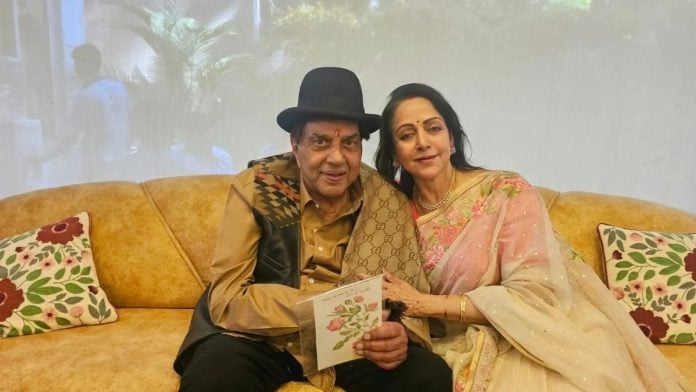
New Delhi: Actor Hema Malini remembered her husband, Dharmendra, on his first death anniversary on November 24, saying that a year had passed since his death but the intensity of her grief remained unchanged.
She described his passing as a “tremendous and irreparable loss”, remembering him as someone who was much more than a husband to her.
“He was my everything – my friend, philosopher and guide, who was my backbone and, in short, was my very existence,” she wrote on X.
Malini described Dharmendra as a unique human being who had reached the pinnacle of success but remained grounded and connected to his roots.
“Life seems so empty without him. His towering personality, his innate goodness that pervaded his whole being and spread his love towards all who knew him,” she wrote.
The 78-year-old actor also referred to the Bhagavad Gita, saying that the soul is immortal and will be reborn.
“I am aware of this, but I am still here in this life, and I cannot but miss his loving presence,” she added.
The Bollywood actor passed away on 24 November 2025, at the age of 89.
Also read: The passing of an era in Indian cinema’: PM Modi pays tribute to veteran actor Dharmendra
Hema Malini and Dharmendra’s on-screen partnership
Hema Malini and Dharmendra married in 1980 and worked together in around 30 films. Their collaborations included Tum Haseen Main Jawaan (1970), Sharafat (1970), Naya Zamana (1971), Seeta Aur Geeta (1972), Raja Jani (1972), Jugnu (1973) and Dost (1974).
They also became one of Hindi cinema’s most memorable on-screen pairs as Veeru and Basanti in Ramesh Sippy’s Sholay (1975).
In an earlier interview with The Indian Express, Malini spoke about how their real-life relationship influenced their performances on screen.
“In those days, the romance was so different. Our love scenes in films were so genuine because we were actually in love. We wanted to work together so that we could spend time together,” she said.
In the same conversation, Dharmendra admitted that they had not done as many romantic films together as they should have.
“We did not do as many romantic films as we should have done,” he said.
(Edited by Maryam Hassan)