





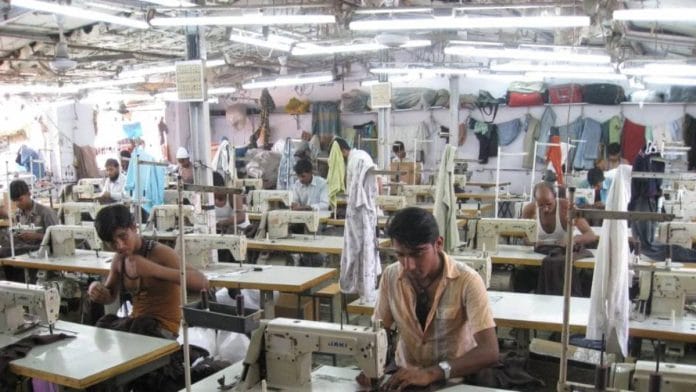



New Delhi: Signalling a renewed push to revive manufacturing-led growth and employment, Union Budget 2026-27 has placed micro, small and medium enterprises (MSMEs) at the heart of the government’s economic and jobs strategy.
Presenting her ninth budget Sunday, Finance Minister Nirmala Sitharaman laid out an ambitious roadmap to scale up manufacturing across seven strategic and frontier sectors, signalling a shift towards building domestic capabilities in high-value and technology-intensive industries.
The manufacturing push is expected to generate jobs not only through new investments but also by reviving traditional industrial hubs and easing access to finance for smaller firms.
“I propose to introduce a scheme to revive 200 legacy industrial clusters to improve their cost competitiveness and efficiency through infrastructure and technology upgradation,” Sitharaman said in her budget speech.
The renewed focus on manufacturing comes against the backdrop of the government’s stated objective of increasing the sector’s contribution to gross domestic product (GDP) from around 17 percent currently to 25 percent by 2035.
The Union Budget 2026-27 also underlined that strengthening MSMEs is critical to boosting productivity, expanding formal employment and improving India’s competitiveness amid volatile global conditions.
MSMEs form the backbone of India’s industrial economy, accounting for 35.4 percent of manufacturing output, 48.6 percent of exports and 31.1 percent of GDP, according to the Economic Survey 2025-26. With over 7.47 crore enterprises employing around 32.8 crore people, MSMEs remain the country’s second-largest source of employment after agriculture.
“The government has identified the MSME sector as a key job generator which would help move non-productive farm labour to non-farm productive activities,” Mayank Arora, Director at Nangia Global Advisors, a consultancy firm, told ThePrint.
However, despite the aggressive policy push, budget documents show a relatively modest rise in allocations for the sector. Budget estimates for MSMEs increased by just 6 percent, from Rs 23,168 crore in BE 2025-26 to Rs 24,566 crore in BE 2026-27.
The revised estimates for 2025-26 stood at Rs 12,096 crore, reflecting underutilisation of nearly 48 percent against the budget estimates of 2025-26.
Also Read: Over-regulation is holding back MSME growth, states need to lead in easing these: Economic Survey
Scaling up manufacturing
A key announcement in the budget with regards to the manufacturing sector was the Biopharma SHAKTI initiative, with an outlay of Rs 10,000 crore over five years, aimed at developing India as a global hub for biologics and biosimilars, alongside expanded clinical trial infrastructure and regulatory capacity.
The government also announced India Semiconductor Mission 2.0, focusing on equipment manufacturing, materials, Indian intellectual property and workforce development. Riding on strong investor interest, the outlay for the electronics components manufacturing scheme will be raised to Rs 40,000 crore.
Other measures include the creation of rare earth corridors in mineral-rich states, new chemical parks to reduce import dependence, and schemes to strengthen capital goods manufacturing.
Labour-intensive sectors such as textiles will see cluster modernisation, skilling upgrades and the development of mega textile parks, alongside targeted initiatives for khadi, handicrafts and sports goods manufacturing.
“These sectors have been identified as drivers of growth towards achieving the Viksit Bharat 2047 target. These new age sectors would ensure increased depth of manufacturing and secure India’s strategic autonomy in a turbulent geopolitical environment,” Arora told ThePrint.
Creating ‘champion’ MSMEs
Presenting the Budget 2026-27, Sitharaman said the government will adopt a three-pronged approach to create “champion” MSMEs. This includes equity support through a Rs 10,000-crore SME Growth Fund, designed to help high-potential enterprises scale up and integrate with global value chains.
The budget also announced Rs 2,000-crore infusion into the Self-Reliant India (SRI) Fund, aimed at sustaining equity support for smaller businesses. “I also propose to top up the Self-Reliant India Fund set up in 2021 with Rs 2,000 crore to continue support to micro enterprises and maintain their access to risk capital,” Sitharaman said.
Launched in 2021, the SRI Fund is designed to back MSMEs across the country through equity financing, targeting enterprises with the potential and financial viability to scale up into larger units.
To address liquidity constraints, Sitharaman announced enhanced use of the Trade Receivables electronic Discounting System (TReDS) platform. The government will move to scale up TReDS, through which over Rs 7 lakh crore has already flowed to MSMEs, she said.
TReDS is an online platform set up to help MSMEs unlock working capital by converting their receivables into cash, and the budget’s focus on expanding its use is aimed at improving liquidity and easing financing stress for smaller firms.
“Creation of SME growth fund will create champions in the MSME space and is likely to do for SMEs what PLI schemes have done for large corporates. This will help provide risk capital for SMEs by diversifying the portfolio among different sectors,” Arora said.
“Topping up the Self-Reliant India Fund, set up in 2021, will also support SMEs which have difficulty accessing traditional means of finance,” he added.
Deepak Maheshwari, senior policy advisor at Centre for Social and Economic Progress, a policy think-tank, said: “The MSME sector is a significant constituent of the economy in terms of production, employment and exports. While MUDRA and other schemes have been implemented even in the past, the three-pronged approach (SME Growth Fund, SRI Fund and enhanced use of TReDS) is a welcome move, indeed.”
(Edited by Nida Fatima Siddiqui)
Also Read: Overlap in Centre’s MSME schemes affecting outcomes—NITI Aayog; offers course-correction roadmap