





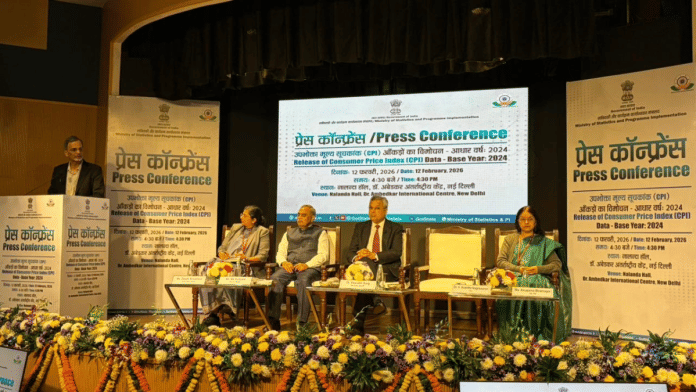



New Delhi: India’s retail inflation for January 2026 based on revised and updated consumer price index (CPI) with base year as 2024 stands at 2.75 percent, according to Ministry of Statistics and Programme Implementation (MoSPI) data released Thursday.
It is the first official inflation reading under the new CPI framework, which replaces the outgoing CPI series based on 2012 as the base year. Under the older series, retail inflation stood at 1.33 percent in December 2025.
However, since index values for months before January 2025 under the new series are not readily available, the year-on-year inflation rate can only be measured for January 2026. Also, December 2025 figure which has been calculated under the old CPI framework is not directly comparable due to change in methodologies.
“The higher reading under the new series does not indicate a sudden surge in price pressures; rather, it reflects the updated weighting structure, which better aligns with current spending patterns, with a lower share of food and greater weight to housing and services,” Aashi Gupta, an associate at think-tank Centre of Social and Economic Progress, told ThePrint.
The new CPI series was released in the presence of MoSPI Secretary Saurabh Garg, Chief Economic Advisor V. Anantha Nageswaran, and other officials.
“The new CPI series now provides policy makers with a more up-to-date basis for assessing real incomes, consumption trends and purchasing power,” Chief Economic Advisor V. Anantha Nageswaran said at the launch of the new CPI series.
He added, “At a macro level, this reflects a progressive diversification of expenditure towards health, education, mobility and connectivity which is what you would expect to see from an economy which is seeing rising incomes and rising living standards.”
The ministry highlighted that the top five items driving inflation in the new series were silver jewellery, tomato, coconut, gold/diamond/platinum jewellery and coconut oil when compared with January 2025.
Among these, silver jewellery with CPI weight of just 0.3127 in new series reported highest price rise of 159.67 percent
Food inflation under the new CPI series with 2024 base year for January 2026 stood at 2.13 percent. In contrast, food inflation for the month of December 2025 under the old CPI series was -2.71 percent.
According to ministry officials, while both values are not comparable, the spike in food inflation in the new series reflects changes in weights, wider market coverage, better specification and use of tablet devices that now capture data more accurately.
The updated consumption basket and weights in the new CPI series is based on the latest Household Consumption Expenditure Survey (HCES) 2023-24. Under the new division-wise weights, weightage of food has come down from about 42.617 in the old series with base year 2012 to around 36.753 in the new series.
“The revised CPI updates the consumption basket to better reflect contemporary spending patterns, with the inclusion of rural housing, digital and online services (such as streaming platforms), value-added food products and other emerging consumption items, while phasing out outdated goods like tape recorders, radio, etc,” Gupta of CSEP told ThePrint.
The CPI revision also comes with a significant expansion in geographical coverage, aimed at making inflation tracking more representative. The number of markets covered will rise from around 2,300 to 2,860, with rural markets increasing to 1,465 and urban markets to 1,395.
Town coverage has also gone up sharply from 310 to 434. At the same time, the number of goods tracked has increased from 259 to 308, while services have risen from 40 to 50, reflecting a broader and more modern consumption basket.
Methodologically, MoSPI has also shifted the CPI framework to the 2018 Classification of Individual Consumption According to Purpose (COICOP). This revision doubles the number of consumption groups from 6 to 12, reducing the size of the earlier “miscellaneous” category and allowing inflation trends to be captured in finer detail.
According to Saurabh Garg, Secretary MoSPI, going forward the base year would be revised every five years after the release of a new household consumption expenditure survey. The next survey is scheduled to take place in 2027-28.
(Edited by Ajeet Tiwari)
Also Read: Don’t expect big shifts in inflation & growth trends after CPI & GDP base year reset—MoSPI secy Garg