







New Delhi: As the US-Iran agreement opens the door for Iranian crude oil to return to global markets after years of sanctions, Russian oil import to India is set to hit a record high in June. At the same time, Venezuelan barrels are emerging as an increasingly important diversification option for Indian refiners.
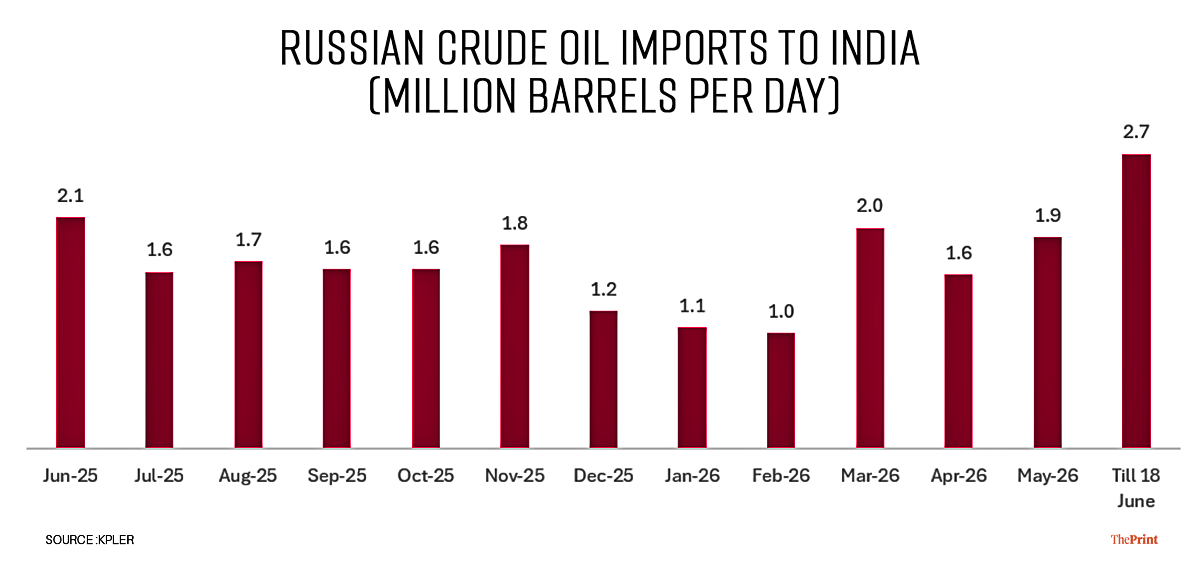
Data provided by global analytics firm Kpler to ThePrint shows India imported around 2.7 million barrels per day (mbpd) of Russian crude from 1 June to 18 June. While the Russian barrels are expected to moderate in the remaining days of the month, imports are still projected to average more than 2.25 mbpd during June, an all-time high for any month.
“India’s imports of Russian barrels remained strong through June, supported by continued discounts and steady refinery demand,” Sumit Ritolia, manager for oil markets at Kpler, told ThePrint. “While barrels will likely average out, June imports are expected to reach an all-time high, exceeding 2.25 mbpd.”
The strong inflows come despite uncertainty over US waiver, which enabled India to purchase Russian crude stranded at sea. This waiver expired on 17 June and has not yet been renewed.
“Regardless of whether the US waiver is extended, we expect India’s imports of Russian crude to remain robust, even if not at record-high levels,” Ritolia said.
According to Ritolia, Russian crude continues to remain competitive against global benchmarks and is likely to retain its dominant position in India’s import basket despite the easing of sanctions on Iran.
“Russian barrels will remain a key component of India’s import basket because of its suitability to Indian refineries and its pricing advantage. In the end, economics will drive procurement decisions,” Prashant Vasisht, senior vice president and co-group head, corporate rating at Investment Information and Credit Rating Agency, told ThePrint.
He added, “However, if US sanctions remain in place, refiners may increasingly turn to non-sanctioned barrels that would then be available at attractive discounts.”
Iranian oil may return, but not immediately
Under the new peace agreement, US has agreed to lift sanctions on Iran and allow exports of crude oil and petroleum products. This has revived prospects of Iranian crude returning to India on a consistent basis after a gap of seven years.
However, analysts caution that while the pathway to Iranian oil has reopened, a large scale resumption of imports may not happen immediately as refiners need to navigate compliance and commercial arrangements.
“Iranian crude had remained a core part of India’s import mix before sanctions hit, so compatibility is really a non-issue here. Indian refineries know these (Iranian) grades well,” Nikhil Dubey, lead analyst for oil markets at Kpler, told ThePrint.
According to Dubey, when US temporarily lifted sanctions on Iranian oil at sea in March, the barrels came to India. “From here, it is really a question about sanctions and compliance.”
In April 2026, India imported limited volumes of Iranian crude for the first time since 2019 after the US temporarily relaxed sanctions on certain Iranian cargoes stranded at sea to stabilise global oil prices after the West Asia conflict.
Kpler data shows India imported around 1,33,000 barrels per day of Iranian crude in April.
“The geographical proximity between Iran and India offers better economics, whereas Iran also offers a credit period of 60-90 days to Indian refiners, compared to around 30 days offered by most Gulf suppliers,” Vasisht said.
Iran was once among India’s largest crude suppliers, providing both light and heavy grades of crude that are well suited to Indian refinery configurations.
At its peak in 2018, Iranian crude accounted for nearly 11.5 percent of India’s total crude oil imports, cites Vasisht.
Venezuelan crude helps India diversify
Venezuelan crude is gradually becoming an important part of India’s crude basket. Till 18 June, Venezuelan crude arrivals stood at around 2,09,000 barrels per day (bpd), with volumes expected to rise to nearly 3,00,000 bpd for the full month, according to Ritolia.
Kpler data shows that India has been consistently purchasing Venezuelan barrels since April, with analysts expecting the supplies to remain an important diversification option for refiners going forward.
While Venezuelan barrels provide India with greater flexibility, their long-term availability remains uncertain due to production constraints, sanction risks and infrastructure challenges.
According Dubey, Venezuela’s crude production currently stands at around 1.1-1.2 mbpd, substantially lower than production levels of Gulf and Russia. Most Venezuelan crude is exported to the US, India and European countries.
“Venezuelan crude will keep flowing to India consistently, but it is unlikely to be dominating,” Dubey said. “Diversification intent is there on India’s side, but the processing constraints put a natural ceiling on how much Venezuelan crude can realistically grow in India’s import mix.”
This suggests that while Venezuelan barrels will remain a key part of India’s crude sourcing strategy, their role will largely be complementary to larger suppliers like Russia and the Gulf.
Oil prices likely to remain elevated
The re-opening of the Strait of Hormuz is expected to improve market sentiment, but analysts do not expect oil prices to go back to pre-conflict levels anytime soon.
Vasisht expects crude prices to remain between $70-$80 per barrel through the rest of 2026, compared with around $65 per barrel before the West Asia conflict erupted.
According to him, the market is still witnessing an estimated supply shortfall of around 11 mbpd. The strategic reserve released by member countries of the International Energy Agency (IEA) has helped bridge part of this gap, but these countries will eventually need to replenish their reserves.
“IEA countries have been releasing around 4 mbpd from reserves to stabilise market prices. Once normal trade flows resume, they will have to rebuild those reserves, so demand will remain elevated even as supply remains constrained in 2026,” Vasisht said.
For India, the return of Iranian crude may offer refineries another supply option, but eventually commercial arrangements will determine refineries purchase decisions. For now, Russian barrels remain attractive, while Venezuelan crude is helping in diversifying supply sources.
(Edited by Viny Mishra)
Also read: India bought Russian oil from 2022 at US request to stabilise market, says Jaishankar