


New Delhi: India’s year-on-year retail inflation, measured by the Consumer Price Index (CPI), reached 6.09 percent in October, its highest level so far in 2026, breaching the Reserve Bank of India’s (RBI) upper tolerance limit of 6 percent, according to data released by the Ministry of Statistics and Programme Implementation (MoSPI) Thursday.
Headline inflation has risen consistently throughout 2026, increasing from 2.74 percent in January to 5.54 percent in September and 6.09 percent in October.
Even as year-on-year inflation has continued to accelerate, the pace of month-on-month price increases has moderated for four consecutive months, an analysis by ThePrint of MoSPI data shows.
MoSPI calculates the CPI using a weighted basket of goods and services consumed by households, including food, housing, clothing, transport, healthcare and education. The current series uses 2024 as its base year.
While year-on-year inflation measures how much prices have changed compared with the same month of the previous year, month-on-month inflation measures price changes relative to the immediately preceding month.
The all-India CPI-based inflation rose 0.51 percent between September and October, compared with 0.69 percent in the preceding month. Monthly price increases peaked in June, when the all-India CPI rose 1.03 percent compared with May.
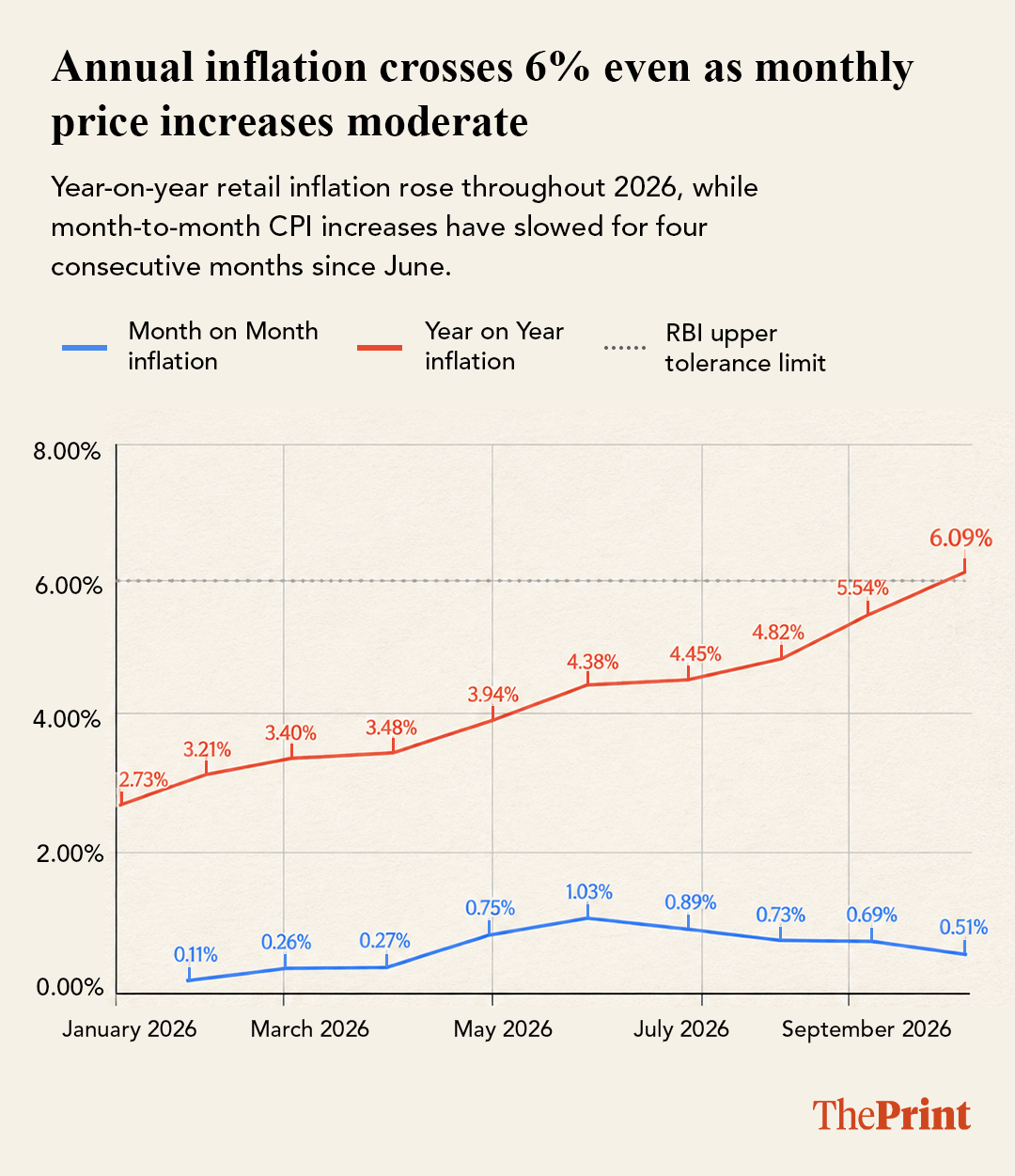
The pace of increase subsequently moderated for four consecutive months: to 0.89 percent in July, 0.73 percent in August, 0.69 percent in September and 0.51 percent in October, each compared with the preceding month.
In October last year, the all-India CPI remained virtually unchanged from September, at 103.74. As a result, even though monthly price increases slowed in October 2026, they were higher than the virtually zero increase recorded a year earlier, pushing annual inflation higher.
Under India’s inflation-targeting framework, the Reserve Bank of India (RBI) is tasked with maintaining retail inflation at 4 percent, with a tolerance band of 2 to 6 percent. While October’s inflation rate of 6.09 percent breached the upper limit, a single monthly breach does not constitute a formal failure to meet the target, which occurs only when average inflation remains above 6 percent or below 2 percent for three consecutive quarters.
Aditi Nayar, Chief Economist at ICRA, a credit rating agency, said in a statement issued Thursday that she expects CPI inflation to remain above the RBI’s 6 percent upper tolerance limit over the next couple of months. With GDP growth expected to remain above 7 percent in the second quarter of FY2027, she said a further 25-basis-point increase in the repo rate appears almost certain at the RBI’s next Monetary Policy Committee meeting, scheduled for 2–4 December.
“Thereafter, the trajectory of crude oil prices, which have cooled in the recent sessions, will be critical in shaping the need for and extent of additional rate tightening in 2027,” Nayar said.
The repo rate is the interest rate at which the RBI lends to commercial banks, and raising it is one way the central bank seeks to curb inflation by making borrowing more expensive.
Also Read: Retail inflation rises to 5.54 pc in Sept on costlier food items
Rural inflation continues to outpace urban inflation
Inflation remained higher in rural India, where consumer prices increased 6.63 percent year-on-year in October, compared with 5.41 percent in urban areas, according to MoSPI data.
The gap between rural and urban inflation widened marginally to 1.22 percentage points in October, from 1.20 percentage points in September.
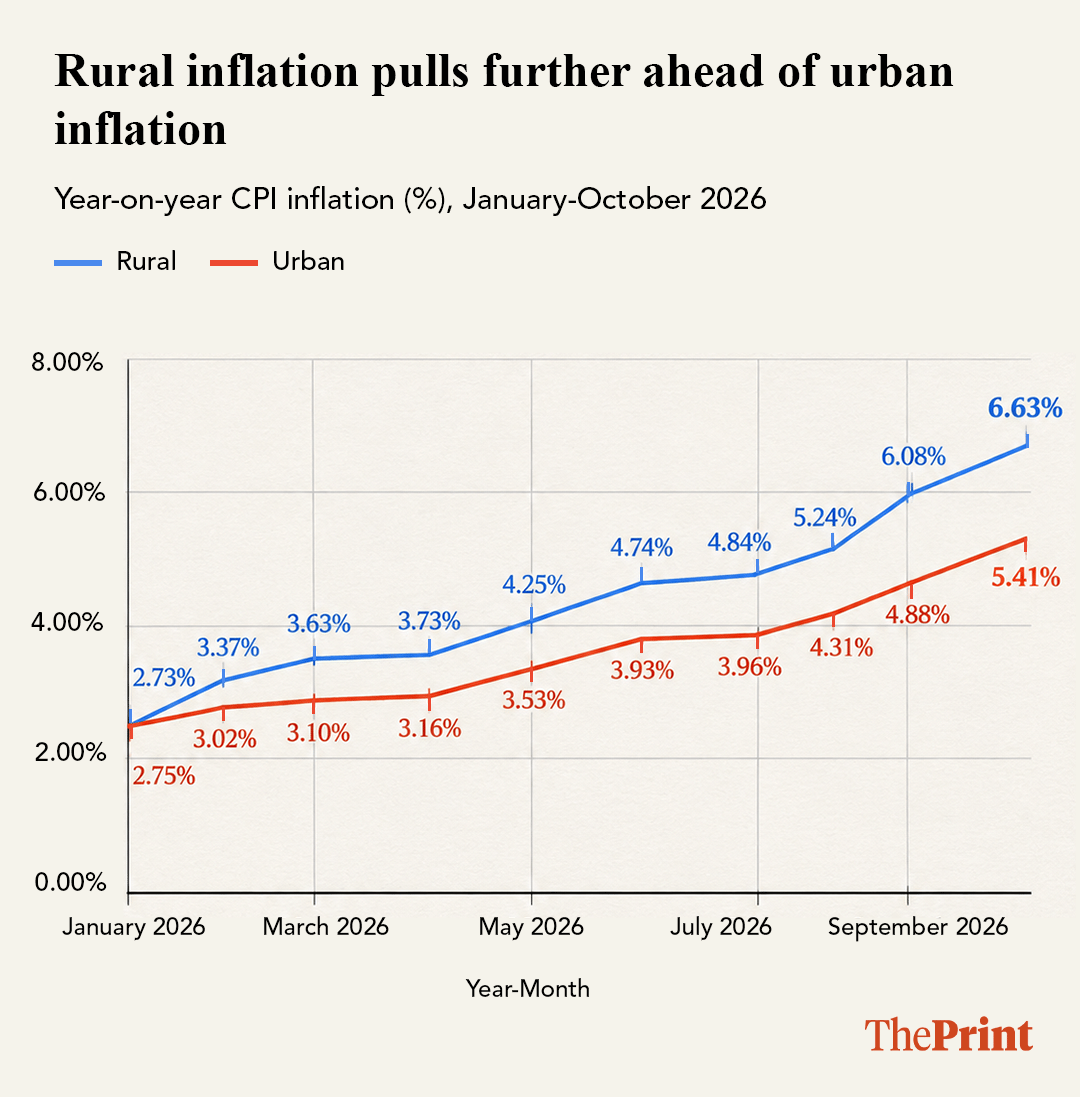
A longer-term analysis reveals that the gap has been widening throughout 2026. In January, rural inflation stood at 2.73 percent, marginally below urban inflation of 2.75 percent. Since February, however, rural inflation has consistently exceeded urban inflation, with the gap widening every month.
This indicates that prices of goods and services consumed by rural households have been rising faster than those consumed by urban households, although it does not necessarily mean the absolute cost of living is higher in rural areas.
Monthly consumer prices also increased faster in rural areas, rising 0.56 percent between September and October, compared with 0.47 percent in urban areas. However, the pace of monthly price increases moderated in both sectors compared with September.
Food and beverages inflation drives rise in retail prices
Inflation in the food and beverages division rose to 8.51 percent in October from 7.36 percent in September, making it a major contributor to the rise in headline retail inflation. Food and beverages account for 36.75 percent of the CPI basket, giving price changes in this category considerable weight in overall inflation.
Aditi Nayar said the sustained increase in food and beverages inflation played a key role in pushing up headline inflation in October, even as inflation accelerated across 11 of the 12 CPI divisions. She expects food and beverages inflation to remain above 8 percent in November, amid upward pressure from milk, sugar and onion prices.
Nayar also cautioned that the deficient monsoon and inadequate replenishment of reservoir levels have raised concerns about the upcoming rabi crop and the possibility of continued pressure on food prices.
(Edited by Anupama Yadav)
Also Read: Moody’s pegs India’s FY27 GDP growth at 7 pc, aided by robust consumption, investment
The RBI should not fall behind the curve on fighting inflation. Why not a 50 basis points increase to signal seriousness of intent at its next MPC meeting in December.