


New Delhi: India’s energy demand is expected to grow three times faster than the global average over the next decade, driven by rising incomes, urbanisation, and industrial expansion. But the West Asia conflict has exposed the country’s vulnerability to disruptions in imported energy supplies, even as its dependence on oil and gas is projected to increase, according to the International Energy Agency’s (IEA) World Energy Outlook 2026, released Thursday.
Over the next decade, India is expected to add more than 12,000 cars to its roads every day, see a 33 percent increase in built-up space and install another 200 million air conditioners in homes. Against this backdrop, the country’s energy demand is projected to grow by 2.5 percent annually until 2035, around three times the global rate, under the IEA’s Stated Policies Scenario (STEPS).
The STEPS includes existing policies and specific measures formally proposed by governments but not yet adopted. For India, it factors in expanding urban gas networks, greater electrification and rising contributions from renewables and other non-fossil sources. It does not assume all proposed measures will be implemented.
India’s growing energy needs are likely to put further pressure on its energy security, given its heavy reliance on imports. The country meets around 40 percent of its overall energy requirements through imports, including 90 percent of its crude oil needs and 50 percent of its natural gas demand, the report said.
The vulnerability was highlighted during the West Asia conflict, which disrupted supplies passing through the Strait of Hormuz. The IEA estimates that liquified petroleum gas (LPG) used in half of the cylinders for residential cooking in India passes through the waterway.
LPG imports fell by more than 50 percent during the first two months of the conflict, prompting the government to maximise domestic production and prioritise household supplies over other consumers.
“The Strait of Hormuz remains critical to India’s energy security,” the report said, adding that expanding natural gas pipelines and electric cooking could moderate the growth in LPG demand over the next decade.
Also Read: India is spending Rs 14,500 crore on energy storage. Why does the grid need it?
Crude and LPG imports set to rise
According to IEA, India’s growing energy requirements will become more challenging as domestic crude oil production is set to decline even while refining capacity expands.
India had nearly 6 million barrels per day (mb/d) of refining capacity in 2025, ranking fourth globally by capacity and third by refinery runs. It consumed around 5.7 mb/d of oil products domestically but remained a net exporter of petroleum products because of its large refining industry.
With another 840,000 barrels per day of refining capacity under construction, the IEA expects India’s refining capacity to expand by around 1 mb/d by 2035 under the STEPS. However, domestic crude oil production is projected to fall by nearly 20 percent over the same period, increasing the country’s reliance on imported supplies.
While crude imports from the Middle East are expected to remain broadly flat, total imports are projected to increase, with much of the additional supply coming from outside the Gulf region.
LPG presents another challenge. India produced around 450,000 barrels per day of LPG in 2025, meeting around 40 percent of domestic demand. Under the STEPS, domestic supply is expected to increase by less than 100,000 barrels per day by 2035, while demand rises by nearly 400,000 barrels per day. This gap could push LPG imports to nearly 1 mb/d by 2035.
Coal remains important as non-fossil power expands
The IEA expects coal to remain a mainstay of India’s energy supply even as renewable energy and other non-fossil sources expand.
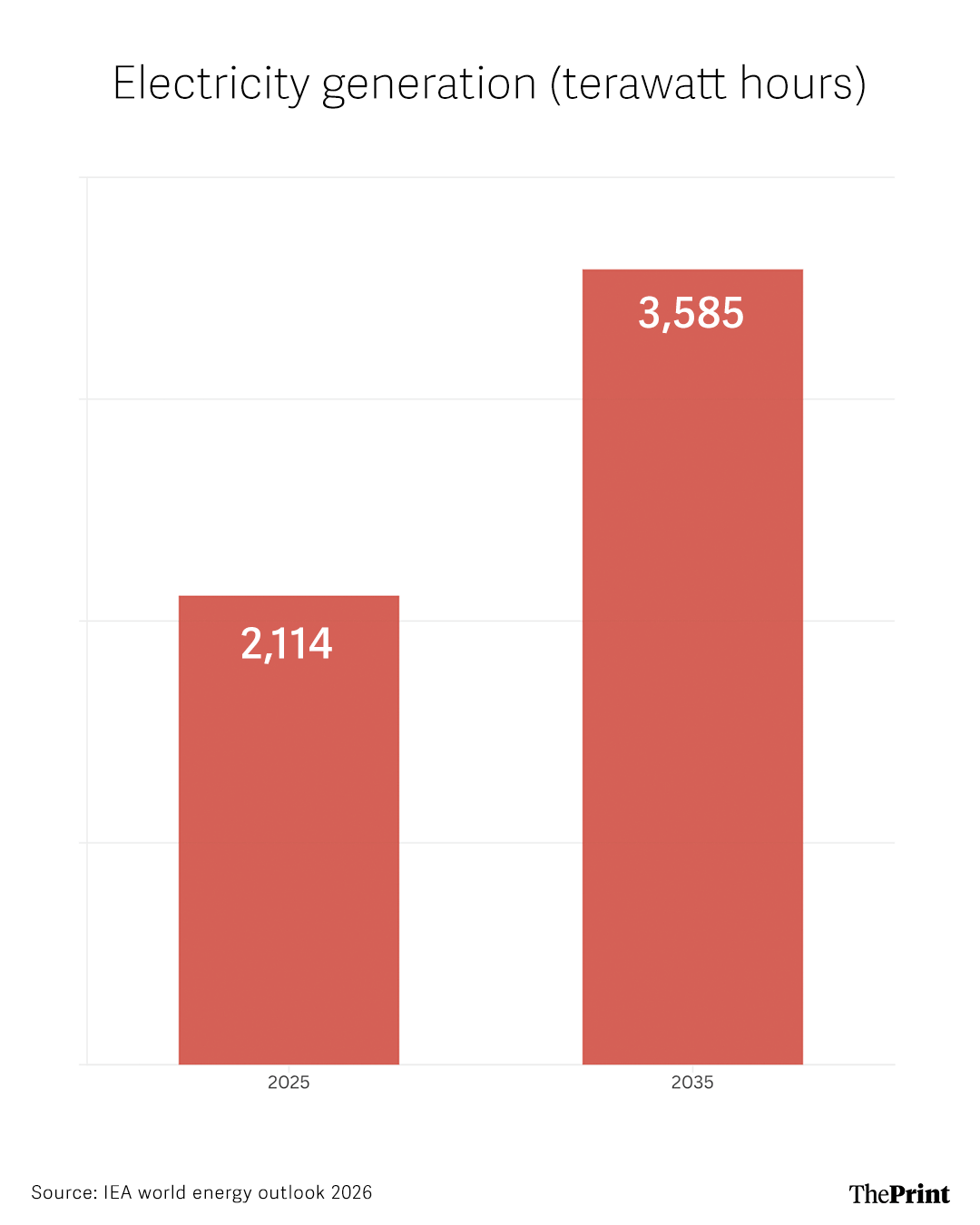
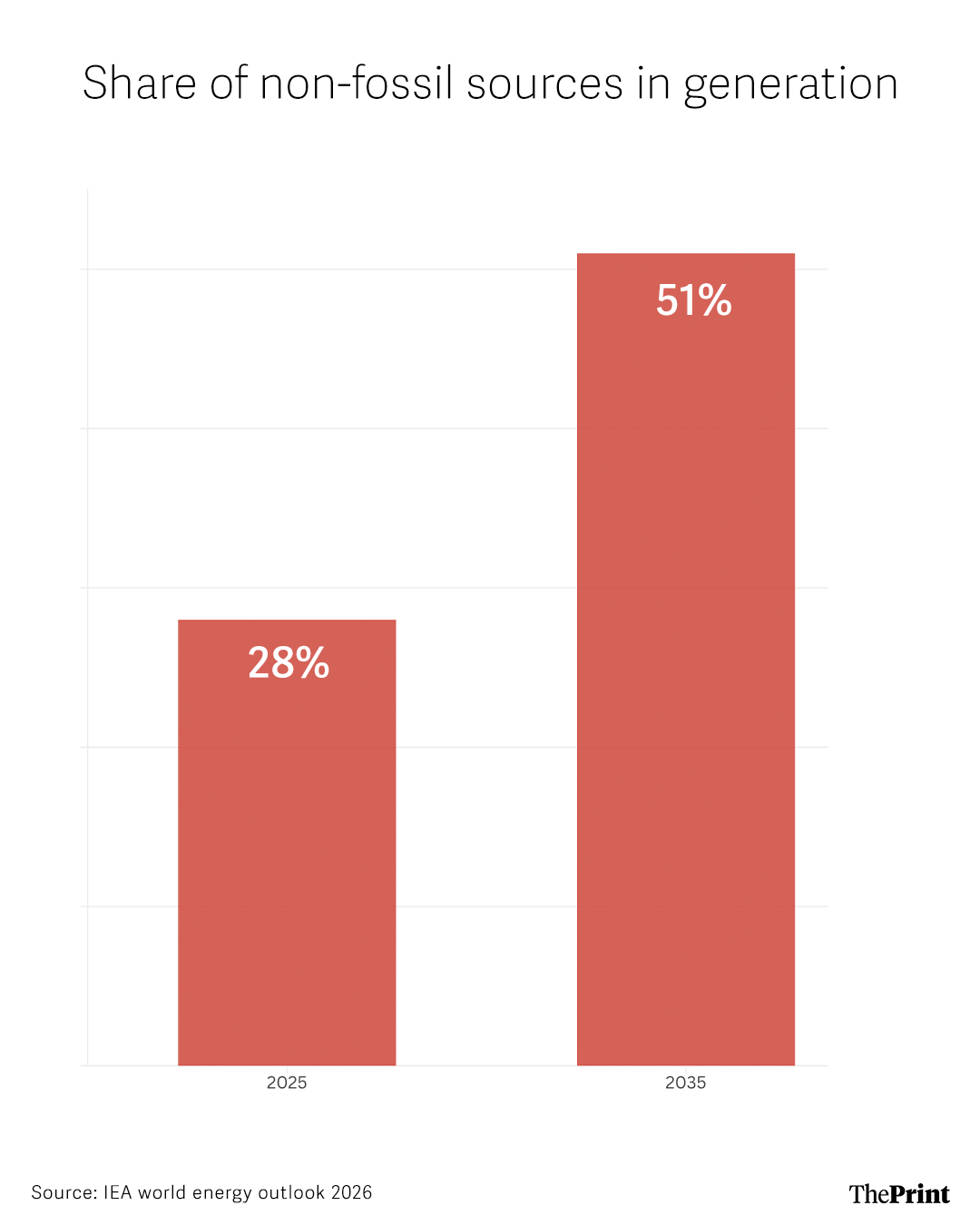
India’s electricity generation is projected to rise from 2,114 terawatt-hours (TWh) in 2025 to 3,585 TWh by 2035 under the STEPS. Over the same period, the share of non-fossil sources, including renewables and nuclear power, is expected to increase from 28 percent to 51 percent.
“As non-fossil capacity continues to expand, India generates well over half of its electricity from non-fossil sources by 2035 in the STEPS,” the report said.
Electricity demand itself is projected to grow by 6 percent annually over the next decade. Solar photovoltaic power accounted for half of India’s capacity additions over the past decade. However, coal will continue to play an important role in meeting electricity demand.
The IEA also examined a scenario in which India takes additional steps to reduce its dependence on imported fuels. This includes faster adoption of electric vehicles, greater industrial electrification, improved energy efficiency and increased use of renewables and domestically produced coal.
Under this scenario, electric car adoption would be 30 percent faster by 2035 than under the STEPS, reducing India’s oil requirement by 580,000 barrels per day and natural gas consumption by 8 percent compared with the STEPS.
Greater domestic coal production could also bring down steam coal imports from nearly 150 million tonnes of coal equivalent in 2025 to around 30 million tonnes by 2035, reducing overall coal import dependence from around 30 percent to 15 percent.
However, rising steel production is expected to push coking coal demand up by 55 percent, leaving India dependent on imports for much of its additional requirement.
(Edited by Amrtansh Arora)
Also Read: The difficulties in India’s renewable payment safeguards