








Thiruvananthapuram: The Left Democratic Front (LDF) government in Kerala has announced a slew of welfare and infrastructural projects, such as health insurance for students and a revised push for a semi-high-speed transport system from Thiruvananthapuram to Kasargod, in its final budget before the assembly polls.
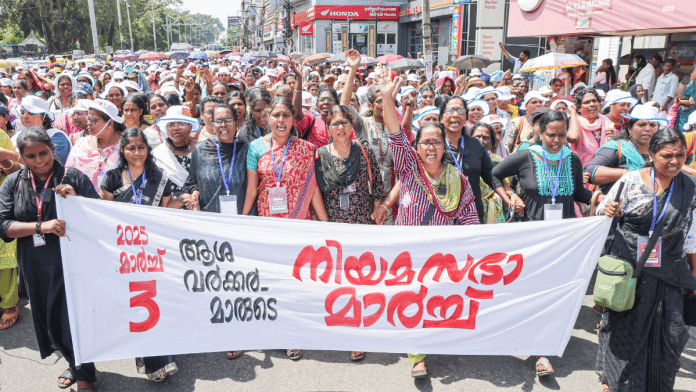
Presenting the 2026-27 Kerala Budget Thursday, Finance Minister K.N. Balagopal announced a Rs 1,000 increase in the monthly honourarium for accredited social health activists (ASHA), anganwadi workers (AWWs), pre-primary teachers, and ‘saksharatha preraks’, who are grassroots educators under the centrally sponsored ‘Saakshar Bharat’ mission, while increasing the noon-meal workers’ salary by Rs 25/day.
This comes months after the LDF government announced a Rs 1,000 hike in the ASHA honourarium, following their months-long protest outside the Kerala secretariat.
Besides, Balagopal Friday announced a new pay revision commission to review and enhance salaries of state government employees, while promising the complete disbursal of dearness allowance (DA) of the employees and dearness relief (DR) of pensioners.
The LDF government has also revealed a plan to establish a ‘Global School’ in Kerala, equipped with modern technologies and capable of providing skill acquisition and vocational training to stop the outflow of students to other states and countries, earmarking Rs 10 crore to this end.
An insurance accident or life insurance scheme would also be implemented for those studying in classes 1 to 12 in Kerala, Balagopal has said, earmarking Rs 15 crore.
Besides, the LDF government has announced a VS Centre in Thiruvananthapuram, earmarking Rs 20 crore to document the life and contributions of its former chief minister, the late Communist Party of India (Marxist) leader V.S. Achuthanandan.
Balagopal Thursday noted that despite the central government imposing financial constraints, the state was able to manage its fiscal health and manage its debt.
“First, let us clarify how Kerala managed to stand strong. That is top-secret! It was foreseen that the Centre would try to financially constrain the Left Government,” Balagopal said, adding the state built a fortress, increasing its own revenue and prioritising its expenses.
The minister said the average annual tax revenue of the LDF government this time was Rs 73,002 crore compared to the previous government’s Rs 47,453 crore, adding that the state was able to get an additional amount of roughly Rs 24,898 crore towards non-tax revenue.
Balagopal also reiterated that there was no reduction in welfare and developmental spending during the time, as the average annual expenditure during the five years of the current government was Rs 1,69,547 crore, compared to Rs 1,17,191 crore during the first Pinarayi Vijayan government and Rs 68,028 crore of the Oommen Chandy government (2011-16).
According to the budget, state debt as a share of Gross State Domestic Product (GSDP) has been on a declining trend. Kerala’s outstanding debt-to-GSDP ratio has fallen to around 33-34 percent of GSDP in 2025-26, down from over 38 percent in 2021.
The state’s opposition has called the budget an “election gimmick”, saying that the government came up with grant plans as it was certain of losing the 2026 elections.
Leader of Opposition V.D. Satheesan from the Congress Party Thursday said that the Left government had left the fiscal health of Kerala in ruins.
“The new normal is announcing as much as it (state) wants and not implementing it. There is no relevance to this budget. The UDF (Congress-led United Democratic Front) government will announce the 2026-27 budget; it’s that budget that will be implemented,” he told media persons.
Major announcements
With the assembly elections expected in April this year, the final budget of the second Pinarayi Vijayan government has featured a mix of welfare schemes and infrastructural projects.
The government has earmarked Rs 20 crore for setting up ‘gig hubs’ and supporting facilities for gig workers, and the same amount each for promoting e-autos and transforming over 5,000 auto stands to smart micro hubs with worker-friendly infrastructure, including solar charging units.
Moreover, Rs 30 crore has been allocated to provide subsidies for setting up retirement homes for the state’s increasing elderly population.
The state’s agricultural sector—declining since 2011–12—has witnessed a recovery over the past five years, Balagopal Thursday said, raising the agriculture-related budget to Rs 2,071.95 crore to continue the trend.
Also, Rs 623.85 crore was allocated for irrigation, flood control, and coastal zone management. The tourism sector allocation was increased from the previous year’s Rs 385.02 crore to Rs 413.52 crore in the 2026-27 budget.
The minister announced Rs 3,236.76 crore and Rs 4,315.69 crore for the general-purpose fund and maintenance fund for local self-government institutions in 2026-27, respectively, coming to nearly Rs 786.96 crore more than the previous year’s.
Noting that the state has topped in spending on welfare activities in India, Balagopal has said that the second Pinarayi Vijayan government spent Rs 48,383.83 crore on welfare pensions, ensuring timely monthly payments of Rs 2,000 to 62 lakh beneficiaries.
The minister said that the LDF government provided houses to 4.81 lakh families under the LIFE Mission, with the total expected to cross 5.25 lakh by the end of the second Pinarayi Vijayan government. Also, Rs 4,236.22 crore was spent under the Karunya Arogya Suraksha Padhathi (KASP) scheme, providing free treatment up to Rs five lakh to nearly 1.5 crore people from 42.1 lakh families.
About the infrastructural projects, the minister has pointed out that a ‘Graphene Innovation Centre’, which was announced last year, is now operational, and several flagship innovation projects, including the ‘Digital Science Park’, university’s ‘Centres of Excellence’, ‘Translation Centres’, ‘Skill Parks’, ‘Agri Parks’, and those under the ‘Work Near Home’ initiative, have either been completed or are nearing completion.
An alternative to K-rail
Another major announcement regarding Kerala’s infrastructure was related to the proposed travel facility from Thiruvananthapuram to Kasaragod. The minister has said that the government envisions that the project would be implemented in four phases in the model of the Delhi-Meerut RRTS Corridor.
The announcement comes years after the state government’s proposed K-rail project failed to take off due to protests by the public and the opposition parties in Kerala.
Proposed in 2017, the 529.45-km dedicated rail corridor would cut the travel time from southern Thiruvananthapuram to Kasargod district from 12 to four hours. But it got stuck at the survey phase due to local protests supported by the UDF and the BJP in 2021.
“Kerala is a land lying along the North-South directions with narrow breadth. Kerala has as much length as two or three countries combined in Europe. Rapid transport facilities along the South-North axis are paramount to the resurrection of Kerala’s economy, market, and culture. Our present stand is that the project will be realised despite the obstructions raised by UDF and BJP,” he said Thursday.
The budget has also outlined Rs 100 crore for a centre as a part of the proposed ‘Rare Earth Corridor’ from Vizhinjam to Chavara to Kochi for tapping rare earth elements, such as thorium and scandium, along the coast, incorporating the Kerala Minerals and Metals Limited, Kerala Minerals and Metals Limited, and Non-Ferrous Materials Technology Development Centre.
The project, aiming to make the state India’s magnetic hub, is expected to invite Rs 42,000 crore investment and 50,000 jobs, Balagopal has said. Besides, Rs 50 crore would be used to create a ‘Defence Research & Development Corridor’, linking major defence and space institutions.
(Edited by Madhurita Goswami)