





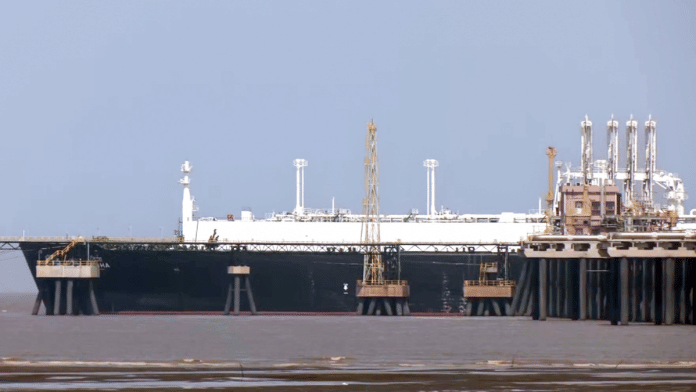


New Delhi: India’s import dependence on liquefied natural gas (LNG) has nearly doubled over the past decade, prompting Parliament’s Estimates Committee to caution that this could threaten the country’s energy security, price stability and foreign exchange reserves if domestic natural gas production is not ramped up significantly.
In its Eighth Report on ‘Supply and Distribution of Natural Gas – Challenges and Prospects’, tabled in Lok Sabha Friday, the committee noted that LNG imports grew from 13.29 million metric tonnes (MMT) in 2014-15 to 26.96 MMT in 2024-25 (Provisional).
Around 50 percent of India’s domestic natural gas requirement is met through LNG imports, with demand projected to exceed 40 MMT per annum by 2030, further increasing the country’s exposure to global gas markets.
While the committee acknowledged the government’s role in diversifying the LNG procurement through long-term and spot contracts, multiple pricing benchmarks and supplier diversification, it cautioned that sustained growth in LNG imports would have implications for energy security and pricing.
“The Committee is of the view that sustained growth in LNG imports may have implications for energy security, price stability and foreign exchange outgo,” the report stated.
The committee recommended strengthening long-term LNG sourcing arrangements while retaining flexibility through spot purchases. It also called for reducing import dependence over the medium to long term by increasing domestic production, expanding Compressed Bio-Gas (CBG) and Coal Bed Methane (CBM), improving energy efficiency, and strengthening energy diplomacy through overseas upstream investments.
The committee’s observations come as India aims to raise natural gas share in its primary energy basket from the current 6 percent to 15 percent by 2030, a key objective of its energy transition strategy.
The parliamentary panel noted that India’s estimated natural gas reserves stand at 1,094.19 billion cubic metres (BCM), with the Western offshore accounting for 31 percent of reserves and the Eastern offshore another 24 percent, highlighting the country’s substantial offshore resource base.
At the same time, domestic production has increased only modestly over the last decade from 33.66 BCM in 2014-15 to about 36.11 BCM in 2024-25 (Provisional), despite rising demand. India’s offshore fields currently contribute around 71.8 percent of total natural gas production.
“The Committee recommends the Government to adopt a holistic and integrated approach for sustained development of the natural gas sector by simultaneously enhancing exploration, accelerating development of discovered reserves and strengthening production infrastructure,” the report stated.
The committee observed that India possesses 26 sedimentary basins spread across 3.36 million square kilometres, but commercial production is largely confined to seven category-I basins.
Although hydrocarbons have already been discovered in five category-II basins, production from these areas is yet to begin, it noted. India’s sedimentary basins are divided into three categories based on their exploration and production status.
The committee also flagged delays in the implementation of the Open Acreage Licensing Programme (OALP). While 144 exploration blocks covering 2.42 lakh square kilometres have been awarded across eight bidding rounds, only 158 of the required 177 Petroleum Exploration Licences (PELs) had been issued as of 31 March 2025. Seven licences are still pending, while 12 blocks were surrendered after state governments failed to issue the necessary licences.
To address this, the committee recommended pre-aligning both inter-ministerial and Centre-State clearances before blocks are awarded to minimise delays in operationalisation and sustain investor confidence.
The report also focused on LNG infrastructure. It noted that India currently has eight operational LNG regasification terminals with a combined capacity of 52.7 MMTPA, while another 20 MMTPA of capacity is under construction or expansion, which would increase total regasification capacity to around 68 MMTPA by the end of the decade.
The committee also expressed concern that LNG infrastructure remains heavily concentrated along the western coast owing to favourable port conditions, pipeline connectivity and higher regional demand. It called for greater focus on developing LNG terminals along the eastern coast in line with the expansion of the National Gas Grid.
“The Committee recommends the Ministry to make focused efforts to promote geographically balanced development of LNG terminal infrastructure, particularly along the eastern coastal regions, in tandem with the expansion of pipeline connectivity under the national gas grid,” the report stated.
It also called for closer coordination between LNG terminal developers, pipeline operators and major gas consumers to enhance energy security.
(Edited by Ajeet Tiwari)