



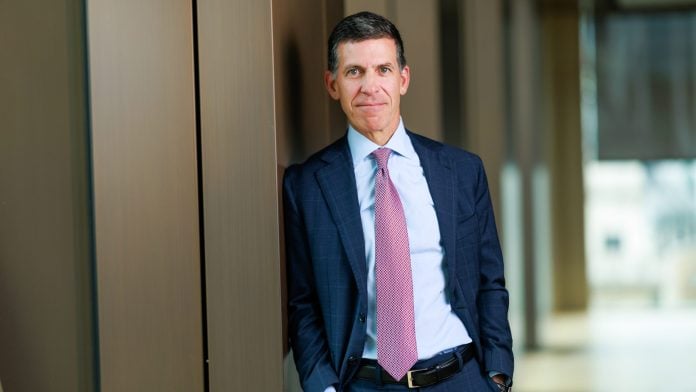
John Waldron, long seen as the likely CEO successor at Goldman Sachs Group Inc., has a lengthy to-do list before he takes the top job.
First up: figuring out what the changes will mean for some of Chief Executive Officer David Solomon’s other high-profile deputies. That list includes trading boss Ashok Varadhan, asset- and wealth-management head Marc Nachmann, banking chief Dan Dees and Chief Financial Officer Denis Coleman.
For that, Waldron will have to lean on Solomon for advice and his own skills as the consummate corporate diplomat. Waldron once kept angry partners at bay when Solomon, 64, was facing backlash in tougher times.
Executives close to Solomon have been expecting him to step down no later than 2028, according to a person familiar with the matter, who asked not to be identified citing private information. The Wall Street Journal reported that the bank’s board has discussed having Waldron take over as CEO as early as next year.
There’s no doubt Waldron is the best person for the job, according to Wells Fargo & Co. analyst Mike Mayo.
“It’s not a close call,” he said. “The real question is: How do you manage those four really important executives? Which of your kids do you love the most?”
Waldron has often served as a softer foil to the harder-charging Solomon in a firm that’s structured like a modern corporation but clings to some vestiges of its partnership past. The 57-year-old has been seen as the heir apparent ever since Solomon, in one of his first moves as CEO eight years ago, named him president.
Solomon and Waldron drastically expanded the management committee. The group has grown to encompass 46 executives, many of whom will be jockeying for promotions. Succession plans several rungs down have already been discussed by the board, which includes Solomon and Waldron, according to a person familiar with the matter, but some executives will inevitably be unhappy with those decisions.
Goldman spokesman Tony Fratto said Monday that “there is no definitive timeline for succession.” He declined to comment for this story.
Retaining Talent
Waldron has been incentivized to stay with a rare board seat and two special awards currently worth almost $200 million. Even when his most recent retention award was handed out with a five-year term, many close to the firm expected the CEO handoff to happen well before those five years were up.
How the next CEO will keep Goldman’s most senior executives happy is a key question. Waldron himself has been a target of poaching by other Wall Street firms, meaning he has seen firsthand how rival banks, buyout shops and hedge funds will likely circle to lure away his colleagues who were passed over for the top job.
Varadhan has been in the spotlight as he’s led a boom year for the bank’s trading business, with Goldman setting Wall Street records in equities for three straight quarters. Nachmann has been driving a spree of acquisitions to build out the firm’s $4 trillion asset-management arm.
Dees, who took a prominent role in Goldman’s work on the record SpaceX IPO in June, was with Waldron and Solomon at President Donald Trump’s cage fight on the White House lawn days later. Coleman has also been taking on more of the firm’s operational work.
Waldron, for his part, is spearheading the OneGS 3.0 initiative, a program that will deploy artificial intelligence across Goldman to help improve efficiency.
Earlier this year, he addressed how AI is already affecting the firm’s workforce, saying that the bank’s “human assembly lines” will become more digitized. He said that he was unsure how headcount would change but he thinks the firm will become “more scalable.”
Wells Fargo’s Mayo said he was impressed with Waldron — a former literature major at Middlebury College in Vermont — in the pair’s first meeting about a decade ago.
“It was a different type of Goldman executive — answering every question I asked. He came across as extremely earnest,” Mayo said. “If you said he was an English literature professor at a liberal arts college, I wouldn’t be surprised.”
That is quite the contrast from Mayo’s experience with Solomon. When Mayo quizzed him about his moonlighting as a DJ during their first meeting, the banker offered a terse, one-word counter — “Really?” — and 10 seconds of uncomfortable silence.
–With assistance from Sridhar Natarajan.
Disclaimer: This report is auto generated from the Bloomberg news service. ThePrint holds no responsibility for its content.