





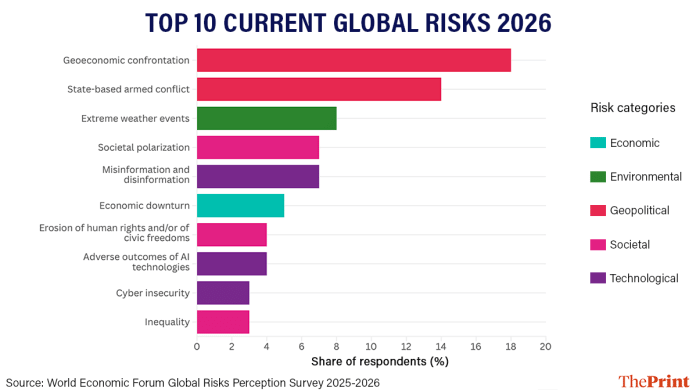



New Delhi: Geoeconomic confrontation is likely to be the top risk that could trigger a material global crisis this year, according to the World Economic Forum’s Global Risk report 2026. The report lists state-based armed conflicts as the second likely trigger of a global crisis, followed by extreme weather events, societal polarisation, and misinformation and disinformation.
Released by the World Economic Forum, Global Risks Perception Survey (GRPS) captures insights from over 1,300 experts worldwide. It studies risks in the current to immediate term (in 2026), short-to-medium term (two-year period i.e. up to 2028) and in the long term (10-year period i.e. up to 2036).
In the two-year timeframe, the experts believe, economic downturn would witness one of the largest rises in severity score, when compared with findings last year, behind only Geoeconomic confrontation.
“Geoeconomic confrontation is top of mind for respondents, and was selected as the top risk most likely to trigger a material global crisis in 2026 by 18 percent of respondents, increasing two positions from last year,” the report states.
Closely following geoeconomic confrontation is state-based armed conflicts, identified by 14 percent of respondents as the second most likely trigger of a global crisis this year. While traditional warfare remains a dominant risk, the report cautions that it is now deeply intertwined with economic instability.
The report also flags a growing erosion of multilateralism, long considered a stabilising force in international relations. “Declining trust, diminishing transparency and respect for the rule of law, along with heightened protectionism, are threatening long standing international relations, trade and investment and increasing the propensity for conflict,” the report says.
“In a world already weakened by rising rivalries, unstable supply chains and prolonged conflicts at risk of regional spillover, such confrontation carries systemic, deliberate and far-reaching global consequences, increasing state fragility,” it notes.
Extreme weather events remain a major concern too in the current and immediate term, and it has been ranked third for 2026 by eight percent of the respondents.
But in the short-to-medium term, according to the report, extreme weather events slipped to fourth place from the second (compared with corresponding figures last year). However, over a 10-year horizon, extreme weather events continue to rank as the most severe global risk.
Pollution fell to the ninth from the sixth as a risk factor in the short and medium term.
‘In a world already weakened by rising rivalries, unstable supply chains & prolonged conflicts, such confrontation carries systemic, deliberate and far-reaching global consequences, increasing state fragility, notes WEF report.
Societal polarisation is the fourth most significant risk for 2026 (current and immediate term), cited by seven percent of the respondents. The report warns that political and social divides are likely to deepen as technology becomes more embedded in everyday life and geoeconomic tensions intensify.
“Rising societal and political polarization is intensifying pressures on democratic systems, as extremist social, cultural and political movements challenge institutional resilience and public trust,” the report states.
Over a two-year timeframe (i.e short and medium term), societal polarisation has risen to the third most severe risk, though it drops to the ninth place over the next decade.
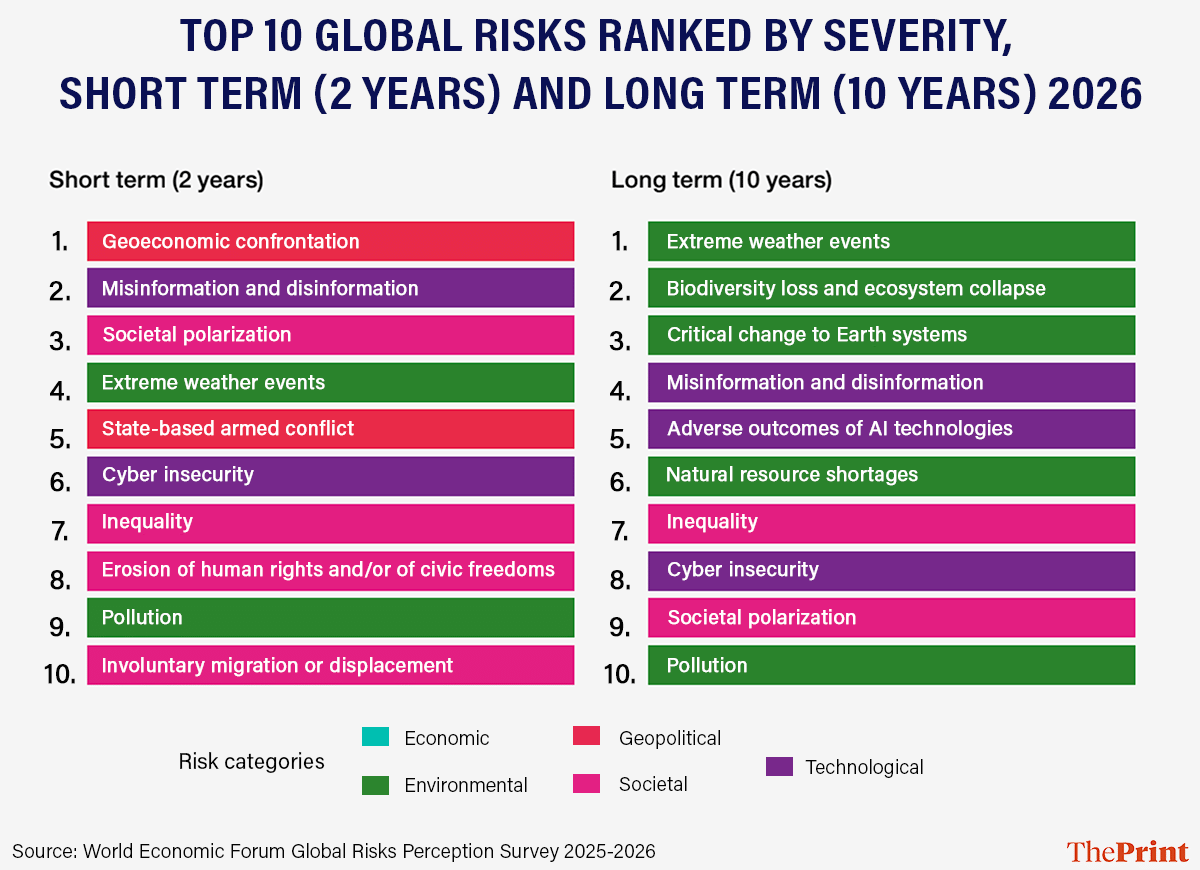
The rapid pace of technological change is also reshaping the global risk landscape. Misinformation and disinformation, ranked fifth for 2026, is seen as a growing threat to democratic processes and social cohesion. On a two-year outlook, it stands as the second most severe risk, behind geoeconomic confrontation.
“Misinformation and disinformation are of particular concern in the online world. The integrity of online news and broader information is increasingly under threat, as distinguishing between authentic and synthetic content, whether video, audio, or written, is becoming progressively more difficult,” the report warns.
As technology-related threats gain prominence, adverse outcomes of AI technologies and cyber insecurity have emerged as new entrants in the 2026 top 10 risks at number 8 (4 percent of respondents) and at number 9 (3 percent of respondents), respectively.
Also Read: India’s growth story rests on stability, reforms & strategic self-reliance: Shaktikanta Das
Economic downturn
Despite being placed sixth in the global risk rankings for 2026, economic downturn registers a sharp rise in perceived threat over two-year period outlook, as it climbs eight positions to rank 11th, signalling growing unease about global economic recovery.
Inflation too has followed a similar trajectory, jumping eight places to reach the 21st position.
The report attributes these concerns to three key factors. First, rising debt levels across both advanced and developing economies are emerging as a major drag on growth. Higher borrowing costs coupled with increased spending pressures could constrain fiscal space for governments, the report highlights.
Second, the report flags risks linked to the surge of capital inflow into artificial intelligence (AI). While AI is widely seen as a transformative growth engine, the report cautions that returns remain uncertain and investor sentiment could reverse rapidly if expectations are not met.
Finally, although inflationary pressures appear relatively contained in the near term, the report warns that higher tariffs, debt monetisation and other policy choices may trigger a resurgence of inflation concerns, thereby adding another layer of risk to global economic outlook.
Where does India position
For India, the top five risks as identified by the Executive Opinion Survey (EOS) 2025 include cyber insecurity, inequality (income and wealth), insufficient public services and social protections (education, pension, infrastructure), economic downturn (recession and stagnation) and state-based armed conflict (proxy, civil wars, coups, terrorism).
The report notes that countries are increasingly using natural resources as leverage in trade and strategic negotiations. Citing the India-Pakistan context, it adds that given the upstream control, India could divert waters of the Indus river basin for domestic use which could become a flashpoint between two countries over the next decade.
The report also highlights India’s 2024 general elections as an example of how misinformation and disinformation are undermining democratic processes worldwide.
“Recent elections in the United States, Ireland, the Netherlands, Pakistan, Japan, India and Argentina have all had to contend with such fabricated content on social media, depicting fictional events or discrediting political candidates, blurring the line between fact and fiction,” it states.
(Edited by Ajeet Tiwari)
Also Read: South rising, west slipping: India’s export map is being redrawn, shows RBI data