









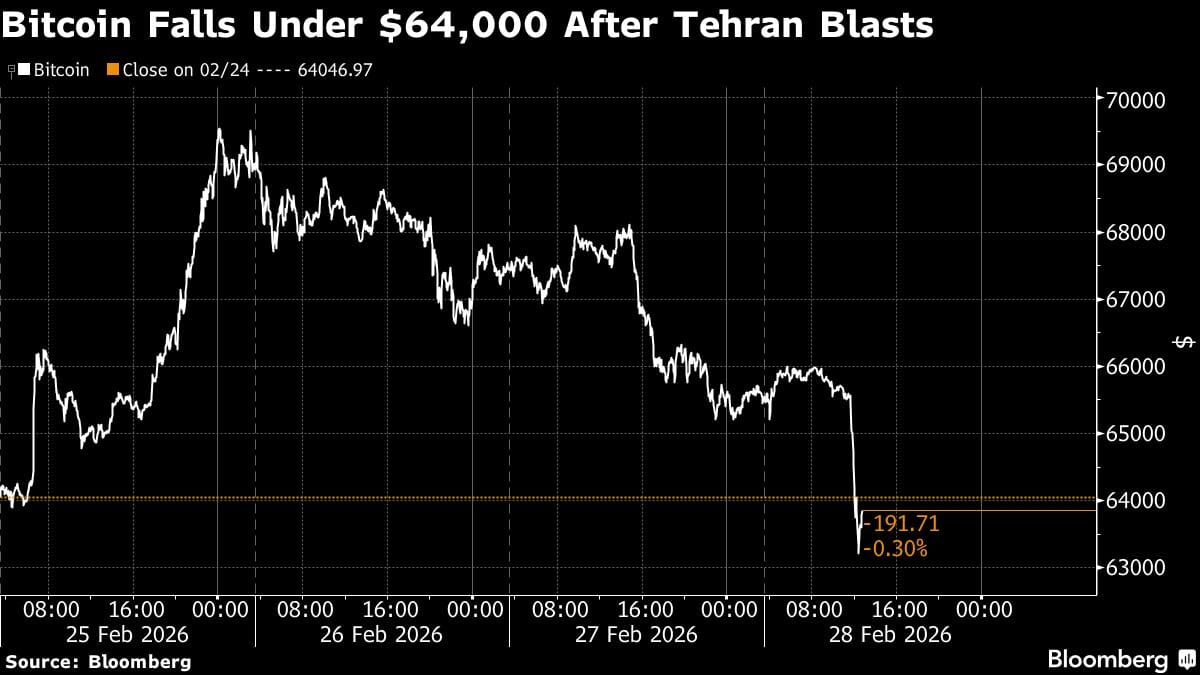
Bitcoin and other cryptocurrencies fell sharply after the US and Israel began striking targets across Iran on Saturday, causing ripples across high-risk assets.
Bitcoin dropped as much as 3.8% to $63,038, before stablizing to trade around the $64,000 mark as of 6 a.m. in New York. Ether, the second-largest token, slid as much as 4.5% to $1,836. Roughly $128 billion in market value was erased across digital assets in the immediate aftermath of the news, according to data from CoinGecko.
Several large explosions were reported in Tehran, shortly after which US President Donald Trump urged Iranians to take over the government once the military campaign comes to an end.
“While risks of conflict erupting again were bubbling given the US troop build-up in the Gulf, hopes had been pinned on fresh negotiations, and the decisive military action came sooner than expected,” Susannah Streeter, chief investment strategist at Wealth Club, said in a note Saturday. “We are set to see another pile-on into assets perceived as safe havens such as gold, as investors look to shelter their money, given the course of the conflict is so unpredictable.”
For Bitcoin, the weekend losses extend a months-long selloff in crypto markets, beginning with the liquidation of some $19 billion in leveraged positions in October. Bitcoin has fallen around 50% from its all-time peak of over $126,000 earlier that month, unable to latch on to rallies in gold and other safe-haven assets.
“As always, when critical events take place during the weekend, Bitcoin plays the role of pressure valve,” said Justin d’Anethan, head of research at Arctic Digital, noting that the initial impact on the token wasn’t as drastic as some might have expected.
“With a lot of the leverage already cleared out and exhausted sellers, there’s only so much impact macro events can have,” he added. “Not to say Bitcoin cannot go lower, just that a lot of the volatility has already been flushed out.”
The reaction also materialized through a sharp increase in selling pressure on Bitcoin derivatives, where within a single hour on Saturday morning, sell volume surged by approximately $1.8 billion, according to an analysis published by CryptoQuant.
“This type of imbalance reflects clear seller dominance and rising short-term risk aversion,” wrote crypto analyst Sylvain Olive. “Flows are driven more by emotion and risk management than by structural dynamic, requiring a cautious approach.”
Disclaimer: This report is auto generated from the Bloomberg news service. ThePrint holds no responsibility for its content.
Also read: Indian economy to grow faster than expected at 7.6% in FY26, shows govt data under new series