







New Delhi: Even though tensions in West Asia have eased following the interim US-Iran agreement and global crude oil prices have softened, the government Thursday said it is not yet ready to withdraw emergency control orders imposed to manage domestic fuel supplies during the crisis.
Officials said it is early to take a call on rolling back the Natural Gas (Supply Regulation) Order, 2026 and the LPG (Regulation of Supply and Distribution) Orders, which were introduced after disruptions in the Strait of Hormuz threatened energy supplies.
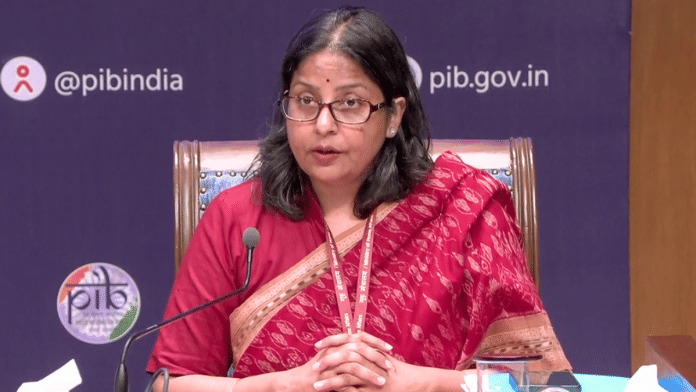
“The government will review these restrictions and consider gradual withdrawal once the situation normalises,” Sujata Sharma, Joint Secretary in the Ministry of Petroleum and Natural Gas, told reporters at an inter-ministerial briefing on the West Asia conflict Thursday.
The government implemented supply-control orders as a precautionary response to the West Asia crisis, when disruptions in the Strait of Hormuz raised concerns over the availability of crude oil, LNG and LPG. These control orders enabled the government to closely monitor fuel supplies, prioritise domestic gas allocation and curb hoarding to ensure the uninterrupted availability of essential fuels.
Sharma also said the government is closely monitoring global crude prices and any decision regarding retail prices of petrol, diesel and LPG will be taken at an appropriate time.
“The crude prices went up to $120 per barrel and now it is coming down, so the government will take appropriate decision regarding retail prices in line with international prices,” Sharma said.
Global crude prices have surged over the past three months amid escalating geopolitical tensions in West Asia and disruptions to energy supplies from the Strait of Hormuz. During this period, retail prices of petrol and diesel were increased by a cumulative Rs 7.5 per litre in four tranches.
Domestic LPG prices were also raised twice—by Rs 60 per cylinder in March and Rs 29 in June—taking the price of a household LPG cylinder in Delhi to Rs 942.
The interim US-Iran agreement includes the lifting of sanctions on Iran and waivers for exports of Iranian crude oil and petroleum products, potentially paving the way for additional oil supplies to return to global markets.
However, on whether India could resume imports of Iranian crude, officials avoided giving a direct answer, saying Indian refiners source oil from nearly 40 countries and procurement decisions are based on commercial considerations.
Sharma said crude purchase decisions depend on commercial viability including refinery compatibility, pricing and reliability of supplies.
According to Kpler data, more than 90 million barrels of stranded non-Iranian crude and around 70 million barrels of Iranian crude could return to the market as the Strait of Hormuz reopens and US restrictions are eased.
Meanwhile, 13 India-flagged vessels remain stranded on the western side of the Strait of Hormuz.
When asked about timelines for the return of these vessels, Opesh Kumar Sharma, Director in the Ministry of Ports, Shipping and Waterways, said the ministry is working closely with the Ministry of External Affairs and the Petroleum Ministry to ensure preparedness and facilitate their return.
Sharma also said that no other vessel bound for India had crossed the Strait of Hormuz this week, apart from the Malta-flagged LNG carrier Disha. The vessel crossed the strait on 15 June carrying 62,370 metric tonnes of LNG and is expected to arrive at Dahej Friday.
(Edited by Viny Mishra)
Also read: Petrol, diesel prices hiked for 4th time in 2 weeks. This won’t be the last