








Mumbai: In 2020, Maharashtra Chief Minister Devendra Fadnavis, who was then the Opposition leader, released a book on how to read budgets, titled ‘Budget Made Easy’.
Having being an MLA since 1999, he had read several budgets by then, but had never actually presented one.
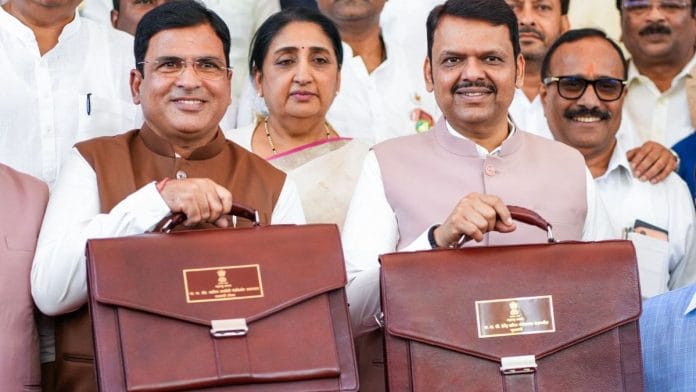
On Friday, Fadnavis crossed that milestone. He presented his very first budget with an outlay of Rs 7,69,467 crore, as a happenstance after state finance minister and Deputy CM Ajit Pawar died in an accident in January this year.
While Fadnavis started his speech in the state legislative assembly dedicating the 2026-27 Maharashtra budget to the late Pawar, the budget had a clear Fadnavis imprint, prioritising all of his political, administrative and governance goals as CM.
The CM’s very first budget laid strong emphasis on capital expenditure and infrastructure development, his goal of making Maharashtra a five-trillion dollar economy by 2047, and ensuring fiscal discipline.
Speaking to reporters after the budget speech, Fadnavis said, “We had a proper plan drawn up for Vikasit Maharashtra 2047. This budget is based on that report. Otherwise, we see different reports are drawn up, and while they are directional, they have nothing to do with the budget.”
‘Fiscal discipline’
Fadnavis has projected a capital expenditure of Rs 1,12,816 crore for 2026-27 as compared to Rs 93,165 that was budgeted for 2025-26. This was later revised to Rs 1,17,376 crore.
“For a long time we were spending just about Rs 30,000 crore to Rs 40,000 crore on capital expenditure. That was eventually raised to about Rs 70,000 crore to Rs 80,000 crore. And now we have crossed Rs 1 lakh crore,” Fadnavis said.
He added, Maharashtra’s projected growth rate for this fiscal at 7.9 per cent is higher than the country’s, projected to be between 6.8 and 7.2 per cent, and if Maharashtra were a country, it would have been the 30th largest economy in the world.
The fiscal deficit for 2026-27 is expected to be 2.7 per cent of the state’s Gross Domestic Product—under 3 per cent as required under the Fiscal Responsibility Budget Management Act. The state’s revenue deficit, Fadnavis said, has been consistently under 1 per cent of the state’s Gross Domestic Product and the debt—which is supposed to be under 25 per cent of the state’s GDP—is at 18.5 percent.
“I said I have dedicated this budget to Ajit dada (Ajit Pawar). He always strived for fiscal discipline as finance minister, and while there is definite pressure, we have managed to keep the state finances within the prescribed limits,” Fadnavis said in his interaction with reporters.
In his budget speech too, the CM praised Pawar’s fiscal prudence, having presented the budget 11 times under different governments.
“The relationship between Ajit dada and the budget had become firm. It was because of his stern discipline that Maharashtra’s fiscal condition remained stable even during difficult times,” Fadnavis said.
The budget includes the announcement of a loan waiver—a pre-election promise of the Mahayuti—up to Rs 2 lakh per farmer with a cut off of 30 September 2025 and a financial incentive of Rs 50,000 for every farmer who has been diligently repaying his or her loans.
The CM has also set aside Rs 23,000 crore to continue the Mahayuti’s scheme of providing 100 free electricity units to farmers using agricultural pumps up to 7.5 HP.
In his budget speech, Fadnavis did not specifically mention an outlay for the ‘Ladki Bahin scheme’ under which the state government grants Rs 1,500 to every eligible woman per month. However, he said the scheme will continue and the required expenditure will be set aside as per the 2025-26 numbers.
Infrastructure works in focus
Declaring that the state’s goal is to ramp up the gross income of the industrial sector to $1,500 billion by 2047 from the $123 billion now, Fadnavis made a bunch of announcements to push industrial growth such as a commissionerate for micro and small industries, a separate service commissionerate to boost the services sector, and have micro, small and medium enterprise centres in every district.
There will be a special focus on rapid road development in Gadchiroli to smoothen the mineral corridor in the district. Developing Gadchiroli is one of Fadnavis’ pet projects.
The CM announced setting up 400 new Global Capability Centres (GCC) across the state, saying Pune is the most preferred destination in the country for GCCs right now.
Outlining his vision to take the development of the Mumbai Metropolitan Region to $300 billion by 2030 from $140 billion now, Fadnavis touched upon several big-ticket infrastructure projects for the region. He said, the state has set aside 130 acres at Wadala for a start-up and innovation hub, and that a “third Mumbai” is being developed around the Sewri-Nhava Sheva Atal Setu, and a “fourth Mumbai” is being planned near Vadhavan in the Palghar district.
The state has also been working on developing the Vadhavan Port, touted to be the country’s largest port, which is estimated to create 12 lakh direct jobs. With there being stringent opposition to land acquisition for the post, the CM on Friday also announced a project to develop a modern fishing port at Satpati in the Palghat district.
“This project will provide safe anchorage for boats, protection from storms and modern facilities through which fish production will increase,” Fadnavis said in his speech.
He also announced a ‘Vadhavan Port Skill Development Programme’ to provide employment to local youth from 44 villages around Vadhavan.
The budget also includes a ‘No New Slum Framework’ for the Mumbai Metropolitan Region under which the state government plans to use GIS-based mapping to prevent illegal construction in the region.
Development plans similar to the Mumbai Metropolitan Region will also be created for cities such as Pune, Nagpur and Chhatrapati Sambhajinagar.
Fadnavis also announced 1,200 kilometres of Metro lines and 6,000 kilometres of expressways across Maharashtra, and a thick network of intra city tunnels in the Mumbai Metropolitan Region.
Memorial for Ajit Pawar, health centre in Shinde’s village
Deputy CM Sunetra Pawar, Ajit Pawar’s wife who has taken over his political legacy after his death, in an interaction with reporters thanked Fadnavis for taking her husband’s work forward.
“Till 27 January, a day before he died, Ajit dada was working on preparing the budget document,” she said.
Pawar died on 28 January after the private plane on which he was travelling to his constituency, Baramati, for campaign rallies ahead of Zilla Parishad polls crash landed, killing everyone on board.
In Friday’s budget speech, Fadnavis announced the building of a “grand memorial” for Ajit Pawar and the institution of a ‘Dynamic Civil Service Award’ in his name, which Sunetra called a “fitting tribute” to her late husband.
“My heart is heavy while delivering this speech today… His (Ajit Pawar’s) departure has created a large void in the state’s public life and administration that can never be filled,” Fadnavis said.
Fadnavis’ budget also had something for his other Deputy—Eknath Shinde—whose fondness for his native Dare village in the Satara district is well known in political circles.
The CM announced that the government will set up a naturopathy centre in the Dare area of Satara for stress and lifestyle-related diseases, mental health as well as preventive healthcare.
Several finance ministers have been known to pause for applause, address members of the house while making the speech, and include elaborate quotes and poems. Fadnavis included all these ingredients in his speech, but in negligible quantities, going studiously from one announcement to another instead of playing to the gallery.
After his opening remarks, he recited a Hindi couplet—“Jab hausla bana liya oonchi udaan ka toh dekhna fizul hai kad aasman ka (When one is determined to fly high, there is no point in looking at the height of the sky).” Incidentally, Prime Minister Narendra Modi had recited the same lines in Parliament six years ago.
Halfway through the budget speech, there were faint murmurs in the house with a few MLAs from the ruling benches talking to each other as Fadnavis’ speech continued. Like a school principal, the CM stopped, looked at the treasury benches and in an attempt at humour said, “Those who are talking will face a salary cut.”
Then he looked at the Opposition benches and immediately quipped in a reassuring tone, “I don’t mean you.”
(Edited by Viny Mishra)
Also read: Rs 47,000 cr push for Mumbai infra as MMRDA tables first surplus budget in nearly a decade