



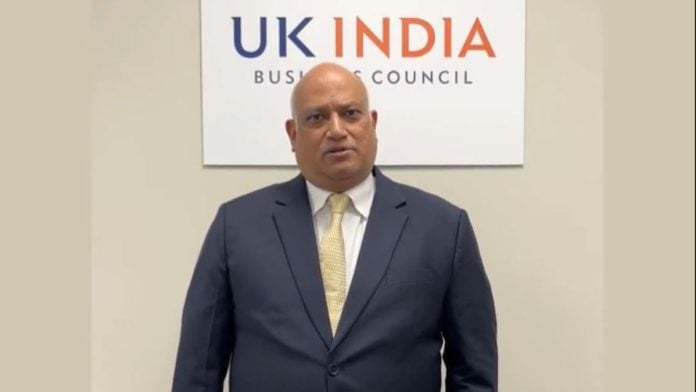
New Delhi: The intellectual property regime in India must be strong so that it creates trust, especially when it comes to co-development in key sectors involving national security such as defence, Kishore Jayaraman, CEO of the United Kingdom-India Business Council (UKIBC), said Sunday.
In an interview with ThePrint, Jayaraman highlighted that the momentum gained from the announcement of the free trade agreement has led to British firms to look to India for scale, but there needs to be an element of comfort and trust when it comes to protection of intellectual property.
“When you look at defence, there’s a whole new angle of defence. It is about national security. It’s about making sure the product is better than everybody else in the world so you can actually defend and then having the ability to have your own supply chain. So when you look at that, it goes into a co-creation concept. And in that concept, it’ll be about a joint IP [intellectual property]. And so the IP regime comes into force.”
He added: “The IP regime has to be very strong in India. So that everybody is very comfortable to come here, develop the technologies. It enables us to create supply chains locally, create more employment…But the whole IP thing, comfort has to be constantly developed.”
His comments come as three British secretaries of state, eight mayors from the North of the United Kingdom and over a hundred businesses begin their visit in India Monday. Secretary of State for Business, Innovation, Science and Trade Jonathan Reynolds is a part of the delegation, underlining the importance of the deepening economic engagement with New Delhi for London.
Commerce and Industry Minister Piyush Goyal is set to co-chair the Joint Economic and Trade Committee (JETCO) with Reynolds. The free trade agreement signed by both countries last year was operationalised on 15 July, with around 99 percent of duties of Indian exports to the UK cut to zero, while around 90 per cent of British exports to India will have no tariffs.
The deal was India’s first bilateral trade deal with a Western power, and combined with the European Union free trade agreement, a key pillar of New Delhi’s search for easier market access, as the global trading regime faces headwinds from the US.
“India offers scalability. India offers sustainability for businesses. And India is also right now looking at how they enhance the capabilities of the Indian companies? How do they build on the creativity side of things in business? So I think it’s a win-win situation that has come about,” said Jayaraman.
He added: “And an FTA that has been one of the fastest FTAs to sign as a bilateral agreement, the Comprehensive Economic Trade Agreement. I think it gives an opportunity because it being signed so fast shows the need of the hour for the fourth and the sixth largest economies, the hunger to grow and the passion to persevere and make things happen.”
British firms in strategic sectors eye India
For the UK, the deal with India is an important marker of its post European Union trading outreach. An argument for the British exit from the EU a decade earlier was that it would allow London to strike deals with different countries, including India.
The FTA negotiations were kickstarted by former UK PM Boris Johnson in 2022, and were completed by the Labour government led by Keir Starmer on 6 May 2025. Sectors where British firms are keen to expand to India include advanced manufacturing, space and defence, pointed out Jayaraman.
“We have unmanned systems. So we are already getting companies together in a defence conclave that’s going to happen in November in the UK. It’s with the Indian High Commission there and it’s with the industry there. And it’s with the local trade bodies there. We’re trying to figure out how we can build these uncrewed systems in collaboration with India. How do you co-create a combat engine? Rolls Royce has been in conversations for quite some time. And now I think that those conversations are moving on to a different level with their partnership with Reliance,” he added.
The UKIBC CEO further said: “The conversation is about, look, there’s a huge market in India. There’s a huge capability stream here. And there is a huge sort of capability in the UK. There’s huge technology in spaces like advanced manufacturing, uncrewed systems and digital technologies, AI, many areas. How do we collaborate in these? And how do we find a synergy that will allow scalability?”
Jayaraman highlighted that the focus remains on the “utilisation” of the FTA, with the UKIBC working on creating a “utilisation manual” for companies to be able to understand the contours of the deal.
He also highlighted that British universities have also joined the delegation, as they are looking towards developing better programmes with their Indian counterparts. At least nine British universities have received permission to open campuses in India, with the University of Southampton’s campus in the national capital region (NCR) operational.
“There are about, I think, about eight or nine universities that are part of this delegation. And the universities are looking at figuring out how we can jointly develop a better education system for ourselves, for both countries. And India offers a scale on that. The UK offers their capability on that. India also has the capabilities. But then there is an opportunity for both to merge and create a sustainable, growing business, even in the university space,” said Jayaraman.
(Edited by Gitanjali Das)
Also Read: Investments push in UK, Silverstone pitstop—Vijay’s first overseas trip as Tamil Nadu CM