





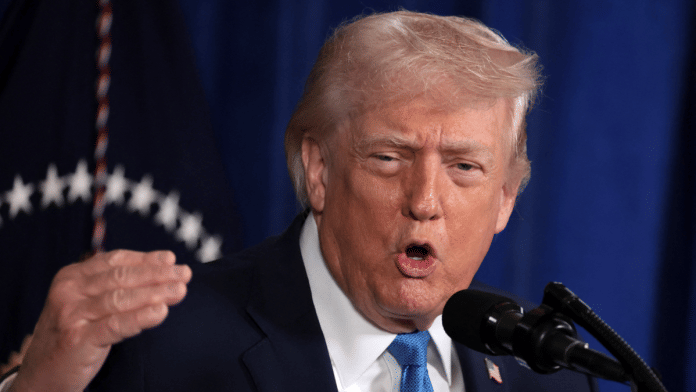



New Delhi: US President Donald Trump threatened that he can “very quickly” increase tariffs on India if it continues to trade with Russia, with particular reference to its oil purchases.
“Modi’s a very good guy. Yes. He’s a good guy. He knew I was not happy, and it was important to make me happy. They do trade. And we can raise tariffs on them very quickly, and it would be very bad for them…And I’ll tell you something. The Russian economy is lousy,” Trump said Sunday during a press gaggle aboard Air Force One.
The American President’s latest statement comes after the US imposed an additional penalty of 25 percent tariffs on India last August for its continued purchase of Russian oil. Indian exports to the US are tariffed at one of the highest rates—50 percent.
Ever since the Russia-Ukraine war began in February 2022, India has expanded its imports of crude from Moscow. The imports grew to over $50 billion in the 2024-2025 financial year.
The increase in Russian oil imports is in a large part due to the price cap imposed by the G7 nations (US, UK, Canada, France, Japan, Italy, Germany and the European Union) at the end of 2022. The price cap envisioned Russian oil being sold at less than $60 a barrel, thereby impacting Russia’s oil revenues while minimising the impact to the global energy markets.
The system was designed by the G7 in large part keeping India’s energy needs in mind. However, the return of Trump to the White House last year shifted the American position on purchase of Russian energy supplies. The US President has been pushing India to purchase more American energy products, which New Delhi has signalled its willingness to do so.
However, Russia still retains its position as India’s top supplier of crude. In the 2025-2026 financial year, India imported roughly $31.6 billion worth of Russian crude till October 2025, according to data released by the Ministry of Commerce and Industry.
The imports of Russian crude have fallen by around 10 percent year-on-year, while it is expected to reduce further following the sanctions imposed by the US on Rosneft and Lukoil–two of the largest petroleum companies in the European nation.
The US has also been looking at the relevant legislation allowing its administration to impose tariffs of up to 500 percent on countries continuing to trade with Russia. The bill has been pushed by Senator Lindsey Graham, who has long railed against Moscow and countries that have maintained trade ties with the country.
“I was at the Indian ambassador’s house about a month ago, and all he wanted to talk about is how they’re buying less Russian oil. Would you tell the president to relieve the tariff? This stuff works. So I’m hoping we’ll bring the bill up, and it’s from zero to 500,” Graham told reporters on Air Force One.
The US Senator added: “He [Trump] picks the number. Nobody else does. But if you’re buying cheap Russian oil, keeping Putin’s war machine going, we’re trying to give the president the ability to make that a hard choice by tariffs.”
India has been pushing to close the first tranche of a bilateral trade deal with the US in return for tariff relief. New Delhi’s latest offer, considered to be its best, is under consideration by the US administration. However, there has been no movement yet on the stalled negotiations, with future rounds of physical discussions not under consideration at the moment.
The US is India’s top export destination. Between April and November 2025, India’s exports were around $50.8 billion. As per the latest trade statistics released by the Ministry of Commerce and Industry, India’s exports to the US has maintained an upward trend in October and November, despite a fall in September, right after the tariffs were imposed.
Trump has been pushing to balance trade with India, urging New Delhi to open its agricultural markets for American goods. India has maintained that agriculture and dairy sectors are a red line for any trade deal. New Delhi has aggressively sought to expand its exports, announcing two free trade agreements with Oman and New Zealand in December.
(Edited by Tony Rai)
Also Read: 2025 was a busy trade year for India. King of Tariffs strain, FTA with New Zealand, UK & Oman deals
Dear Modiji,
Please ask all Indians on H1B, to return to India immediately, because nearly half a million Indians are making American tech companies rich, while facing tantrums of US govt and getting abused by their politicians. They don’t deserve us.
Bonus points if you can make all US citizens of Indian origin, to invest in India too. This capital inflow, would strengthen the Indian rupee too,
This is an empty threat, India must not take it seriously.
It is very good that India is not signing any deal with this madman ! At this rate I would not be surprised if this narcissist tries to repeat Jan 6 again , this time more unabashedly, when the next election comes. This guy is not thinking about American future but for himself !